Rubik's cube and speedcubing: the best books to solve it fast
This curriculum takes a complete beginner from their very first solve all the way to competitive speedcubing, building layer by layer — literally and conceptually. Each stage introduces new methods, algorithms, and mental frameworks that depend on mastery of the previous stage, ensuring no step feels like a leap into the unknown.
First Solve: Foundations
BeginnerUnderstand the cube's mechanics, notation, and solve it reliably using a beginner layer-by-layer (LBL) method without memorizing overwhelming amounts of algorithms.
▸ Study plan for this stage
Pace: 4–5 weeks, ~20–30 pages/day with daily cube practice (15–20 minutes)
- Cube anatomy: faces, layers, pieces (corners, edges, centers), and how they relate spatially
- Rubik's cube notation (U, D, L, R, F, B, and their modifiers: prime, double turns) for reading and executing moves
- Layer-by-layer (LBL) method: solving white cross → white corners → middle layer edges → yellow cross → yellow edges → yellow corners
- The concept of piece orientation vs. position: understanding when a piece is in the right place but wrong orientation
- Fundamental algorithms: the 2–3 core move sequences (e.g., R U R' U' for corner insertion) that enable the LBL method
- Intuitive solving vs. algorithmic solving: recognizing patterns without memorizing every possible case
- Common mistakes and how to recover: identifying when you've made an error and how to undo moves
- Can you identify all 20 movable pieces on a Rubik's cube and explain the difference between corner, edge, and center pieces?
- What does the notation R U' D2 F mean, and can you execute this sequence on a physical cube?
- Explain the layer-by-layer method in order: what is the goal of each of the six main steps?
- Why is it important to understand piece orientation (e.g., a corner piece in the right position but twisted) separately from piece position?
- What is the core algorithm for inserting edges into the middle layer, and why does it work?
- After solving the white face and first two layers, how do you recognize when you need to apply an algorithm vs. when you can solve intuitively?
- Scramble a cube and identify every piece by name and location (e.g., 'front-right-top corner,' 'back-left edge'); repeat until you can do this in under 2 minutes
- Practice writing down a 10–15 move sequence in notation, then execute it on the cube without looking at the notation again
- Solve the white cross 10 times in a row, focusing on intuitive placement rather than memorized moves; time yourself to build muscle memory
- Perform the middle-layer edge insertion algorithm (R U R' U') repeatedly until it becomes automatic; then practice recognizing which edges need it
- Solve the cube 5 times using only the LBL method from 'You Can Do the Cube,' then 5 times using the approach in 'Speedsolving the Cube' and note the differences
- Intentionally scramble only the top layer and practice the top-layer algorithms (cross, corners, edge orientation) in isolation 10 times each
- Time yourself solving the cube 20 times and track your times; aim for consistency (within 30 seconds) before worrying about speed
Next up: This stage equips you with a reliable, intuitive foundation in the LBL method and notation, preparing you to move into the next stage where you'll learn to optimize each step, memorize advanced algorithms, and begin developing the pattern recognition and finger dexterity needed for faster solves.

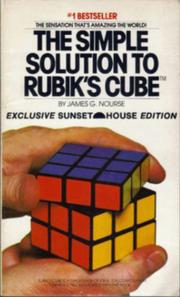
The classic entry-level guide that introduced millions to solving the cube with simple, visual step-by-step instructions. It establishes core notation and the layer-by-layer mindset that every subsequent method builds on.
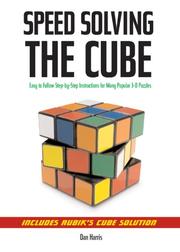
After achieving a first solve, this book bridges the gap between beginner and intermediate by introducing CFOP concepts and finger-trick fundamentals — read the early chapters here to plant the seeds before diving deeper.
Building Speed: The CFOP Method
IntermediateLearn the industry-standard CFOP (Fridrich) method — Cross, F2L, OLL, and PLL — and understand how to execute algorithms with efficiency and flow.
▸ Study plan for this stage
Pace: 4–5 weeks, ~20–30 pages/day with 30–45 minutes of hands-on practice per session
- The layer-by-layer solving philosophy and why it's foundational to speedcubing
- The Cross: solving the bottom layer edges efficiently and recognizing optimal rotations
- F2L (First 2 Layers): pairing corner-edge slots and inserting them without breaking the cross
- OLL (Orient Last Layer): understanding the 57 possible orientations and learning key algorithmic patterns
- PLL (Permute Last Layer): the 21 permutation cases and how to execute them with minimal rotations
- Algorithm notation and how to read, memorize, and execute move sequences fluidly
- Flow and efficiency: minimizing cube rotations, reducing pauses between algorithm phases, and building muscle memory
- What are the four main phases of the CFOP method, and why is the order important?
- How do you recognize and solve the Cross efficiently without unnecessary rotations?
- What is an F2L pair, and how do you insert it while preserving the solved cross?
- How many OLL cases exist, and what is the purpose of learning OLL algorithms?
- What is the difference between OLL and PLL, and why do speedcubers prioritize learning PLL first?
- How do you read standard Rubik's cube notation (R, U, L, D, F, B, and their modifiers), and why is this essential for speedcubing?
- Solve the cross 50 times on a single cube, timing yourself and tracking your best and average times; aim to consistently solve it in under 10 seconds
- Practice 10 F2L pairs in isolation using a cube with only the cross and one pair solved; repeat until you can insert each pair smoothly without pausing
- Solve 20 complete cubes using only the cross and F2L phases (stop before OLL/PLL); focus on flow and eliminating rotations
- Learn and drill 5–10 OLL algorithms daily over 2 weeks; practice each algorithm 20 times per session to build muscle memory
- Learn and drill 5–10 PLL algorithms daily over 2 weeks; practice each algorithm 20 times per session, focusing on fast, smooth execution
- Perform 50 full CFOP solves, recording your times and noting which phase slows you down; analyze patterns and adjust your focus accordingly
Next up: This stage equips you with the complete CFOP framework and algorithmic foundation needed to move into advanced speedcubing techniques such as lookahead, rotationless solving, and specialized method variants (Roux, ZZ) that build upon or diverge from the Fridrich approach.
A compact, mathematically clean breakdown of cube logic that sharpens your intuition for why algorithms work — understanding the 'why' behind moves accelerates algorithm retention and lookahead skills.
Thinking Ahead: Lookahead & Efficiency
IntermediateDevelop lookahead — the ability to plan future steps while executing current ones — and optimize cross and F2L solutions to eliminate pauses and reduce move count.
▸ Study plan for this stage
Pace: 4–5 weeks, ~25–30 pages/day with daily cubing practice
- Lookahead technique: maintaining cube awareness and planning the next 1–2 steps while executing the current step
- Cross efficiency: reducing cross moves to 8 or fewer and recognizing optimal cross solutions before solving
- F2L pair recognition and tracking: identifying where pairs are located and predicting their positions after rotations
- Pause elimination: building muscle memory to execute moves fluidly without stopping to plan
- Move count optimization: understanding why certain move sequences are more efficient than others
- Cube rotations and their impact: minimizing rotations to reduce wasted moves and maintain lookahead
- Fingertrick efficiency: correlating smooth finger techniques with faster, more fluid solving
- What is lookahead and why is it critical for speedcubing beyond just knowing algorithms?
- How do you identify an optimal cross solution, and what is the target move count?
- Describe the process of tracking F2L pairs during the cross—how do you maintain awareness of pair locations?
- What causes pauses during solving, and what specific techniques from Scheffler's work address them?
- How do cube rotations affect lookahead and move efficiency, and when should you minimize them?
- Explain the relationship between fingertrick execution and lookahead ability.
- Slow solves (2–3 minutes per solve): focus entirely on lookahead and planning the next pair while inserting the current one; do not time yourself
- Cross-only practice: solve 50 crosses daily, aiming for 8 or fewer moves each; write down move counts to track progress
- Pair tracking drills: scramble the cube, execute 2–3 moves, then pause and identify the location of all four F2L pairs without looking at the cube
- Pause elimination practice: solve 20 cubes focusing on eliminating any hesitation between cross and F2L; use a timer to identify where pauses occur
- Rotation minimization challenge: solve 10 cubes with a rule—no more than 1 rotation allowed per solve; analyze how this forces better lookahead
- Fingertrick refinement: practice 10 minutes daily of smooth, fluid move execution (R U R' U' sequences) to build muscle memory that supports lookahead
Next up: Mastering lookahead and F2L efficiency in this stage provides the foundation for advanced techniques like advanced F2L shortcuts, CFOP optimization, and alternative methods that build on fluid, pause-free solving.

This narrative deep-dive into the competitive speedcubing world is packed with practical insights from world-class solvers on lookahead, mental approach, and deliberate practice — essential for breaking through plateaus.
Advanced Methods & Competition Mindset
ExpertExplore advanced systems (Roux, ZZ, full OLL/PLL recognition), competition strategy, and the psychological and physical drills used by sub-20-second solvers.
▸ Study plan for this stage
Pace: 4–5 weeks, ~25–35 pages/day, with 2–3 dedicated practice sessions per week
- Group theory fundamentals: permutations, cycles, and how they describe cube rotations and move sequences
- The symmetric group S₄₈ and how it models the Rubik's cube state space
- Conjugation and commutators as tools for understanding move sequences and deriving advanced algorithms
- Parity constraints and why certain states are unreachable (mathematical foundations for move legality)
- How group-theoretic analysis reveals optimal subgroup solving strategies (e.g., solving layer-by-layer as nested group actions)
- The connection between mathematical structure and speedcubing efficiency: why certain methods work and others don't
- Practical applications: using group theory to invent, verify, and optimize custom algorithms for competition
- How do permutations and cycles mathematically represent a sequence of Rubik's cube moves, and why is this representation useful for speedcubers?
- What is the symmetric group S₄₈, and why does it describe all possible states of a Rubik's cube?
- How do conjugation and commutators work, and how can speedcubers use them to derive or understand advanced algorithms?
- What are parity constraints on the Rubik's cube, and how does group theory explain why certain states cannot be reached?
- How can group-theoretic thinking help you design or optimize your own solving method or algorithm set?
- What is the relationship between the mathematical structure of the cube and the practical efficiency of different speedcubing methods?
- Work through Joyner's permutation and cycle notation exercises; write out 5–10 common speedcubing moves (R, U, F, etc.) in cycle notation and verify they match the book's examples
- Manually compute the order of a move (e.g., how many times must R be applied to return the cube to solved state) using group theory; verify with a physical cube
- Study 3–4 commutators from the book and physically execute them on a cube; document the effect and relate it to the mathematical description
- Derive a custom 2-move or 3-move algorithm using conjugation (e.g., X A X⁻¹) and test it on a cube to confirm the predicted effect
- Map one advanced speedcubing method (Roux, ZZ, or CFOP) to its group-theoretic structure: identify the subgroups being solved and explain why the method works
- Solve 10–15 scrambles using group-theoretic insight: before solving, predict which parity issues or constraints will arise based on the scramble's cycle structure
Next up: This stage grounds the mathematical principles underlying advanced methods, enabling the next stage to focus on practical competition execution, mental resilience, and physical optimization with a deep understanding of *why* certain strategies and algorithms work.
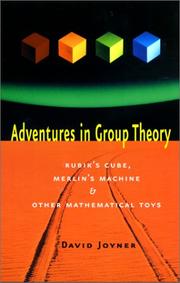
Introduces the group theory mathematics underlying the cube, giving advanced solvers a rigorous framework to understand algorithm generation, commutators, and conjugates — the tools used to build custom algorithm sets.
Discussion
Keep reading
Paths that share books, cover the same subject, or open a related topic.