Rebecca Solnit Reading Order: Where to Start
Rebecca Solnit writes essays that wander on purpose, and the best way in is one of the short, personal books rather than one of the big researched histories. Start with the two that made her famous, then read the pair on walking and on political hope that most of her later work argues from. After that the long-form histories and the memoirs can be read in either order, and the recent political essays close the loop by showing where forty years of this thinking arrived.
The Best Entry Points
BeginnerGet the Solnit sentence and her characteristic move — starting somewhere small and personal and ending somewhere political — in the two shortest books.
▸ Study plan for this stage
Pace: 2-3 weeks for about 380 pages. A Field Guide to Getting Lost is 210 pages of nine essays and should be read one essay a sitting, because each one wanders far from where it started and the pleasure is in following the drift rather than arriving. Men Explain Things to Me is 174 pages and much faster -
- The Solnit method: begin with something small, personal or apparently trivial and end somewhere political, without the join showing
- Digression is structural in her work, not a lapse - an essay that appears to lose its thread is usually holding two threads at once
- Being lost as a positive capacity: the Field Guide argues that not knowing where you are is a condition for discovery rather than a failure of navigation
- Her range of evidence is deliberately unacademic - country songs, captivity narratives, the colour blue, punk shows - and treating that as rigour rather than whimsy is the key to reading her
- Men Explain Things to Me shows the polemical register: shorter sentences, a clear target, an argument that names a pattern
- Naming a common experience is itself political work, which is the claim the title essay makes and the late books return to
- These two books are short on purpose; the wandering form is easier to learn at this scale than at the length of a full history
- In the Field Guide's essays on blue, what is the argument, and how would you state it without the digressions?
- How does Solnit get from a personal anecdote to a political claim without the transition feeling like a bait and switch?
- What does the title essay of Men Explain Things to Me actually argue beyond the anecdote it opens with?
- Which of her two registers - the meditative and the polemical - do you find more persuasive, and is that a judgement about her or about you?
- What kinds of evidence does she treat as admissible that a conventional historian would not?
- Take one Field Guide essay and map its route: note every subject it passes through in order. Seeing the itinerary written down is the fastest way to understand that the wandering is planned.
- Write 400 words that start with something you lost and end with something political. You will find out immediately how hard her transitions actually are.
- Reread the title essay of Men Explain Things to Me and mark where it stops being about her and starts being about a pattern. That pivot is her signature move at its most compressed.
- Keep a list of the sources she cites in the Field Guide. The breadth of it is the argument about what counts as knowledge.
Next up: You now recognise the wandering essay at chapter length, which is exactly what Wanderlust and Hope in the Dark sustain for a whole book.
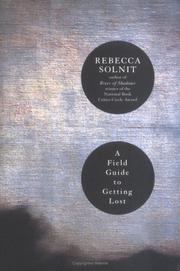
Nine essays on being lost, on the colour blue, on captivity narratives and country songs. The purest example of her method and the book most readers finish as converts.
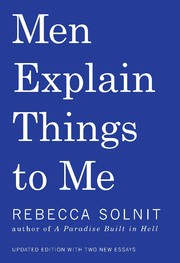
The essay that put a name to a common experience, plus six others. Very short, widely argued about, and the fastest way to see her polemical register alongside the meditative one.
Walking And Hope
BeginnerRead the two books that establish her core subjects, both of which the later work keeps returning to.
▸ Study plan for this stage
Pace: 4-5 weeks for about 520 pages. Wanderlust is 326 pages of cultural history and is denser than anything in the previous stage; two or three chapters a week is honest, and the chapters on pilgrimage and on the walking body reward slowing down. Hope in the Dark is 192 pages and can be read in a few sit
- Walking as thinking: Solnit's claim that the pace of the body sets the pace of the mind, and that a culture that stops walking loses a kind of thought
- Walking as protest and as claim-making, from pilgrimage to the march, which is where the book turns political
- Who gets to walk safely is the book's hardest question, and it is the thread that connects Wanderlust to Recollections of My Nonexistence later in the path
- Hope as a stance toward an uncertain future rather than a prediction about it - explicitly not optimism, and explicitly not comfort
- Uncertainty is the ground for hope in her argument: if the future were knowable, hope would be pointless
- Political victories are usually invisible, indirect and slow, and hope is what lets you keep working before the evidence arrives
- Hope in the Dark was written out of the Iraq war and has been reissued repeatedly since, which is itself evidence for its argument about long time horizons
- Every political essay she has written since assumes this book, so it is the load-bearing volume of the path
- What is Solnit's actual claim about the relationship between walking and thinking, and what evidence would count against it?
- How does Wanderlust get from the pleasures of the country walk to the politics of the street march?
- What is the difference between hope and optimism as Solnit defines it, and why does she insist so hard on it?
- If political change is usually invisible while it happens, how would you ever know whether her argument was working?
- Where does Hope in the Dark risk becoming a consolation rather than an argument, and does she avoid it?
- Walk for an hour with no destination and no phone, then write for twenty minutes. Wanderlust makes a claim about this and it is cheap to test.
- List three political changes in your lifetime that seemed impossible ten years before they happened. That list is Hope in the Dark's evidence base, and building it yourself is more convincing than reading hers.
- Note every place in Wanderlust where safety and gender enter the discussion, and hold that note for the memoir stage - the two books are in direct conversation.
- Summarise Hope in the Dark in three sentences without using the word hope. It forces the argument out of its own vocabulary.
Next up: Hope in the Dark makes an empirical claim about how people behave when the future opens up, and the next stage is where she goes looking for the evidence.

A history of walking as thinking, protest and pleasure. It is the origin of the wandering structure you already met in A Field Guide, now applied at book length.
Her argument that hope is not optimism but a stance toward an uncertain future, written after the Iraq war and reissued repeatedly since. Every political piece she has written since assumes it.
The Researched Histories
IntermediateSee what she does with archives and reporting rather than memory, in her two most substantial works of history.
▸ Study plan for this stage
Pace: 5-6 weeks for about 670 pages. River of Shadows is 305 pages and the most conventionally structured book she has written - a real biography with a chronology you can hold, so it moves faster than the page count suggests. A Paradise Built in Hell is 368 pages across five disasters and reads as five l
- Muybridge as the hinge figure: the man who froze motion, and through him the industrialisation of time and space in nineteenth-century California
- Technology as something that changes perception rather than merely capability, which is River of Shadows' central historical claim
- The railroad, the photograph and the corporation arriving together, and Solnit's insistence that they are one story rather than three
- The disaster finding in A Paradise Built in Hell: ordinary people behave with improvised generosity in catastrophes, and it is elites who panic
- Elite panic as a named phenomenon, and the way official responses can do more damage than the disaster
- Five disasters treated comparatively - the method here is closer to social science than to the essays, and worth noticing as a shift in register
- This is Solnit working from archives and interviews rather than memory, which is the best test of whether her method survives contact with hard evidence
- What did Muybridge actually change, and why does Solnit think a photographic technique is a fit subject for a book about California?
- How does River of Shadows connect the railroad, the studio and the state? Is the connection argued or asserted?
- What is elite panic, and what does Solnit offer as evidence that it is a pattern rather than a set of anecdotes?
- How does A Paradise Built in Hell function as proof of Hope in the Dark's claims, and where does it fall short of proof?
- Do the researched books read as the same writer as the personal essays? What survives the change of method and what does not?
- Look up one of Muybridge's motion sequences and watch it before reading the chapter about it. Solnit is describing something you can see, and seeing it first changes the reading.
- For each of the five disasters in Paradise, write one sentence on what officials did and one on what residents did. The pattern emerges from your own notes more forcefully than from her summary.
- Find a recent disaster covered in the news and check the coverage against Solnit's model. This is the book's own invitation and it holds up or it does not.
- Compare a paragraph from River of Shadows with one from the Field Guide. Sentence length, citation density and pronoun use all change, and naming the change tells you what her researched mode actually costs her.
Next up: Having seen what she does with archives, the memoirs show what happens when she turns the same evidentiary care on her own life.

Eadweard Muybridge, the birth of motion pictures, and the industrialisation of time and space in California. Her most conventionally researched book and the one that won her a wide critical readership.
Five disasters and the improvised communities that formed inside them — the evidentiary backbone for Hope in the Dark's claims. Read it after that book so you can see the argument acquire its proof.
The Personal Books
IntermediateRead the two memoirs, where the wandering essay form turns inward on her own life.
▸ Study plan for this stage
Pace: 3-4 weeks for about 510 pages. The Faraway Nearby is 259 pages and formally her most ambitious book - nested stories, a chapter structure that runs outward and then back, and a single sentence threaded along the bottom of the pages. Do not fight the structure; read a chapter at a time and let the ne
- The Faraway Nearby is built as nested stories - a box of apricots, her mother's dementia, Iceland, the Arctic - and the nesting is the argument about how narrative works
- Storytelling as survival technology: the book's claim that we assemble ourselves out of the stories we can tell
- Illness, care and inheritance handled without the redemptive arc that memoir usually supplies
- Recollections of My Nonexistence is about a young woman in 1980s San Francisco learning that public space is not equally available to everyone
- Erasure as a physical condition rather than a metaphor - the title is precise and the book earns it
- This memoir supplies the biography under Men Explain Things to Me, and reading them far apart in the path is deliberate
- Both books use the wandering essay form on personal material, which is harder than using it on Muybridge and worth watching closely
- How does the nested structure of The Faraway Nearby change what the book can say about her mother?
- What does Solnit mean by the phrase that gives that book its title, and where does she locate the nearby?
- In Recollections of My Nonexistence, what is the relationship between the desk she was given and the writing life she built?
- How does the memoir change your reading of Men Explain Things to Me, three stages back?
- What does she refuse to do that a conventional memoir would do, and is the refusal a gain?
- Draw The Faraway Nearby's structure as concentric rings before you finish it. The book is symmetrical and seeing the shape halfway through makes the second half far more legible.
- Read the running footer sentence in The Faraway Nearby on its own, start to finish, after finishing the book. It is a separate text and it reads as one.
- List the threats and constraints Recollections describes, then check them against the questions Wanderlust raised about who can walk safely. The two books answer each other.
- Write 500 words about a single object from your own past, following it wherever it goes. That is the Faraway Nearby method reduced to one exercise.
Next up: With the biography, the method and the political argument all in place, the recent essays can be read as the sum of forty years rather than as commentary.
A box of apricots, her mother's dementia, Iceland and the Arctic, arranged as nested stories. Formally her most ambitious book, and easier to follow once A Field Guide has taught you the shape.
The straightest autobiography she has written: a young woman in 1980s San Francisco learning that being unsafe is a condition of public life. It supplies the biography under Men Explain Things to Me.
The Late Essays
BeginnerFinish with the recent political and literary writing, which reads best once you know everything it is drawing on.
▸ Study plan for this stage
Pace: 3-4 weeks for about 510 pages. Call Them by Their True Names is 177 pages of shorter American essays and reads quickly, though each one repays a second pass because the arguments are compressed. Orwell's Roses is 336 pages and is the slowest book in the path - it wanders further than anything since
- Precise naming as political work: the collection's organising claim that a euphemism is a policy
- Her sharpest contemporary subjects - policing, homelessness, climate, the language of American politics - handled at essay length
- Orwell's Roses starts from the fact that Orwell planted roses and uses it to argue that pleasure and beauty are not distractions from resistance but conditions for it
- The book braids the walking strand, the hope strand and the historical-research strand at once, which is why it reads as a culmination
- Coal, empire and the industrial rose trade give the book its hard historical spine and keep it from becoming a meditation
- Reading a canonical writer through an oblique detail is her method applied to literary biography, and the risks of it are visible here
- Forty years of the same convictions arriving somewhere: this stage is where you can judge whether the method compounds or repeats
- What does Solnit mean by calling things by their true names, and where in the collection does the renaming do the most work?
- Which of the American essays has aged best since publication, and what does that tell you about which arguments were structural rather than topical?
- Why roses? What does the detail let Solnit say about Orwell that a conventional study could not?
- Where does Orwell's Roses risk making its subject a mirror, and does she catch herself doing it?
- Having read the whole path, is Solnit's body of work one argument in many forms, or several arguments that share a voice?
- Pick one euphemism in current news coverage and rewrite the sentence using true names. That is the collection's method in a single exercise.
- Read Orwell's essay on the toad and the spring before starting Orwell's Roses. Solnit is in conversation with a specific piece and the conversation is audible.
- Trace the walking thread through Orwell's Roses and note how much of Wanderlust is still operating in it, twenty years later.
- Write your own reading order for Solnit for a friend who has never read her, and defend the entry book. Anyone who has finished this path will have a view, and articulating it is the best test of what you took from it.
Next up: The path ends here; the natural continuation is either her ongoing political journalism or the writers she keeps citing, from Woolf to the nature writers she argues with.

American essays on policing, homelessness, climate and language, and her sharpest sustained argument that naming a thing accurately is political work.

Orwell's garden as a way into pleasure, beauty and resistance — the culmination of the walking, hope and history strands at once. A rewarding last book, and a confusing first one.
Discussion
Keep reading
Paths that share books, cover the same subject, or open a related topic.