Pluto by Naoki Urasawa Reading Order: Where to Start
Pluto is eight volumes read one through eight, and unusually for a manga of its stature there is no alternate order, no arc you can skip and no side series to slot in. The one thing that trips readers up is the name: the books are printed as Pluto: Urasawa x Tezuka, but library and retail catalogues file them under the bare form Pluto, Vol. 1 through Vol. 8, so searching the cover title returns almost nothing. This path follows those eight volumes in sequence and then points at the Tezuka story Urasawa is rewriting, which is far better read afterwards than before.
Start Here: The Detective
BeginnerMeet Gesicht and the seven great robots, and settle into a murder mystery that happens to be told about machines.
▸ Study plan for this stage
Pace: One to two weeks for the first three volumes. Each runs 190-210 pages of comics, so an unhurried volume takes 40 minutes to an hour; most readers do one an evening and then read volume 3 twice. One practical note before you start: the books are printed as Pluto: Urasawa x Tezuka, but library and ret
- The premise stated plainly in volume 1: a robot and a human are killed on the same night, both bodies arranged with horns, and Gesicht — a Europol robot detective — investigates. Urasawa establishes grief as the real subject in the first chapter, not the last
- You need no Astro Boy knowledge whatsoever. The Tezuka story this rebuilds is stage 4's reading, deliberately placed after rather than before
- The seven great robots as a structural device: Mont Blanc, North No. 2, Brando, Hercules, Epsilon, Gesicht and Atom. The list is a countdown, and each name you learn is a scheduled loss
- Urasawa's chapter-portrait method — each robot gets a largely self-contained sequence establishing who they are before the plot touches them. These read like digressions and are not; they are the entire emotional engine
- The Mont Blanc opening as the tone-setter: the series begins with a public funeral for a machine and expects you to take the mourning seriously without arguing for it
- The North No. 2 chapters in volume 3, which is the sequence most readers name when they recommend Pluto — a war robot working as a butler for a blind composer. Its power comes from being an interruption in a thriller, which is why it must be read in place
- Urasawa's face acting: he holds on reaction shots for whole pages and the information is usually in the expression rather than the dialogue. Slow down on the wordless panels; they are not filler
- How does the series get you to grieve a machine in the first twenty pages? Name the specific choices — panel time, funeral staging, whose reaction you are shown
- What is Gesicht's demeanour, and where in these three volumes does it first crack? Mark the panel
- Why does the North No. 2 sequence work better here than it would as a standalone short story? What does its position in a countdown do to it?
- The horns arranged at each scene are a signature. What does the series want you to think they mean at this stage, and is it already misdirecting you?
- By the end of volume 3, what do you believe about who is doing the killing? Write it down
- Keep a list of the seven great robots with, for each, one line on who they are and one on where they were during the Central Asian war. You will fill in the war column across stage 2
- Reread the North No. 2 chapters immediately after finishing volume 3. It is a short reread and it is the best possible calibration of how the series wants to be read
- Find three pages in these volumes with no dialogue at all and write a sentence on what each conveys. If you cannot, you are reading the balloons and skipping the art
- Write down your volume-3 theory about the killer, sealed. You will open it after volume 6
Next up: The murders have a pattern and a list; the next volumes trace that pattern backwards into the war that made every robot on it.
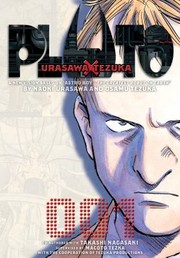
The only starting point. A Europol robot detective investigates the killing of a robot and a human on the same night, and the series establishes its real subject — grief — in the first chapter rather than the last. No prior Astro Boy knowledge is needed.

The list of targets becomes clear and the story starts moving between countries and witnesses. Second because Urasawa builds his cast by giving each robot a self-contained chapter; skipping any of them costs you the ending's weight.
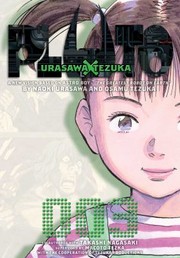
Contains the North No. 2 chapters, the sequence most readers name when they recommend the series. Third, exactly where it falls — its power comes from being an interruption in a thriller.
The War
BeginnerFollow the investigation back into the Central Asian war, and understand what the series is actually arguing about hatred and memory.
▸ Study plan for this stage
Pace: About a week for volumes 4 and 5, 200 pages each. These two are the pivot and reward a slower pass than the opening — read them across four or five evenings rather than two, and reread volume 4's memory sequences before starting 5.
- Gesicht's memory is edited, and the series lets you notice before he does. The gaps and the repeated dream are the mechanism, and volume 4 is where the reader's confidence in the narrator breaks
- The 39th Central Asian War as the story's actual origin: the seven great robots were built as or used as weapons in it, and the investigation of a present-day murder is really an excavation of that war
- The obvious real-world parallel — a war fought over weapons of mass destruction that may not have existed, and an inspection regime — and the fact that Urasawa lets it sit rather than pressing it. Notice how little the manga underlines this
- The hatred thesis, which is the series' central argument: that hatred is transmissible and reproducible, that it can be built into a machine, and that this is exactly what makes it a human problem rather than a robot one
- Atom moving to the foreground in volume 5 and what Urasawa does with a character every Japanese reader has known since childhood — the choice to make him quiet and sad is a statement about the source material before stage 4 shows you the source
- Epsilon and the war orphans as the series' counterweight: the one robot who refused to fight, given the burden of caring for the war's children. Watch how the series positions him relative to the countdown
- Volume 5 as the halfway turn — the point where the series stops withholding and begins paying out, and the last place where the plot is still a mystery rather than a tragedy
- When did you first suspect Gesicht's memories were unreliable, and what was the specific cue? Was it something he noticed or something only you could see?
- State the series' argument about hatred in one sentence. Then find the panel where it is put most directly, and decide whether the manga is stronger for stating it or would be stronger for leaving it implicit
- Why is Epsilon's refusal to fight given to a character who is otherwise peripheral? What would change if the pacifist were Atom?
- The war parallel is available to any reader. Why does Urasawa refuse to press it, and does the restraint help or weaken the argument?
- Update your list of the seven robots with what each did in the war. Which of them is the series most reluctant to judge?
- Chart the timeline the series is actually about — the war, the treaty, the inspections, the present investigation — as two parallel tracks. The manga withholds this deliberately, and building it yourself is the best way to see what has been withheld
- Mark every appearance of Gesicht's recurring dream and note what is different each time. The changes are the plot
- Reread the first chapter of volume 1 after finishing volume 5. It reads as a different scene, and noticing exactly which panel changed meaning is the exercise
- Write 200 words on what Atom is for in this story, given that most readers outside Japan meet him here first. Then keep it for stage 4
Next up: The war explains the motive; the last three volumes decide what the series wants to say about acting on it.
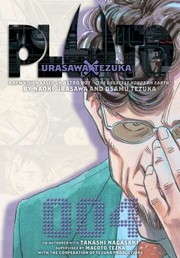
Gesicht's own memories start to look edited, and the war that produced these robots comes into focus. Fourth: this is the volume that converts the mystery into a political story.
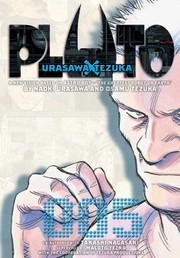
Atom takes the foreground and the antagonist finally has a shape. Fifth, and the halfway point where the series stops withholding and starts paying out.
The Ending
IntermediateFinish the story and see how Urasawa resolves a plot about revenge without endorsing it.
▸ Study plan for this stage
Pace: About a week to ten days for volumes 6, 7 and 8. Read 6 and 7 back to back with no gap — they are effectively one movement — and then leave a day before volume 8. Volume 8 is the longest at 244 pages and is the one to read in a single uninterrupted sitting.
- Volume 6 as the reveal volume: the pieces arrive in quick succession and the arrangement of the opening murders is finally explained. Reading it slowly is a mistake — it is built for momentum
- Volume 7 as the bleakest, and deliberately so: the cost is made fully explicit before any resolution is offered, which is what makes the finale land as something other than a genre payoff
- How Urasawa resolves a revenge plot without endorsing revenge — the ending's whole design problem, and the reason the series is discussed as more than a thriller
- The two grieving figures the ending sets against each other, and the fact that the series treats their grief as identical in kind while judging their choices differently. This is the argument in dramatic form
- Pluto's own characterisation, held back almost to the end, and why the withholding is necessary for volume 8 to work
- The final image and what it decides. Readers genuinely disagree about how hopeful volume 8 is, and the disagreement is a fair one rather than a misreading by one side
- That there is no continuation. Eight volumes, no sequel, no side series, no alternate order — the story is closed
- Open the sealed theory you wrote after volume 3. What did you get right, and were you given the evidence to have got the rest?
- How does volume 8 avoid endorsing revenge while still giving the revenge plot a resolution? Name the specific narrative choice
- Volume 7 is unrelieved. What would be lost if it were softened by a single hopeful chapter?
- Is the ending hopeful? Argue it both ways using specific panels — this is a real split among readers, not a puzzle with an answer
- Was the whole thing a thriller or an argument? Volume 8 is designed to make that question decidable; say which way it decided for you and on what evidence
- Reread the Mont Blanc funeral from volume 1 immediately after finishing volume 8. The series opens and closes on the same note and the symmetry is exact
- Go back to your seven-robots list and complete it — how each one dies or survives, and what the manner of it says about them. The pattern across the seven is the series' method in one table
- Pick the single page in the last three volumes you would show someone to explain why Pluto is regarded as it is, and write 200 words on why that page and not another
- Write 300 words on the ending's treatment of the two grieving figures, without deciding which is right. If your paragraph settles it, you are arguing rather than reading
- Reread volume 3's North No. 2 chapters one final time. Having finished, they mean something different, and that difference is the best measure of what the series did to you
Next up: The story is complete, so the last stage is optional context: the 1964 original Urasawa is rewriting, and where to go next in his own work.
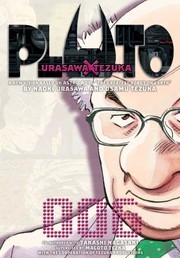
The reveals arrive in quick succession and the body count of the opening premise is finally explained. Sixth — read straight on from five, the two are effectively one movement.

The penultimate volume, and the bleakest. Seventh: it earns the finale by making the cost explicit before offering any resolution.

The last volume, and the one that decides whether the whole thing was a thriller or an argument. Eighth and final; stop here, there is no continuation.
What Pluto Is Made Of
IntermediateRead the Tezuka story Urasawa is retelling, and the Urasawa series most readers move to next.
▸ Study plan for this stage
Pace: Two weeks, unhurried, and treat both as afterwords rather than as continuations. Astro Boy Volume 3 is 208 pages and collects The Greatest Robot on Earth — an evening or two. Naoki Urasawa's Monster, Vol. 1 is 212 pages and is a sample rather than a commitment; if it holds you, the full series is lo
- The Greatest Robot on Earth, collected in Astro Boy Volume 3, is the 1964 Tezuka story Pluto rebuilds: seven great robots, a challenger, and a tournament. Every plot element you have just read for eight volumes is present in a fraction of the pages
- Read it after and never before. Tezuka's version is bright, fast and structured as a contest; Urasawa's is slow, sad and structured as a bereavement. The contrast is the entire point of stage 4, and reading Tezuka first collapses it
- What Urasawa keeps: the seven robots, the names, the challenger, the arithmetic of horsepower ratings. What he converts: a tournament into a murder investigation, a boy hero into a grieving child, a spectacle into an argument about war
- Tezuka's Astro Boy as a children's serial with real political content underneath — robot rights, discrimination, an author who lived through the war — which is why Urasawa's reading is a legitimate excavation rather than an imposition
- Monster as the natural next Urasawa: the same patience, the same long investigative structure, and the same central question about whether evil is made or born, at roughly three times Pluto's length
- How to decide: if what held you in Pluto was the investigation and the accumulating dread, Monster is the direct continuation of that mode. If it was the grief and the science-fiction argument, Monster will feel colder
- That Monster volume 1 is genuinely a sample — Urasawa's openings are slow by design, and judging his long series on one volume is judging a first movement
- Read Tezuka's version and list what Urasawa kept unchanged. The list is shorter than you expect — what does that tell you about what an adaptation is?
- Tezuka's story is a contest with a winner. Urasawa's is a countdown with no winner. Which structural change made the others possible?
- How is Atom characterised in Tezuka compared with Pluto? Name three differences and say which one carries the most weight
- Tezuka wrote for children in 1964 and put war and discrimination in the story anyway. Does Urasawa uncover something already there, or add something new? Defend your answer with a specific Tezuka page
- After volume 1 of Monster, what is the same about Urasawa's method and what is different? You now have enough to answer this precisely
- Read The Greatest Robot on Earth in one sitting and then write a one-page comparison table: same seven robots, and for each, what Tezuka gives them versus what Urasawa gives them
- Take the North No. 2 chapters from Pluto volume 3 and find the corresponding character in Tezuka. Write 300 words on what Urasawa built out of what he was given — this single comparison is the clearest demonstration of the adaptation's method
- Write 200 words on why reading Tezuka first would have damaged Pluto, and be specific about which reveals it would have pre-empted
- Read Monster volume 1 and write a paragraph deciding whether to continue. Note which quality of Pluto you are looking for and whether volume 1 shows it
Next up: This is the end of the path: you have read Pluto in its only order, seen the 1964 story underneath it, and sampled the Urasawa series most readers move to next.
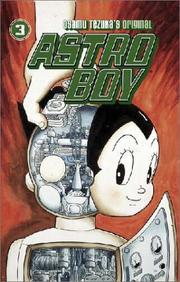
Collects The Greatest Robot on Earth, the 1964 Astro Boy story Pluto rebuilds. Read it after, not before — Tezuka's version is bright and fast where Urasawa's is slow and sad, and the contrast is the whole point.

The obvious next Urasawa: the same patience, the same interest in whether evil is made or born, at three times the length. Start here if Pluto's investigative structure was what held you.
Discussion
Keep reading
Paths that share books, cover the same subject, or open a related topic.