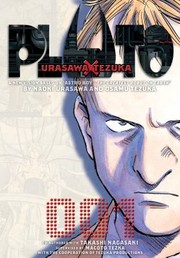
Start with Pluto, Vol. 1. There is no alternative worth considering: the series runs one through eight, there is no side story to slot in, no arc that can be skipped, and no chronological reshuffle anyone argues for. Among manga of this stature that is unusual, and it makes this one of the easiest reading orders on the site.
The thing that actually trips people up is the name. The books are printed with the cover title Pluto: Urasawa x Tezuka, but library and retail catalogues file them under the bare form used here, volume by volume. Searching the cover title returns almost nothing, which is why readers regularly conclude the series is out of print when it is not. If a search comes back empty, drop the subtitle.
Volumes one to three: the detective
Pluto, Vol. 1 opens with a Europol robot detective investigating the killing of a robot and a human on the same night. The series establishes its real subject, which is grief rather than robotics, in the first chapter rather than the last, and it assumes no prior knowledge of Astro Boy whatsoever.
Pluto, Vol. 2 makes the list of targets clear and starts moving the story between countries and witnesses. Urasawa builds his cast by giving each robot a self-contained chapter, so skipping any of them costs the ending its weight. Pluto, Vol. 3 contains the North No. 2 chapters, the sequence most readers name when they recommend the series. Read it exactly where it falls — the power of that stretch comes from being an interruption in a thriller, and it does not survive being read on its own.
One catalogue oddity to expect: the credits vary by volume. Ours lists volume one under Osamu Tezuka and volume three under Takashi Nagasaki. Pluto is drawn and written by Naoki Urasawa, co-plotted with Nagasaki, and based on Tezuka's original story, so all three names are legitimate — the inconsistency is in how each edition was recorded, not in the authorship.
Volumes four and five: the war
Pluto, Vol. 4 is where the mystery becomes a political story. Gesicht's own memories start to look edited, and the Central Asian war that produced these robots comes into focus. Pluto, Vol. 5 brings Atom forward, gives the antagonist a shape, and is the halfway point at which the series stops withholding and starts paying out.
Volumes six to eight: the ending
Pluto, Vol. 6 delivers the reveals in quick succession and should be read straight on from five; the two are effectively one movement. Pluto, Vol. 7 is the penultimate volume and the bleakest, making the cost explicit before offering any resolution. Pluto, Vol. 8 decides whether the whole thing was a thriller or an argument.
Stop there. There is no continuation, no sequel and no epilogue volume, and anything presented as one is a different edition of the same eight books.
What to read afterwards
Astro Boy volume three collects The Greatest Robot on Earth, the 1964 Tezuka story Pluto rebuilds. Read it after, not before. Tezuka's version is bright and fast where Urasawa's is slow and sad, and the contrast is the entire point of the exercise — going in the other direction just spoils a plot. Editions of Astro Boy are numbered differently across printings, so check the contents rather than the volume number.
Naoki Urasawa's Monster, Vol. 1 is the obvious next series: the same patience and the same interest in whether evil is made or born, at roughly three times the length. Only the first volume is in our catalogue at present, which is a gap on our side rather than an editorial judgement about the rest.
Ten books, one straight line. Follow the full path below.
Follow the full ordered path here: Pluto by Naoki Urasawa Reading Order: Where to Start.