Best Books on McCarthyism and the Red Scare
This curriculum moves from the broad political and social context of postwar America into the specific machinery of HUAC, the blacklists, and McCarthy himself, before finishing with the archival revelations — declassified documents and post-Soviet intelligence files — that allow a final, evidence-based verdict. Starting at the intermediate level, each stage assumes the vocabulary and frameworks built in the one before it, so the path rewards reading in order.
The Postwar Climate & Origins of the Red Scare
IntermediateUnderstand the political, social, and psychological conditions in postwar America that made a second Red Scare possible, and grasp the key players and institutions before zooming in on McCarthy.
▸ Study plan for this stage
Pace: 4–5 weeks, ~40–50 pages/day. Start with Shirer's historical narrative (approximately 400 pages), then move to Fariello's oral histories and analysis (approximately 350 pages). Allow 1 week for Shirer, 1.5 weeks for Fariello, then 1.5–2 weeks for review, synthesis, and exercises.
- The ideological and geopolitical roots of anti-communism: how the Soviet Union's emergence and early Cold War tensions shaped American fears
- The role of institutional actors: FBI, Congress, media, and business interests in amplifying and weaponizing anti-communist sentiment
- The psychology of fear and scapegoating: how economic anxiety, social upheaval, and existential threats to American identity fueled mass suspicion
- The continuity between the 1920s Red Scare and the post-1945 Red Scare: patterns of persecution, false accusations, and erosion of civil liberties
- Key players and power structures: Hoover's FBI, conservative politicians, labor opponents, and their pre-McCarthy infrastructure for targeting suspected communists
- The distinction between actual communist activity and the exaggerated threat narrative: how real espionage cases were weaponized to justify broader purges
- Social and cultural dimensions: how ordinary Americans participated in informing, blacklisting, and ostracizing suspected communists
- The vulnerability of specific groups: labor organizers, intellectuals, immigrants, and minorities as primary targets before McCarthy's rise
- What specific geopolitical events and ideological conflicts between the U.S. and Soviet Union in the 1930s–1940s created the conditions for a second Red Scare?
- How did J. Edgar Hoover and the FBI establish the institutional framework for mass surveillance and anti-communist investigations before McCarthy emerged as a public figure?
- What role did business interests, conservative politicians, and media outlets play in amplifying communist threats in the immediate postwar period?
- How did the experiences and testimonies in Fariello's oral histories illustrate the psychological and social mechanisms through which ordinary Americans became both perpetrators and victims of the Red Scare?
- What were the key differences and continuities between the 1920s Red Scare (covered in Shirer) and the post-1945 Red Scare in terms of targets, methods, and justifications?
- How did real instances of Soviet espionage (e.g., the Rosenberg case, Alger Hiss) become distorted into justifications for broader, indiscriminate persecution?
- Create a timeline of key events from 1930–1950 (using both Shirer and Fariello) that shows how Cold War tensions escalated and anti-communist institutions grew. Annotate each event with the institutional actors involved.
- Analyze 3–4 oral history excerpts from Fariello: identify the narrator's role (informant, accused, witness), the mechanisms of accusation, and the consequences they faced. Write a 2–3 page synthesis on patterns of persecution.
- Compare Shirer's historical account of the 1920s Red Scare with Fariello's accounts of the post-1945 period. Create a Venn diagram or comparative chart showing similarities, differences, and escalations.
- Research and write a 3–4 page profile of J. Edgar Hoover using evidence from both books: his ideology, his institutional power, his methods, and his influence on the Red Scare before McCarthy.
- Conduct a close reading of one major espionage case mentioned in both books (e.g., the Rosenberg case or Alger Hiss). Separate documented facts from the narrative distortions and exaggerations that fueled public fear.
- Create a 'fear map': identify the primary sources of anxiety in postwar America (economic, ideological, social) and trace how each was channeled into anti-communist campaigns using evidence from both texts.
Next up: This stage establishes the institutional, psychological, and social infrastructure of anti-communism that McCarthy will exploit and amplify, allowing the next stage to focus on how one senator weaponized these pre-existing systems to achieve unprecedented political power.
Shirer's firsthand journalism grounds the reader in the anxious postwar atmosphere and the rise of authoritarian politics, providing essential emotional and historical context before diving into domestic anti-communism.
An oral-history mosaic of victims, informers, and bystanders that humanizes the era immediately, giving the reader concrete faces and stakes before the institutional analysis that follows.
HUAC, the Blacklists, and the Hollywood Inquisition
IntermediateMaster the mechanics of the House Un-American Activities Committee, understand how the entertainment and academic blacklists operated, and see how ordinary careers and lives were destroyed.
▸ Study plan for this stage
Pace: 8–10 weeks, ~40–50 pages/day. Start with Navasky (450+ pages), move to Hellman (130 pages), finish with Vaughn (200+ pages). Allow 1–2 weeks between books for reflection and note synthesis.
- HUAC's investigative structure, legal tactics, and the mechanics of the loyalty oath/testimony requirement—how the Committee weaponized naming as a tool of coercion
- The distinction between 'friendly' and 'unfriendly' witnesses, and the moral/career consequences of each choice
- How blacklists operated as informal but devastating enforcement mechanisms across Hollywood and academia, enforced by studios, networks, and industry gatekeepers rather than law
- The informer economy: how naming names became currency for career survival, and the psychological/ethical toll on both accusers and the accused
- Lillian Hellman's defiant stance ('I cannot and will not cut my conscience to fit this year's fashions') as a counterpoint to capitulation
- Robert Vaughn's systematic documentation of how careers were destroyed, reputations erased, and lives derailed by association and accusation
- The chilling effect: how fear of accusation silenced speech, creativity, and dissent across entire industries
- The role of studios, networks, and institutional actors in enabling and perpetuating the blacklist despite its illegality
- What were HUAC's formal investigative powers, and how did the Committee use the threat of contempt charges to coerce testimony and naming?
- What was the practical difference between being a 'friendly' witness (cooperating, naming names) and an 'unfriendly' witness, and what were the career consequences of each?
- How did the Hollywood blacklist operate without a formal, published list? Who enforced it, and what mechanisms made it so effective at destroying careers?
- What was Lillian Hellman's position on naming names, and how did her letter to HUAC reflect a different moral calculus than many of her contemporaries?
- According to Vaughn, what were the systemic patterns in how careers were destroyed—who was targeted, how were accusations used, and what happened to those blacklisted?
- How did the blacklist extend beyond Hollywood into academia and other industries, and what role did institutional gatekeepers play in its enforcement?
- Create a detailed timeline of HUAC investigations (1947–1958) using Navasky's account, marking key hearings, friendly vs. unfriendly witnesses, and outcomes. Annotate with the names of major figures and their choices.
- Build a 'naming map': track 3–4 specific individuals through Navasky who named names, and trace the ripple effects—who they accused, who was blacklisted as a result, and what happened to their own careers.
- Write a comparative analysis (2–3 pages) of Hellman's refusal to name names versus the choice made by at least two other figures in Navasky or Vaughn. What were the moral, legal, and career stakes?
- Diagram the blacklist enforcement structure using Vaughn's evidence: identify the studios, networks, unions, and industry figures who made or enforced blacklist decisions. How did information flow?
- Select one blacklisted figure from Vaughn's account and research their pre-blacklist career, their HUAC testimony (or refusal), and their post-blacklist life. Write a 2–3 page case study.
- Conduct a close reading of Hellman's letter to HUAC (reproduced in her memoir). Annotate it for rhetorical strategy, moral reasoning, and legal risk. Compare its tone and argument to a 'friendly' witness statement from Navasky.
Next up: This stage equips you with the granular, human-scale understanding of how McCarthyism operated through institutional mechanisms and individual choices; the next stage will likely expand to the broader ideological, political, and cultural contexts that enabled the Red Scare and its aftermath.
The definitive study of the informer culture and the Hollywood blacklist; Navasky's moral framework for understanding 'naming names' is essential vocabulary for everything that follows.

Hellman's memoir of her own HUAC appearance is a primary-source complement to Navasky, showing the personal cost and the ethical choices faced by those who refused to cooperate.
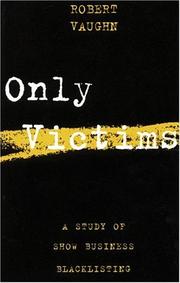
A systematic survey of HUAC's assault on the entertainment industry that broadens the picture beyond Hollywood's most famous cases and rounds out this stage's institutional portrait.
McCarthy: Rise, Reign, and Fall
IntermediateDevelop a full biographical and political understanding of Joseph McCarthy himself — his tactics, his demagogic appeal, the Army-McCarthy hearings, and the forces that finally brought him down.
▸ Study plan for this stage
Pace: 6–7 weeks, ~40–50 pages/day (Rovere: ~200 pages in 4–5 days; Oshinsky: ~500+ pages in 4–5 weeks)
- McCarthy's early political career and rise to prominence through anti-communist rhetoric (1946–1950)
- The mechanics of McCarthy's demagogic tactics: accusation without evidence, exploitation of Cold War anxiety, and media manipulation
- McCarthy's Senate power base and his use of the Subcommittee on Investigations as a weapon
- The Army-McCarthy hearings (1954) as the turning point: how televised confrontation exposed McCarthy's bullying methods
- McCarthy's personal character: ambition, recklessness, alcoholism, and lack of ideological conviction
- The role of institutional and political forces in McCarthy's downfall: Senate censure, loss of media support, and Republican abandonment
- The distinction between McCarthyism as a tactic versus McCarthy as an individual—how the movement outlived the man
- How did Joseph McCarthy transform himself from an obscure Wisconsin politician into a national figure, and what specific events in 1950 marked his breakthrough?
- What were McCarthy's primary demagogic tactics, and how did he exploit Cold War fears to maintain political power despite lacking substantive evidence?
- What role did the Senate Subcommittee on Investigations play in McCarthy's power, and how did he use it to intimidate witnesses and institutions?
- Why were the Army-McCarthy hearings a watershed moment, and what specific moments or exchanges revealed McCarthy's vulnerability?
- What personal characteristics and behaviors (beyond his politics) contributed to McCarthy's eventual isolation and downfall?
- How did the Senate censure of 1954 come about, and what combination of factors—institutional, political, and media-driven—made it possible?
- Timeline exercise: Create a detailed chronology of McCarthy's career from 1946–1957, marking key accusations, hearings, and political turning points using both books
- Demagogue's toolkit analysis: Extract and categorize McCarthy's rhetorical and tactical strategies from Rovere's account (e.g., vague accusations, character assassination, media exploitation) with specific examples
- Army-McCarthy hearings close reading: Select 3–4 pivotal exchanges from the hearings (as described in both books) and analyze how McCarthy's behavior alienated senators and the public
- Character study: Write a 2–3 page psychological profile of McCarthy using evidence from Oshinsky about his personal life, motivations, and contradictions
- Comparative document analysis: Collect 2–3 contemporary newspaper headlines or political cartoons from 1950–1954 and analyze how media coverage of McCarthy shifted over time
- Institutional failure exercise: Map out which institutions (Senate, media, Republican Party, military) failed to check McCarthy early, and identify the specific moment each withdrew support
Next up: This stage grounds you in McCarthy as a historical actor and reveals how one demagogue's tactics functioned within Cold War institutions; the next stage will expand outward to examine McCarthyism as a broader cultural and political phenomenon that persisted after McCarthy's personal fall.
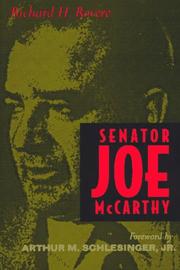
Written by a contemporary journalist who covered McCarthy closely, this short classic captures the senator's character and methods with an immediacy no later biography can fully replicate; read it first to feel the era.
The most comprehensive and authoritative modern biography of McCarthy; having read Rovere and Griffith, the reader can now absorb Oshinsky's full narrative with critical sophistication.
What the Archives Revealed
ExpertEvaluate McCarthyism in light of declassified Venona intercepts, Soviet archives, and FBI files — understanding what was real espionage, what was paranoid fabrication, and how historians now weigh the evidence.
▸ Study plan for this stage
Pace: 8–10 weeks, ~40–50 pages/day. "Venona" (approx. 400 pages) over 4 weeks; "The Haunted Wood" (approx. 500 pages) over 4–5 weeks, with 1–2 weeks for synthesis and review.
- Venona intercepts as primary evidence: what the decoded Soviet cables actually reveal about American espionage networks, and the limits of what they prove
- The distinction between confirmed Soviet intelligence operations (e.g., the Rosenberg ring, Alger Hiss contacts) and McCarthy's unsubstantiated accusations
- How Haynes uses cryptographic evidence and archival documentation to reconstruct specific spy networks, and the methodological rigor required to do so
- Soviet recruitment strategies and motivations: ideological commitment vs. coercion, and how individual agents were identified and handled
- Weinstein's use of Soviet archives and defector testimony to corroborate and contextualize Venona findings, particularly regarding the scope of Soviet espionage
- The historiographical debate: how Cold War historians reassessed McCarthy-era accusations once classified materials became available
- The gap between what Venona proved and what McCarthy claimed: quantifying real espionage vs. the scale of his allegations
- Counterintelligence tradecraft and the FBI's investigative methods as revealed in declassified files
- What specific espionage networks does Venona evidence definitively establish, and what are the limitations of using intercepted cables as sole proof?
- How does Weinstein use Soviet archival sources and defector accounts to either confirm or complicate the picture drawn by Venona intercepts?
- What percentage of McCarthy's accusations can be verified through declassified evidence, and what does this reveal about the relationship between real espionage and McCarthyist claims?
- How did Soviet intelligence services recruit American agents, and what motivated individuals like those in the Rosenberg ring or Hiss network?
- What methodological challenges did historians face in interpreting Venona intercepts, and how did Haynes and Weinstein address issues of ambiguity or incomplete information?
- How did the availability of Venona and Soviet archives change historians' understanding of 1950s counterintelligence and the legitimacy of some (but not all) of McCarthy's concerns?
- Create a detailed timeline of the major espionage networks identified in Venona (e.g., the Rosenberg ring, the Hiss network, the Silvermaster group), noting dates of recruitment, handlers, and what each agent provided to the Soviets.
- Compile a side-by-side comparison: list 10 of McCarthy's most prominent accusations, then research which ones are supported by Venona/Soviet archives (confirmed), which are partially supported (ambiguous), and which are refuted or unsupported.
- Analyze 3–4 specific Venona intercepts cited by Haynes: decode the cryptonym references, identify the agents involved, and explain what the cable reveals about the operation and what it does not.
- Write a 1,500–2,000 word historiographical essay: 'What Venona Proved and What It Didn't' — using Haynes and Weinstein to argue how declassified evidence reshaped the McCarthy debate.
- Conduct a source evaluation: compare how Haynes uses Venona intercepts vs. how Weinstein uses Soviet archives and defector testimony to make the same or different arguments about espionage scope and significance.
- Create an annotated map or network diagram of Soviet intelligence operations in America (1930s–1950s) based on both books, showing recruitment chains, handlers, and the flow of information to Moscow.
Next up: This stage equips you with the archival and cryptographic evidence necessary to move beyond Cold War mythology and assess McCarthyism's actual historical foundations, preparing you to evaluate how declassified materials have reshaped modern interpretations of the era's security threats and political responses.
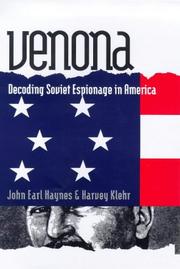
The essential guide to the Venona project — the decrypted Soviet cables that confirmed real espionage networks — giving the reader the evidentiary foundation for all archival debates.

Drawing on KGB archives opened briefly after 1991, Weinstein documents Soviet intelligence operations in America, allowing a nuanced comparison of genuine spy activity versus McCarthy's reckless accusations.
Discussion
Keep reading
Paths that share books, cover the same subject, or open a related topic.