Best Books to Learn Zulu, in Reading Order
This curriculum takes a complete beginner from zero Zulu to confident conversational and grammatical competence in isiZulu. Each stage builds directly on the last: you first gain survival phrases and the sound system (including clicks), then master the famous Bantu noun class system that governs all Zulu grammar, then deepen reading and listening fluency through graded texts and authentic conversation practice.
Foundations: Sound, Script & Survival Zulu
BeginnerProduce the click consonants correctly, read isiZulu spelling, and handle basic greetings, numbers, and everyday phrases with confidence.
▸ Study plan for this stage
Pace: 4–5 weeks, ~20–25 pages/day, with 2–3 days per week dedicated to pronunciation drills and speaking practice
- The three Zulu click consonants (c, q, x) and their articulation points: palatal, velar, and lateral respectively
- isiZulu orthography: noun class prefixes, vowel harmony, and consonant clusters that distinguish meaning
- Greeting protocols in Zulu culture: formal vs. informal contexts and appropriate responses (Sawubona, Yebo, Ayoba)
- Numbers 1–20 in isiZulu and their use in basic counting and age expressions
- Essential survival phrases: introductions, polite requests, basic questions (Ungubani? Unjani?), and responses
- Tone and stress patterns in isiZulu pronunciation and their role in word meaning
- The relationship between click consonants and their written representations in the Latin-based script
- Can you produce all three click consonants (c, q, x) with correct articulation and distinguish them in minimal pairs?
- How do noun class prefixes in isiZulu affect spelling and meaning, and can you identify them in written text?
- What are the appropriate greetings and responses for formal and informal situations in Zulu culture?
- Can you count from 1–20 in isiZulu and use numbers in simple sentences about age or quantity?
- How do you introduce yourself in isiZulu, ask someone's name, and ask how they are?
- What role does tone play in isiZulu pronunciation, and can you identify tonal differences in common words?
- Can you read and pronounce basic isiZulu words and phrases using the Latin-based orthography without prior memorization?
- Daily click consonant drills: spend 10–15 minutes isolating and repeating each click (c, q, x) in syllables and words from the books; record yourself and compare to audio resources or native speaker models
- Transcription practice: write out 5–10 new isiZulu words or phrases from the readings using the Latin-based script, then check pronunciation against the book's audio or online resources
- Greeting dialogues: memorize and role-play 3–4 common greeting exchanges (e.g., Sawubona → Yebo, sawubona) with a language partner or mirror, varying formality levels
- Number flashcards: create cards with numerals 1–20 and their isiZulu names; drill daily for speed and accuracy, then use them in sentences (e.g., 'Ngineminyaka emithathu' — I am three years old)
- Survival phrase scenarios: write out and practice 5–6 real-world dialogues (ordering food, asking directions, introducing yourself) using phrases from both books; perform them aloud
- Orthography analysis: select 10 words from the readings, identify noun class prefixes and vowel patterns, and explain how these affect spelling and meaning
- Listening and repetition: listen to audio samples of basic phrases from the books 3–4 times per week, pause after each phrase, and repeat until your pronunciation matches the native speaker's
Next up: This stage equips you with the phonetic foundation and basic communicative toolkit needed to move into the next stage, where you'll expand your vocabulary, master verb conjugations, and engage in longer conversational exchanges with greater grammatical complexity.
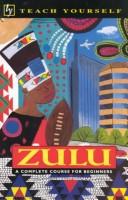
A compact, widely-used beginner phrasebook and introduction that covers pronunciation — including the three Zulu clicks (c, q, x) — greetings, and essential survival vocabulary. Start here to get sound and script right before tackling grammar.
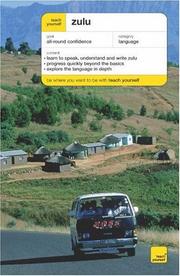
The classic self-study course in the Teach Yourself series; it introduces dialogues, basic sentence patterns, and core vocabulary in a structured, audio-supported format. Read this second to convert your pronunciation base into real communicative phrases.
Advanced Reference & Lexical Depth
ExpertAchieve near-native lexical range, handle formal and literary registers, and use a comprehensive dictionary independently for ongoing self-directed learning.
▸ Study plan for this stage
Pace: 8–10 weeks, ~45–60 minutes daily (selective deep-dive study rather than linear reading)
- Dictionary structure and navigation: understanding Doke's organizational system, abbreviations, phonetic notation, and cross-references
- Lexical categorization: recognizing word families, root morphology, and semantic fields within Zulu
- Register and formality markers: identifying formal, literary, colloquial, and archaic usage labels in entries
- Contextual word selection: using example sentences and usage notes to choose appropriate vocabulary for different registers
- Morphological analysis: leveraging Doke's treatment of prefixes, suffixes, and stem variations to infer meaning and expand vocabulary
- Idiomatic expressions and phrasal constructions: understanding how Doke documents fixed phrases and cultural expressions
- Self-directed learning strategies: developing habits for independent dictionary consultation, note-taking, and vocabulary consolidation
- How do you navigate Doke's dictionary to find a word when you know only its root or a related form?
- What do the register labels (formal, literary, colloquial, archaic) tell you about when and how to use a particular word?
- How can you use Doke's morphological notes to understand and generate new words from known roots?
- What is the difference between the example sentences provided in Doke and how they inform appropriate usage in different contexts?
- How do you identify and use idiomatic expressions and phrasal constructions documented in the dictionary?
- What strategies will you use to move beyond passive dictionary lookup and actively consolidate new vocabulary for long-term retention?
- Morphological mapping: Select 10 root words from Doke and trace all their derivatives (prefixes, suffixes, tense forms) to build a visual family tree of related terms
- Register comparison: Find 5 words with multiple register labels (e.g., formal vs. colloquial) and write example sentences for each register to internalize the distinctions
- Idiomatic expression collection: Extract 15–20 phrasal constructions or idioms from Doke and create a personal reference sheet with translations and cultural context
- Dictionary navigation drills: Practice finding words using only root forms, partial spelling, or semantic hints without jumping to the English side first
- Contextual writing exercises: Write 3–4 short paragraphs (100–150 words each) on different topics (formal letter, literary description, casual narrative) deliberately using vocabulary sourced from Doke with attention to register
- Vocabulary consolidation journal: Maintain a weekly log of 20–25 new words encountered, organized by semantic field, with example sentences from Doke and personal usage notes
- Cross-reference tracing: Follow 5 complex entries in Doke that have multiple cross-references; map how meanings connect across related entries to deepen understanding of semantic networks
Next up: This stage transforms you from a dictionary consumer into an independent lexical researcher, equipping you with the skills and confidence to sustain advanced Zulu learning indefinitely through self-directed reference work and vocabulary expansion.

The standard scholarly Zulu-English dictionary compiled by the founding figure of Zulu linguistics; at this stage it becomes your primary tool for resolving vocabulary questions, exploring word roots, and reading unsimplified texts independently.
Discussion
Keep reading
Paths that share books, cover the same subject, or open a related topic.