Best Books to Learn Yiddish, in Reading Order
This curriculum takes a complete beginner from the Yiddish alphabet all the way into authentic literary texts, building script literacy, grammar, vocabulary, and reading fluency in four progressive stages. Each stage unlocks the next: you cannot read a dictionary entry or a literary passage without first mastering the alphabet and core grammar, so the path is strictly ordered from script to sentence to story.
Grammar & Core Language Structure
BeginnerUnderstand Yiddish grammar — nouns, verbs, cases, and sentence structure — well enough to construct and parse simple sentences independently.
▸ Study plan for this stage
Pace: 8–10 weeks, ~15–20 pages/day (focusing on grammar chapters; can skip some cultural/historical sections on first pass)
- Yiddish noun declension and gender (masculine, feminine, neuter) with definite and indefinite articles
- Verb conjugation in present, past, and future tenses, including regular and irregular verbs
- Case system (nominative, accusative, dative, genitive) and how cases affect noun and adjective endings
- Adjective agreement with nouns in gender, number, and case
- Basic sentence word order (SVO vs. SOV patterns) and the role of verb position in main vs. subordinate clauses
- Pronoun forms and their case variations
- Prepositions and their case government
- Introduction to aspect and perfective/imperfective verb pairs
- How do Yiddish nouns change form across the four cases, and what role does gender play in these changes?
- What are the main differences between regular and irregular verb conjugation in Yiddish, and can you conjugate common verbs (e.g., 'zayn', 'hobn', 'geyn') across tenses?
- How do adjectives agree with nouns in Yiddish, and what happens to adjective endings in different cases and genders?
- Explain the basic word order rules for Yiddish main clauses versus subordinate clauses, and why verb position matters.
- What is the relationship between prepositions and case in Yiddish, and can you use at least five prepositions correctly in sentences?
- How do pronouns decline across cases, and can you identify the correct pronoun form in context?
- Noun declension drills: Take 20 common nouns from Weinreich and decline them across all four cases in both singular and plural forms; create a personal reference chart organized by gender.
- Verb conjugation practice: Conjugate 15 high-frequency verbs (zayn, hobn, geyn, kumen, zogn, tuen, etc.) across present, past, and future tenses; use flashcards or a spreadsheet to track mastery.
- Sentence construction: Write 30 simple sentences (5–8 words each) using different noun cases, ensuring correct article and adjective agreement; have a native speaker or tutor review for accuracy.
- Case identification: Take 50 example sentences from Weinreich's text and identify which case each noun/adjective uses and why (based on verb or preposition government).
- Adjective agreement exercises: Create 20 noun phrases with adjectives in different cases and genders; practice modifying them across cases (e.g., 'a guter man' → 'dem gutn man').
- Translation and back-translation: Translate 10 simple English sentences into Yiddish using the grammar rules learned, then translate them back to check for accuracy and identify gaps.
- Verb tense and aspect practice: Write short paragraphs (3–4 sentences) in past, present, and future tenses, paying attention to perfective/imperfective distinctions where relevant.
Next up: This stage equips you with the grammatical scaffolding needed to move into reading comprehension and conversation, where you'll apply these structures to real texts and dialogues while building vocabulary in context.
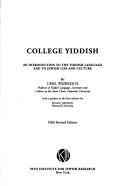
The classic, authoritative Yiddish grammar-and-reader used for decades; its structured lessons build systematically on the alphabet knowledge from Stage 1 and remain the gold standard for self-study grammar.
Vocabulary Building & Reference Tools
IntermediateAcquire a working Yiddish vocabulary and gain the reference tools needed to read independently, look up unfamiliar words, and understand the language's Germanic and Slavic roots.
▸ Study plan for this stage
Pace: 8–10 weeks, ~45–60 minutes daily (focused dictionary work with active vocabulary practice)
- Dictionary structure and navigation: understanding entry organization, abbreviations, phonetic transcriptions, and grammatical labels in Weinreich's dictionary
- Yiddish phonetic system: mastering YIVO transliteration and how sounds map to English equivalents
- Germanic and Slavic etymological roots: recognizing cognates with German, English, and Slavic languages to infer meaning and deepen retention
- Word families and morphology: understanding prefixes, suffixes, and root variations to expand vocabulary exponentially from core words
- Contextual word usage: learning how words function across different registers (formal, colloquial, literary) as shown in Weinreich's example sentences
- Building a personal reference system: creating flashcards, etymology notes, and thematic word lists for independent lookup and retention
- How do you navigate Weinreich's dictionary to find a word, and what do the abbreviations and phonetic symbols tell you about pronunciation and grammar?
- Given an unfamiliar Yiddish word, how would you use its Germanic or Slavic roots to make an educated guess about its meaning?
- What is the difference between a root word and its inflected forms in Yiddish, and how does Weinreich's dictionary help you identify them?
- How do you recognize and use word families (words sharing the same root) to expand your vocabulary beyond individual entries?
- What contextual clues in Weinreich's example sentences help you understand when and how to use a word appropriately?
- How would you build a personal reference system to organize and review vocabulary for long-term retention and independent reading?
- Daily dictionary deep-dives: Select 10–15 words per session from different semantic fields (food, family, emotions, daily actions); write out full entries including transliteration, English equivalents, and example sentences
- Etymology mapping: For 20–30 words per week, trace Germanic and Slavic roots; create a chart showing cognates in German, English, and related Slavic languages to strengthen pattern recognition
- Flashcard system creation: Build digital or physical flashcards for 200–250 high-frequency words, organized by theme and including pronunciation guides, etymological notes, and example sentences
- Word family expansion: Take 5–10 core words weekly and find all related forms (verb conjugations, noun declensions, adjective variations) listed in Weinreich; document patterns in morphology
- Contextual sentence practice: Copy 3–5 example sentences from dictionary entries for each word studied; rewrite them with slight variations to internalize usage patterns
- Reference tool customization: Create a personal Yiddish reference notebook with sections for high-frequency words, etymological patterns, grammatical notes, and thematic vocabulary clusters for quick lookup
Next up: Mastery of Weinreich's dictionary and a working vocabulary of 300–400 core words, combined with understanding of Yiddish morphology and etymological patterns, will enable you to move into reading authentic Yiddish texts with confidence, using your reference tools to independently decode unfamiliar words and appreciate the language's linguistic heritage.
The definitive bilingual Yiddish dictionary, essential as a daily reference once grammar is in place; Weinreich's scholarship makes it authoritative for both modern and literary Yiddish.
Reading Yiddish Literature
IntermediateRead authentic Yiddish prose and poetry — from graded readers to canonical literary works — developing real fluency and a feel for the richness of Yiddish literary culture.
▸ Study plan for this stage
Pace: 8–10 weeks, ~40–50 pages/day of Yiddish text with glosses and notes. Weeks 1–4: Tevye stories (slower pace, more cultural context); Weeks 5–8: I.L. Peretz Reader (varied genres, accelerating pace); Weeks 8–10: Review and deeper re-reading of favorite pieces.
- Sholem Aleichem's narrative voice and use of monologue as a vehicle for character and social commentary in the Tevye stories
- The rhythms and idioms of conversational Yiddish as preserved in dialogue-heavy prose
- Peretz's range: from realist stories to Hasidic tales to symbolist and modernist experiments
- The relationship between Yiddish literature and Jewish life in Eastern Europe: poverty, faith, family, displacement
- Stylistic variation across authors and genres—how tone, diction, and structure shift between Sholem Aleichem's warmth and Peretz's intensity
- Literary devices in Yiddish: irony, understatement, humor as survival, the tragic-comic register
- How to read for both surface narrative and deeper cultural/historical resonance
- What is Tevye's relationship to God, and how does Sholem Aleichem use Tevye's monologues to explore faith, doubt, and resilience?
- How do the railroad stories differ in tone and structure from the Tevye stories, and what new themes do they introduce?
- Identify three distinct stylistic or thematic approaches in the Peretz Reader—how does Peretz move between realism, Hasidic narrative, and modernism?
- What role does humor and irony play in both Sholem Aleichem and Peretz, and how do they use it to address serious social and existential questions?
- How do the lives and preoccupations of Tevye and the characters in Peretz's stories reflect the historical conditions of Eastern European Jewish communities?
- What linguistic or idiomatic features of Yiddish did you notice becoming more natural to you as you read, and how did they shape your understanding of character and voice?
- Read one Tevye story aloud (or listen to a recording if available) to internalize the rhythm of Sholem Aleichem's conversational Yiddish; note colloquialisms and how they convey personality.
- Write a short character sketch (200–300 words in English) of Tevye based on one story, focusing on his contradictions and coping mechanisms.
- Compare two stories from the Peretz Reader that differ in genre or tone (e.g., a realist story and a Hasidic tale); write a brief analysis of how Peretz's style and concerns shift.
- Create a glossary of 20–30 recurring Yiddish words or phrases from both authors; note their emotional or cultural weight beyond literal translation.
- Retell one scene from Tevye or Peretz in your own words, then compare your version to the original—what details did you miss, and what does the original's language add?
- Research the historical context of one story (e.g., the pogroms alluded to in Tevye, or the Hasidic world in Peretz) and write a one-page reflection on how the literature illuminates that history.
Next up: This stage deepens your fluency in authentic, literary Yiddish and attunes you to the emotional and cultural texture of canonical works; the next stage will likely build on this foundation by introducing more challenging modernist or contemporary texts, or by shifting focus to critical reading, literary analysis, and engagement with Yiddish literary history and theory.
The most beloved work of Yiddish literature, and the perfect first literary text: the language is vivid, the humor accessible, and annotated translations allow learners to check comprehension against the original.
A curated anthology of one of Yiddish literature's founding masters; reading Peretz after Sholem Aleichem exposes learners to a more formal, symbolist literary register and completes a well-rounded introduction to the Yiddish canon.
Discussion
Keep reading
Paths that share books, cover the same subject, or open a related topic.