Yiddish is a Germanic language written in the Hebrew alphabet, with a substantial Hebrew-Aramaic component and a Slavic layer from centuries in Eastern Europe. That description is also a warning about transliteration. Many popular Yiddish books present the language in Latin letters, which feels friendlier and is a trap: you cannot read a Yiddish newspaper, a Sholem Aleichem story, or a street sign in Brooklyn without the Hebrew script, and delaying it only doubles the work later. Learn the alphabet first, in week one.
The second decision is which Yiddish. The YIVO standard — the basis of essentially all academic instruction, including the books here — is a codified literary norm. It is not identical to the living Yiddish of Hasidic communities, which is the language's largest and fastest-growing body of native speakers today and differs in pronunciation, vocabulary, and some grammar. Neither is more correct; they serve different purposes. Study the standard, and know that the speech you hear in Williamsburg or Antwerp will not match it exactly.
The course that everyone uses
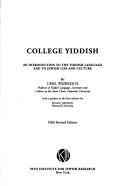
College Yiddish by Uriel Weinreich has been the standard textbook since 1949 and remains the backbone of most university courses. Thirty lessons take you from the alphabet through the full grammar — the case system, verb prefixes and their separability, the past tense with hobn and zayn — using the Hebrew script from the outset. Each lesson pairs grammar with a reading passage and cultural material on Ashkenazi life, so vocabulary arrives in context. It is a classroom book, drier than a modern self-study course and short on audio, so supplement with recordings; but nothing has replaced it for systematic coverage.
The dictionary you will actually need
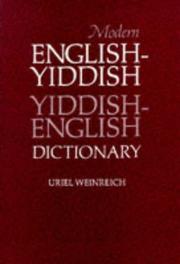
Modern English-Yiddish, Yiddish-English dictionary, also by Uriel Weinreich, is the essential companion and effectively the standard reference. It is bidirectional, it marks the Hebrew-origin words whose spelling is unpredictable (they retain their Hebrew orthography rather than following Yiddish phonetic spelling — a genuine stumbling block), and it gives grammatical information you will need constantly. Buy it at the same time as the course, not later.
Then read the two anchors
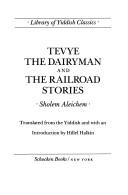
Tevye the dairyman and The railroad stories by Sholem Aleichem is the obvious next stop, and Hillel Halkin's English translation is one of the great translations of any Yiddish work. An honest note: reading in translation does not build your Yiddish. It does something else valuable — it shows you what the language is for, gives you the plots and voices before you tackle the originals, and Halkin's introduction on the problem of translating Tevye's biblical quotations is an education in itself. Then go back and read a story in the original with a dictionary; you will already know where it is going, which is the ideal condition for extensive reading.
I. L. Peretz Reader, The completes the pair. Peretz is the more formally ambitious of the two — neo-Hasidic tales, modernist experiments, social realism — and this anthology gathers the essential work. Where Sholem Aleichem gives you the vernacular voice, Peretz gives you the range of what Yiddish literature attempted, which is much wider than the shtetl-nostalgia reputation suggests.
One course, one dictionary, two writers. Work the course properly and the literature is closer than it looks. See related language paths for how neighbouring literatures are sequenced.
Follow the full ordered path here: How to Learn Yiddish from Books, in Reading Order.
Ready to learn something deeply?
Build a reading path — free