Learn Swedish: The Best Books to Study, in Order
This curriculum takes a complete beginner from zero Swedish to confident self-study independence across four carefully sequenced stages. Each stage builds on the last — starting with pronunciation and survival phrases, moving through core grammar and vocabulary, then into reading fluency and authentic conversation, so no step feels like a leap.
First Steps: Sound, Script & Survival Swedish
BeginnerUnderstand how Swedish sounds, master the alphabet and pronunciation rules, and handle basic everyday phrases with confidence.
▸ Study plan for this stage
Pace: 4–5 weeks, ~20–25 pages/day (focus on pronunciation drills and repetition)
- Swedish phonetics: vowel sounds (a, e, i, o, u, y, å, ä, ö) and their variations in different syllables
- Consonant pronunciation rules, including the soft consonants (k, g before e/i/y) and sibilants (s, sj, skj, stj, kj)
- The Swedish alphabet and letter names; understanding how spelling relates to pronunciation
- Stress and intonation patterns in Swedish words and sentences, including the musical pitch accent
- Basic survival phrases for greetings, introductions, polite expressions, and essential daily interactions
- Present tense verb conjugation for common verbs (vara, ha, gå) and basic sentence structure
- Gender and number agreement in nouns and adjectives (ett/en, singular/plural forms)
- Reading and writing the Swedish script accurately, including proper use of diacritical marks (å, ä, ö)
- How do you pronounce the Swedish vowels (å, ä, ö) and when do they appear in common words?
- What are the soft consonant rules in Swedish, and how do they affect pronunciation of k and g?
- Can you introduce yourself in Swedish with correct pronunciation, including your name and a basic personal detail?
- What is the difference between the two Swedish pitch accents, and how do they change word meaning?
- How do you form the present tense of common verbs like 'vara' (to be) and 'ha' (to have)?
- What are the key differences between ett-words and en-words, and how does this affect adjective agreement?
- Phonetic drills: Record yourself pronouncing all Swedish vowels and consonants in isolation, then in common words from the books; compare with native speaker audio
- Alphabet mastery: Write out the full Swedish alphabet (29 letters) daily and practice naming each letter aloud until automatic
- Survival phrase repetition: Memorize and practice 20–25 essential phrases (greetings, 'thank you,' 'excuse me,' 'do you speak English?') until you can produce them without hesitation
- Pitch accent practice: Listen to minimal pairs that differ only in pitch accent (e.g., 'anden' vs. 'anden') and practice reproducing the distinction
- Verb conjugation drills: Conjugate vara, ha, and gå in present tense across all persons (jag, du, han/hon, vi, ni, de) daily for one week
- Dictation exercises: Have a native speaker or audio recording dictate 10–15 simple Swedish words; write them down and check spelling and diacritical marks
- Conversation simulation: Practice introducing yourself and answering basic questions ('Vad heter du?' 'Var är du från?') using correct pronunciation and grammar
Next up: Mastering these foundational sounds, letters, and survival phrases equips you with the phonetic confidence and basic communicative tools needed to move into the next stage, where you'll expand vocabulary, learn more complex grammar structures, and begin constructing longer, more natural conversations.
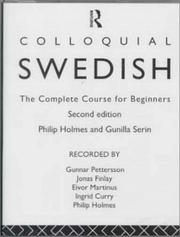
A classic self-study course that pairs pronunciation guidance with dialogues and audio, making it the ideal first contact with Swedish sounds and basic sentence patterns.
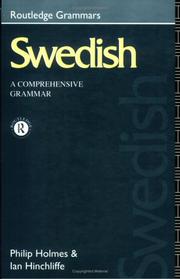
A concise, learner-friendly reference grammar that lays out the rules of Swedish clearly; reading it early prevents fossilized mistakes and gives you a reliable map of the language.
Core Grammar & Vocabulary Building
BeginnerInternalize Swedish grammar fundamentals — nouns, verbs, adjectives, word order — and build a working vocabulary of 1,000–2,000 words.
▸ Study plan for this stage
Pace: 8–10 weeks, ~40–50 pages/day (Units 1–15 of Teach Yourself Swedish Complete Course)
- Swedish noun gender (common/neuter) and definite/indefinite article forms (en/ett, -en/-et suffixes)
- Present tense regular and irregular verbs; infinitive, present, and past tense conjugations
- Adjective agreement with noun gender and number; predicate vs. attributive adjectives
- Swedish word order: V2 (verb-second) rule in main clauses and subordinate clause patterns
- Essential vocabulary clusters: greetings, numbers, time, family, food, daily routines, and common objects (~1,500 words)
- Pronouns (personal, possessive, reflexive) and their case usage in sentences
- Question formation and negation patterns (inte, inget, ingen)
- Introduction to Swedish phonetics and stress patterns to support accurate pronunciation
- How do you form the definite and indefinite articles for Swedish nouns, and why does gender matter?
- What is the V2 (verb-second) rule, and how does it differ between main clauses and subordinate clauses?
- Can you conjugate a regular Swedish verb in present and past tense, and identify common irregular verbs?
- How do Swedish adjectives agree with nouns in gender and number, and what is the difference between predicate and attributive adjectives?
- What are the core Swedish pronouns (personal, possessive, reflexive), and when do you use each?
- How do you form questions and negations in Swedish, and what are the key negation words?
- Complete all grammar drills and exercises in Teach Yourself Swedish Units 1–15, focusing on noun gender classification and article usage
- Create flashcard sets (physical or digital) for 100–150 high-frequency words per week, organized by semantic field (family, food, time, etc.)
- Write 10–15 short sentences daily (3–5 words each) using new vocabulary and the grammar point of the week; review and self-correct weekly
- Practice verb conjugation tables: write out present and past tense forms for 20 regular and 10 irregular verbs, then use each in a sentence
- Engage with the audio dialogues in Teach Yourself Swedish: listen, repeat aloud for pronunciation, then transcribe key sentences to internalize word order
- Complete weekly vocabulary quizzes covering the units studied; aim for 80%+ accuracy before moving forward
- Write a short daily journal entry (5–10 sentences) in Swedish using only the grammar and vocabulary learned so far; have a tutor or language partner review for accuracy
Next up: Mastery of Swedish grammar fundamentals and a solid 1,500–2,000 word vocabulary equips you to move into conversational fluency, where you'll practice real-world dialogues, listening comprehension, and interactive communication in authentic contexts.
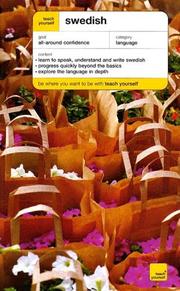
A structured, dialogue-driven course that systematically introduces grammar topics and vocabulary in realistic contexts, reinforcing what the grammar reference introduced.
Intermediate Fluency: Reading & Listening
IntermediateTransition from controlled exercises to authentic Swedish text and speech, developing reading stamina and an ear for natural conversation.
▸ Study plan for this stage
Pace: 4–5 weeks, ~40–50 pages/day (including textbook dialogues, listening exercises, and comprehension work)
- Recognizing and producing present, past, and future tense forms in authentic Swedish contexts
- Understanding Swedish sentence structure and word order patterns in real dialogues and narratives
- Building vocabulary through thematic units (daily life, travel, work, relationships) embedded in Rivstart's contextual lessons
- Developing listening comprehension skills by engaging with Rivstart's audio materials and natural speech patterns
- Reading stamina: processing longer, connected Swedish texts without translation aids
- Identifying cultural context and pragmatic meaning in Swedish conversations beyond literal word translation
- Mastering common Swedish expressions, idioms, and colloquialisms presented in Rivstart's dialogues
- Can you read a full dialogue from Rivstart without stopping to translate, and summarize its main points in Swedish or English?
- How do you form and recognize past tense (preteritum and perfekt) in Swedish texts, and when is each used appropriately?
- What are the key differences in Swedish word order between statements, questions, and subordinate clauses, and can you apply them in your own sentences?
- After listening to a Rivstart audio dialogue once or twice, can you identify the main topic, key details, and the speakers' attitudes or intentions?
- Can you explain the cultural context or social norms reflected in a Swedish dialogue (e.g., formality levels, politeness conventions)?
- What strategies do you use to infer meaning from unfamiliar words in context, and how does Rivstart's visual and thematic support help you?
- Daily listening: Play one Rivstart dialogue (2–3 minutes) without subtitles, then with Swedish transcripts; identify new expressions and cultural cues
- Dialogue shadowing: Read a Rivstart dialogue aloud while following the audio, focusing on pronunciation, intonation, and natural pacing
- Comprehension summaries: After each Rivstart unit, write a 5–7 sentence summary in Swedish of the main dialogue or text
- Vocabulary mapping: Create flashcards or a notebook for thematic vocabulary clusters from each Rivstart unit (e.g., 'At the Restaurant,' 'Describing People')
- Tense identification drills: Highlight all past and future tense verbs in a Rivstart text, classify them (preteritum/perfekt/futurum), and explain why each tense was chosen
- Role-play dialogues: Pair up (or record yourself) performing Rivstart dialogues with natural intonation, then create variations by changing context or adding details
- Listening gap-fill: Use Rivstart's audio materials to fill in missing words or phrases in partially transcribed dialogues, then check against the full text
Next up: Mastery of Rivstart's A1/A2 material establishes a solid foundation in Swedish grammar, vocabulary, and listening comprehension, preparing you to engage with more complex, unscripted authentic texts (news articles, podcasts, literature) and to sustain longer conversations in the next stage of advanced fluency.

Sweden's most widely used communicative course, used in university classrooms worldwide; its task-based approach pushes you into producing real Swedish for real purposes.
Conversation, Culture & Independent Use
IntermediateSpeak and write Swedish spontaneously, understand cultural context, and have the tools to continue learning independently without a teacher.
▸ Study plan for this stage
Pace: 8–10 weeks, ~40–50 pages/day (Rivstart B2+C1 Textbok: 4–5 weeks; Swedish: A Comprehensive Grammar: 3–4 weeks, with 1–2 weeks overlap for integration)
- Advanced conversational fluency: navigating complex discussions, expressing nuance, and responding spontaneously to native-speed Swedish in Rivstart's authentic dialogues and scenarios
- Swedish cultural literacy: understanding Swedish social norms, workplace etiquette, historical context, and contemporary issues presented in Rivstart's thematic units
- Mastery of complex grammar structures: subjunctive mood, passive voice, conditional constructions, and word order rules from Holmes' comprehensive reference for writing and speaking precision
- Idiomatic expression and colloquial language: recognizing and using Swedish idioms, slang, and register variation (formal vs. informal) from Rivstart's diverse texts
- Independent learning strategies: using Holmes' grammar reference as a self-study tool, consulting dictionaries, analyzing authentic Swedish media, and self-correcting
- Spontaneous production in speech and writing: moving from structured exercises to free composition and extemporaneous conversation without teacher scaffolding
- Metalinguistic awareness: understanding why Swedish grammar works the way it does (Holmes) to troubleshoot errors and apply rules to new contexts
- How do you initiate, sustain, and conclude a complex conversation in Swedish on an unfamiliar topic, and how do you ask for clarification or express disagreement politely?
- What are the key differences between Swedish workplace culture, educational system, and social customs as presented in Rivstart, and how would you adapt your language and behavior accordingly?
- When should you use the subjunctive mood, passive voice, and conditional constructions in Swedish, and what are the common errors learners make with these structures (per Holmes)?
- How do you recognize and use Swedish idioms and colloquial expressions appropriately, and what register shifts are necessary when moving from formal to informal contexts?
- Given a grammar question or language problem, how would you use Holmes' Comprehensive Grammar as a reference to find the answer and apply it to your own writing or speech?
- How do you plan to continue improving your Swedish independently after this stage—what resources, media, and self-study habits will you establish?
- Complete all dialogue and role-play activities in Rivstart B2+C1 Textbok, recording yourself speaking and comparing your pronunciation and fluency to native speaker models
- Write 5–7 short essays (300–500 words each) on topics from Rivstart's thematic units (e.g., Swedish history, contemporary social issues, workplace scenarios) without consulting notes, then self-correct using Holmes' grammar reference
- Conduct 10–15 unscripted conversations with a language partner or tutor on topics from Rivstart, focusing on spontaneous response and register appropriateness; record and review for errors
- Create a personal grammar reference notebook: for each major grammar topic in Holmes (subjunctive, passive, conditionals, word order), write 3–5 example sentences from your own experience and test yourself weekly
- Consume and analyze authentic Swedish media (news articles, podcasts, films, social media) aligned with Rivstart's themes; identify idioms, colloquialisms, and advanced structures, then use them in your own writing or speech
- Translate 5–10 complex English sentences into Swedish, then reverse-translate your Swedish back to English to check for accuracy; use Holmes to resolve grammar ambiguities
- Prepare and deliver a 10–15 minute presentation in Swedish on a topic of personal interest, incorporating vocabulary and structures from Rivstart and demonstrating spontaneous Q&A handling
Next up: This stage equips you with the grammatical precision (via Holmes), conversational confidence (via Rivstart), and cultural awareness needed to engage with native Swedish speakers and media independently, setting the foundation for advanced proficiency and specialized learning (e.g., professional Swedish, literary analysis, or regional dialects) without formal instruction.

The natural continuation of Rivstart, pushing into upper-intermediate territory with richer texts, nuanced grammar, and conversation tasks that mirror real-life Swedish.

The most thorough English-language reference grammar for Swedish; at this stage you can use it to resolve subtle questions and refine your accuracy as an independent learner.
Discussion
Keep reading
Paths that share books, cover the same subject, or open a related topic.