Learn Persian (Farsi): The Best Books to Study, in Order
This curriculum takes a complete beginner from zero knowledge of Persian (Farsi) to confident conversational ability and solid grammatical understanding through four carefully sequenced stages. It begins with mastering the Persian script — an essential gateway — before layering in grammar, vocabulary, and finally real-world conversation and reading practice. Each stage builds directly on the last, ensuring no learner is thrown into deep water before they can swim.
Core Grammar & Essential Vocabulary
BeginnerUnderstand Persian sentence structure (SOV word order, ezafe construction, verb conjugation, and noun/pronoun systems) and build a working vocabulary of ~500–800 high-frequency words.
▸ Study plan for this stage
Pace: 8–10 weeks, ~20–25 pages/day, with 2–3 days per week dedicated to grammar drills and vocabulary consolidation
- Persian SOV (Subject-Object-Verb) word order and how it differs from English
- Ezafe construction (the Persian possessive/attributive particle) and its role in noun phrases
- Present and past tense verb conjugation, including regular and common irregular verbs
- Persian pronoun system (personal, possessive, and reflexive pronouns) and their agreement patterns
- Noun and adjective declension, including plural formation and case marking
- Essential high-frequency vocabulary (~500–800 words) organized by semantic domains (family, daily activities, numbers, time, common objects)
- Question formation and negation patterns in Persian
- Introduction to Persian script (alphabet, diacritics, and reading conventions)
- How does Persian word order differ from English, and why is SOV structure important for reading comprehension?
- What is the ezafe construction, and how do you identify and use it in noun phrases?
- How do you conjugate regular Persian verbs in the present and past tenses, and what are the most common irregular verbs?
- What are the main categories of Persian pronouns, and how do they agree with nouns and verbs?
- How are Persian nouns pluralized, and what role does case marking play in the language?
- What are the 500–800 most essential Persian words, and how are they organized by frequency and semantic domain?
- How do you form questions and negations in Persian, and what word order changes occur?
- Complete all grammar exercises in 'Colloquial Persian' chapters 1–6, focusing on verb conjugation tables and pronoun substitution drills
- Create flashcard sets (digital or physical) for the ~600 high-frequency vocabulary items presented in the book, organized by semantic domain (family, food, time, numbers, actions)
- Write 50–75 simple Persian sentences (5–8 words each) using the SOV word order, ezafe constructions, and present/past tense verbs from each chapter
- Practice reading and transcribing 10–15 short Persian texts from the book's reading passages, paying attention to script recognition and diacritic marks
- Conduct daily 10-minute vocabulary drills using the book's word lists, testing both recognition (reading) and recall (writing/speaking)
- Record yourself reading aloud 5–10 dialogue passages from 'Colloquial Persian,' then compare your pronunciation to the audio materials
- Translate 20–30 English sentences into Persian, focusing on correct word order, pronoun agreement, and verb conjugation
- Create a personal grammar reference sheet summarizing SOV word order, ezafe rules, verb conjugation patterns, and pronoun charts for quick review
Next up: This stage equips you with the grammatical scaffolding and foundational vocabulary needed to move into conversational fluency and real-world text comprehension, where you'll apply these structures in authentic dialogues, written narratives, and media.

A structured, self-study-friendly coursebook that introduces grammar points step by step with dialogues, exercises, and audio. Starting here gives the learner a complete grammatical skeleton to hang vocabulary on.
Intermediate Grammar, Reading & Expanding Vocabulary
IntermediateHandle complex grammatical structures (subjunctive mood, compound verbs, relative clauses), read authentic short texts, and expand vocabulary toward the 1,500–2,000-word range.
▸ Study plan for this stage
Pace: 8–10 weeks, ~40–50 pages/day (alternating between grammar study and reading practice)
- Subjunctive mood formation and usage in Persian (conditional, desire, necessity contexts)
- Compound verbs and their grammatical behavior (e.g., کردن + noun combinations, separable verbs)
- Relative clauses and relative pronouns (که, آنچه) in complex sentence construction
- Advanced verb tenses: perfect, imperfect, and their combinations in narrative and discourse
- Vocabulary expansion strategies and thematic word families (1,500–2,000-word range)
- Reading comprehension of authentic short texts: news snippets, short stories, and cultural passages
- Participles and gerunds in Persian and their role in sentence modification
- Prepositions and postpositions in complex prepositional phrases
- How do you form and use the subjunctive mood in Persian, and in what grammatical contexts does it appear?
- What are compound verbs in Persian, and how do they differ from simple verbs in terms of conjugation and meaning?
- How do relative clauses function in Persian, and what role do relative pronouns like که play in connecting ideas?
- Can you read and comprehend a short authentic Persian text (150–250 words) and identify its main ideas and grammatical structures?
- How do participles and gerunds function as modifiers in Persian sentences, and how do they expand vocabulary?
- What strategies can you use to infer the meaning of unfamiliar words in context, and how do word families help expand your active vocabulary?
- Work through subjunctive mood drills in 'Persian Grammar' (Mace): convert indicative sentences to subjunctive forms in conditional and desire contexts; practice 20–30 sentences per session
- Identify and analyze compound verbs in 'Teach Yourself Modern Persian' (Farzad) reading passages; create a personal reference list of 15–20 compound verbs with example sentences
- Extract relative clauses from authentic texts in Farzad's book and rewrite them using different relative pronouns; practice combining simple sentences into complex ones
- Read 2–3 short authentic texts per week from Farzad's materials; write a 100–150 word summary in Persian for each, focusing on using subjunctive and compound verbs
- Build thematic vocabulary clusters (e.g., family, work, emotions) from both books; create flashcards with word families and use them in 5–10 original sentences per cluster
- Translate 10–15 sentences weekly from English to Persian, focusing on subjunctive mood, compound verbs, and relative clauses; compare your translations with provided answer keys
Next up: Mastery of intermediate grammar structures and authentic reading comprehension prepares you to tackle advanced discourse, literary texts, and specialized vocabulary in the next stage.

The most respected English-language Persian reference grammar, covering every major structure clearly and concisely. Reading it cover-to-cover at this stage fills in gaps and provides a reliable reference for the rest of the journey.
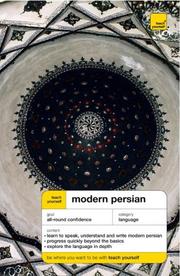
A well-structured intermediate coursebook that pushes vocabulary and reading comprehension further with longer texts and more nuanced grammar explanations, bridging the gap between beginner courses and advanced reading.
Discussion
Keep reading
Paths that share books, cover the same subject, or open a related topic.