Learn Swahili: The Best Books to Study, in Order
This curriculum takes a complete beginner from zero Swahili to confident self-study reading and conversation across four progressive stages. Each stage builds directly on the last — first establishing pronunciation and core grammar, then expanding vocabulary and sentence structure, then developing real conversational fluency, and finally opening the door to authentic Swahili texts and cultural depth.
Foundations: Pronunciation, Grammar & Core Vocabulary
BeginnerUnderstand Swahili's noun class system, basic sentence structure, and pronunciation rules well enough to form simple sentences and read phonetically.
▸ Study plan for this stage
Pace: 4–5 weeks, ~20–25 pages/day (Units 1–5 of "Teach Yourself Swahili Complete Course")
- Swahili noun classes (M/Mi, N, Ki/Vi, U, Pa, Ku, M/Wa) and their agreement patterns with adjectives and verbs
- Pronunciation rules including vowel consistency, consonant clusters, and stress patterns (typically on penultimate syllable)
- Basic sentence structure: subject-verb-object (SVO) word order and the role of subject/object prefixes on verbs
- Present tense verb conjugation with -na- infix and subject prefixes (ni-, u-, a-, tu-, m-, wa-)
- Core vocabulary (200–300 words) covering greetings, family, body parts, numbers 0–20, and everyday objects
- Agreement rules: how noun class prefixes determine adjective and verb forms
- Simple question formation using interrogative words (nani, nini, wapi, lini, kwa nini)
- Negation patterns using -si- and -ha- in present tense
- How do Swahili noun classes work, and why do adjectives and verbs change form depending on the noun class of their subject?
- What are the main pronunciation rules in Swahili, and how do they differ from English?
- How do you form a simple present-tense sentence in Swahili, and what role do subject prefixes play?
- Can you conjugate a regular verb in the present tense across all six person categories (I, you singular, he/she, we, you plural, they)?
- How do you form negative sentences and yes/no questions in Swahili?
- What are the core 200–300 vocabulary items covered in Units 1–5, and can you use them in simple sentences?
- Pronunciation drills: Record yourself reading aloud the vocabulary lists and dialogue passages from Units 1–3, focusing on vowel clarity and penultimate-syllable stress; compare with the book's audio (if available) or online resources.
- Noun class sorting: Create a table with the 7 main noun classes, list 10 nouns in each, and write the corresponding adjective forms (e.g., 'big', 'small', 'good') to internalize agreement patterns.
- Verb conjugation charts: For 5 common verbs (e.g., -ku-wa 'to be', -ku-soma 'to read', -ku-andika 'to write'), write out full present-tense conjugations with subject prefixes and -na- infix across all six persons.
- Dialogue reconstruction: Take 3 dialogues from Units 2–4, remove the Swahili text, and try to reconstruct it using the English translation and grammar rules learned; compare with the original.
- Sentence building: Write 20 simple present-tense sentences using the core vocabulary (e.g., 'Mimi ni mwalimu' / 'I am a teacher'; 'Yeye ana kitabu' / 'He/she has a book'), ensuring correct noun class agreement.
- Question formation practice: Convert 15 statements into yes/no questions and wh-questions (nani, nini, wapi, lini, kwa nini) using the patterns from Unit 5.
Next up: This stage equips you with the grammatical scaffolding and phonetic foundation needed to move into the next stage, where you'll expand verb tenses (past and future), learn more complex sentence structures, and build conversational fluency through dialogues and real-world scenarios.

A comprehensive beginner course covering pronunciation, vocabulary, and grammar in dialogue-based units. Reading this second reinforces the grammar from Mukherjee with real conversational contexts and audio-linked practice.
Building Blocks: Vocabulary Expansion & Sentence Fluency
BeginnerDramatically expand core vocabulary, master verb tenses and agreement, and begin constructing multi-clause sentences with confidence.
▸ Study plan for this stage
Pace: 8–10 weeks, ~40–50 pages/day from "Colloquial Swahili" (weeks 1–6), then 2–3 weeks on "Lonely Planet Swahili Phrasebook & Dictionary" for targeted vocabulary and real-world phrases
- Verb conjugation patterns across all tenses (present, past, future) and their relationship to subject prefixes in Swahili's noun class system
- Noun class agreement: how adjectives, verbs, and demonstratives must agree with noun classes (M-/Wa-, M-/Mi-, Ki-/Vi-, etc.)
- Building complex sentences using conjunctions (na, lakini, kwa sababu) and relative clauses from 'Colloquial Swahili'
- Expanding active vocabulary to 800–1200 high-frequency words through systematic study of 'Colloquial Swahili' dialogues and 'Lonely Planet' thematic sections
- Mastering common verb stems and their derivations (e.g., -penda, -soma, -kula) to unlock productive word formation
- Practical sentence construction: moving from isolated words to fluent multi-clause utterances in present, past, and future contexts
- How do Swahili verb prefixes change based on the subject (I, you, he/she, we, they), and what is the relationship between these prefixes and noun classes?
- Explain noun class agreement: if you use an adjective like 'kubwa' (big) with different nouns, how does its form change across noun classes?
- What are the main conjunctions and relative clause markers in Swahili, and how would you construct a sentence with two independent clauses?
- Given a verb stem like -soma (to read) or -andika (to write), can you conjugate it across all major tenses and with different subjects?
- How would you construct a multi-clause sentence in Swahili that expresses cause, contrast, or condition using material from 'Colloquial Swahili'?
- What are the 15–20 most common verb stems in Swahili, and how do they appear in the dialogues and examples from both books?
- Complete all dialogue comprehension and substitution exercises in 'Colloquial Swahili' chapters 1–8, focusing on verb conjugation drills and noun class agreement patterns
- Create a personal verb conjugation table for 10 high-frequency stems (-penda, -soma, -kula, -andika, -sema, -kwenda, -fanya, -anza, -maliza, -jua) across all tenses; test yourself weekly
- Extract 50 example sentences from 'Colloquial Swahili' dialogues and rewrite each one by substituting different subjects and objects to practice agreement and conjugation
- Use the 'Lonely Planet Phrasebook' thematic sections (food, travel, shopping, etc.) to build 5–10 original multi-clause sentences per theme, incorporating conjunctions and relative clauses
- Conduct weekly 'vocabulary sprints': select 20–30 words from 'Lonely Planet' by theme, create sentences using them, and speak them aloud to internalize pronunciation and fluency
- Record yourself reading dialogues from 'Colloquial Swahili' aloud, then listen back to identify pronunciation and intonation patterns; compare with audio resources if available
- Build a 'sentence transformation' workbook: take simple sentences from 'Colloquial Swahili' and expand them into complex sentences using conjunctions, relative clauses, and different tenses
Next up: This stage equips you with the grammatical foundations and vocabulary breadth needed to move into intermediate reading, where you'll encounter authentic texts, literary narratives, and nuanced discourse that rely on confident command of verb tenses, noun class agreement, and complex sentence structures.
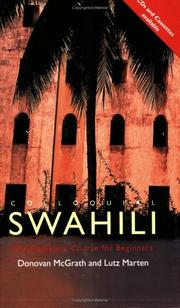
Colloquial Swahili introduces natural, everyday language patterns and a wider vocabulary range through realistic dialogues. Coming after the grammar foundation, it bridges the gap between textbook rules and living speech.

A practical, topic-organized reference for real-world vocabulary across travel, food, health, and social situations. Used here as a vocabulary-building supplement to read and absorb thematically grouped words and phrases.
Advanced: Authentic Texts & Deep Linguistic Mastery
ExpertRead authentic Swahili literature and reference works, understand complex grammar at a native-speaker level, and achieve genuine reading independence.
▸ Study plan for this stage
Pace: 8–12 weeks, ~15–20 pages/day (selective deep study rather than cover-to-cover reading)
- Dictionary structure and navigation: understanding headwords, subentries, grammatical labels, and cross-references in Johnson's Standard English-Swahili Dictionary
- Morphological analysis: recognizing Swahili noun classes, verb stems, and affixes through dictionary entries and etymological notes
- Contextual word selection: distinguishing between synonyms and near-equivalents based on usage notes, register, and example sentences
- Idiomatic expressions and phrasal constructions: identifying how Swahili idioms differ from literal English translations in dictionary entries
- Historical and regional variation: understanding how Johnson's dictionary documents colonial-era Swahili and regional dialects
- Building active vocabulary at advanced level: moving from passive recognition to productive use of sophisticated lexical items
- Reference work literacy: using a comprehensive dictionary as a linguistic research tool, not merely a lookup resource
- How does Johnson's dictionary organize and present Swahili noun classes, and why is this organization crucial for understanding Swahili morphology?
- What information can you extract from a single entry in Johnson's dictionary beyond the basic English translation, and how does this support deeper linguistic understanding?
- How do you use Johnson's dictionary to distinguish between synonymous Swahili words and select the most appropriate one for a specific context?
- What are the key differences between how Johnson's dictionary treats idiomatic expressions versus literal translations, and how does this reflect native-speaker usage?
- How has Swahili vocabulary and usage evolved since Johnson's dictionary was compiled, and how do you identify which entries reflect historical versus contemporary usage?
- How would you use Johnson's dictionary as a reference tool to verify or research a linguistic question about Swahili grammar or word formation?
- Select 10 high-frequency Swahili words (e.g., -taka, -penda, -kuja) and trace all their dictionary entries, subentries, and example sentences; create a comprehensive usage guide for each word
- Choose 5 Swahili noun class prefixes (e.g., m-/wa-, ki-/vi-, u-) and systematically document 20+ dictionary entries for each class, noting patterns in meaning and usage
- Identify 15 idiomatic expressions in Johnson's dictionary and compare them to their literal translations; explain why the idiomatic meaning differs and how you would teach this to a learner
- Create a thematic vocabulary list (e.g., agriculture, trade, kinship) by mining Johnson's dictionary; organize by Swahili word families and note historical/regional variations
- Analyze 10 entries that include multiple Swahili synonyms; write comparative notes explaining the subtle differences in meaning, register, or usage for each synonym pair
- Research 5 words in Johnson's dictionary that have changed meaning or fallen out of use since the dictionary's publication; verify with contemporary Swahili sources and note the evolution
Next up: Mastery of Johnson's dictionary as a linguistic research tool and deep familiarity with Swahili lexical structure prepares you to engage with authentic literary texts and specialized reference works with the ability to independently resolve vocabulary ambiguities and understand nuanced register choices made by native authors.

The canonical reference dictionary for Swahili, compiled from the standard dialect. At this stage, using a Swahili-to-English dictionary (rather than a bilingual phrasebook) forces deeper engagement with the language on its own terms.
Discussion
Keep reading
Paths that share books, cover the same subject, or open a related topic.