Best Books to Learn Malay and Indonesian, in Order
This curriculum takes a complete beginner from zero Malay to confident, nuanced usage across both Malaysian and Indonesian contexts. Each stage builds directly on the last: you first gain spoken survival skills and phonics, then master Malay's famously simple grammar, then expand vocabulary and reading fluency, and finally develop an informed awareness of how Malaysian Malay and Indonesian differ in register, vocabulary, and culture.
Foundations: Sounds, Scripts & Survival Malay
BeginnerPronounce Malay accurately using Rumi (Roman) script, handle basic greetings and everyday transactions, and understand why Malay grammar is considered one of the world's most learner-friendly.
▸ Study plan for this stage
Pace: 4–5 weeks, ~25–30 pages/day, with 2–3 days per week dedicated to audio pronunciation drills and conversation practice
- Rumi (Roman) script pronunciation rules and phonetic patterns in Malay, including vowel length distinctions and consonant clusters
- Basic Malay phonetics: the five vowels (a, e, i, o, u) and their consistent pronunciation across words
- Essential greetings and social courtesies (Selamat pagi, Apa khabar, Terima kasih) and their contextual usage
- Survival transactions: ordering food, asking for directions, shopping, and telling time using simple present-tense structures
- Malay grammar fundamentals: the absence of verb conjugation, no grammatical gender, and simple subject-verb-object word order that make the language accessible
- Affixation system (prefixes and suffixes) as the primary mechanism for creating word variations without changing root meanings
- Numbers 0–100 and basic quantity expressions for everyday transactions
- Cultural context: politeness markers (lah, lor, meh) and their role in natural Malay conversation
- How do you accurately pronounce the five Malay vowels, and what are the key differences between short and long vowel sounds?
- What are the most common greetings in Malay, and how do you choose the appropriate greeting based on time of day and social context?
- Why is Malay grammar considered learner-friendly compared to languages like Spanish or Mandarin, and what specific features make it simpler?
- How do you construct a simple sentence to order food, ask for directions, or complete a basic transaction using subject-verb-object word order?
- What is the role of affixes (prefixes like me-, ber-, and suffixes like -kan, -an) in forming new words from root words, and can you provide three examples?
- How do politeness particles (lah, lor, meh) modify the tone and meaning of a sentence, and when is it appropriate to use each one?
- Phonetic drills: Record yourself pronouncing 20–30 common Malay words from 'Colloquial Malay' (e.g., makan, rumah, terima kasih), then compare your recording to native speaker audio to identify and correct pronunciation gaps
- Greeting role-play: Practice all greetings from both books at different times of day (morning, afternoon, evening) with a language partner or tutor, focusing on natural intonation and appropriate responses
- Survival transaction scripts: Write out and memorize 3–4 short dialogues (ordering at a restaurant, asking for directions, shopping for groceries) from 'Malay for Everyone', then perform them aloud 5 times each
- Affixation mapping: Create a chart with 10 root words from the books, then systematically add prefixes and suffixes (me-, ber-, -kan, -an) to generate related words and write example sentences for each
- Number and quantity drills: Practice counting 0–100 aloud, then complete 15–20 spoken exercises combining numbers with everyday items (e.g., 'Saya mahu tiga kopi' — I want three coffees)
- Politeness particle substitution: Take 5 simple sentences from the books and rewrite them with different politeness particles (lah, lor, meh), then discuss how the tone shifts with a native speaker or tutor
Next up: Mastering accurate pronunciation, essential survival phrases, and understanding Malay's grammatical simplicity equips you to move into the next stage—building conversational fluency through expanded vocabulary, more complex sentence structures, and real-world dialogue scenarios.
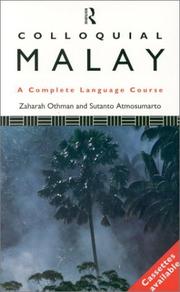
The gold-standard beginner course for English speakers, with dialogues, audio support, and clear explanations of pronunciation and basic sentence patterns. Start here to build an immediate spoken foundation.
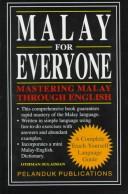
A widely used Malaysian introductory textbook that reinforces the same core vocabulary and phrases with plentiful drills, making it an ideal companion once Colloquial Malay has introduced the basics.
Vocabulary Building & Reading Fluency
IntermediateExpand active vocabulary to several thousand words, develop reading stamina with authentic texts, and use a reliable dictionary efficiently for self-directed learning.
▸ Study plan for this stage
Pace: 4–6 weeks, ~45–60 minutes daily (focused dictionary work + reading practice)
- Dictionary structure and navigation: understanding headwords, alphabetical ordering, and cross-references in Wilkinson's dictionary
- Etymology and word origins: recognizing how Malay words derive from Sanskrit, Arabic, Dutch, and indigenous roots to infer meaning
- Affixation and word families: identifying prefixes (me-, ber-, ter-) and suffixes (-an, -i, -kan) to unlock related word meanings
- Contextual word usage: distinguishing between formal, colloquial, and archaic entries to select appropriate vocabulary for different registers
- Active vocabulary retention: moving from passive dictionary lookup to productive use in writing and speech
- Reading fluency with authentic texts: applying dictionary skills to longer passages without constant interruption for lookups
- Self-directed learning strategies: developing efficient lookup habits and building personal vocabulary lists for spaced repetition
- How do you efficiently locate a word in Wilkinson's dictionary, and what information does each entry provide beyond the English translation?
- What are the major language sources (Sanskrit, Arabic, Dutch, etc.) that influenced Malay vocabulary, and how can recognizing these origins help you guess unfamiliar words?
- How do Malay affixes (prefixes like me-, ber-, ter- and suffixes like -an, -i, -kan) change word meaning, and how can you use this knowledge to expand your vocabulary exponentially?
- What is the difference between formal, colloquial, and archaic vocabulary in Wilkinson's entries, and when should you use each register?
- How can you transition from looking up every unknown word to reading fluently with only occasional dictionary consultation?
- What personal vocabulary-building system (e.g., spaced repetition, word families, thematic grouping) works best for your learning style, and how will you maintain it?
- Dictionary deep-dive: Select 10 random headwords from Wilkinson's dictionary. For each, note the entry structure, all listed meanings, example phrases, and any cross-references. Identify the likely language origin of each word.
- Affix mapping: Create a chart of common Malay prefixes and suffixes (me-, ber-, ter-, -an, -i, -kan, etc.). For each, find 5–8 example words in Wilkinson's dictionary and write out how the affix changes the base word's meaning.
- Etymology chains: Pick 5 words of Sanskrit or Arabic origin from the dictionary. Research or infer their original meanings, then trace how they evolved in Malay. Write a short paragraph explaining the connection.
- Register sorting: Find 15 words in Wilkinson's dictionary that have multiple meanings or usage notes (formal vs. colloquial). Create a table categorizing them by register and write example sentences for each.
- Fluency reading with scaffolding: Select a short authentic Malay text (news article, blog post, or literary excerpt, 300–500 words). Read it once without stopping to look up words, marking unknown terms. Then use Wilkinson's dictionary to clarify only the most frequent or essential unknowns. Re-read for comprehension.
- Personal vocabulary list: Build a spreadsheet or flashcard deck of 100–150 words from your reading, organized by theme (e.g., daily life, business, emotions). Include headword, definition, example sentence, and word family. Review weekly using spaced repetition.
Next up: Mastering Wilkinson's dictionary and building a robust active vocabulary of several thousand words equips you to tackle authentic, longer Malay texts with confidence, setting the stage for the next level where you'll apply these skills to literature, journalism, and specialized domains.

The classic scholarly Malay-English reference, invaluable for understanding word roots and etymology — using a good dictionary actively is the fastest proven path to vocabulary growth.
Malaysian vs. Indonesian: Divergence & Nuance
ExpertUnderstand the historical split between Bahasa Malaysia and Bahasa Indonesia, recognise key differences in vocabulary, spelling, register, and cultural connotation, and read both varieties with confidence.
▸ Study plan for this stage
Pace: 6–8 weeks, ~40–50 pages/week (approximately 2–3 hours of focused reading per week, with 1–2 hours for exercises and reflection)
- Historical and political factors that drove the divergence between Bahasa Malaysia and Bahasa Indonesia after independence (1945–1967)
- Systematic vocabulary differences between Malaysian and Indonesian varieties, including loanwords, neologisms, and semantic shifts
- Spelling and orthographic conventions unique to each variety (e.g., diphthongs, consonant doubling, suffix handling)
- Register, formality levels, and cultural connotations embedded in word choice across both varieties
- The role of language standardization bodies (Dewan Bahasa dan Pustaka in Malaysia vs. Badan Pengembangan dan Pembinaan Bahasa in Indonesia) in codifying differences
- How colonial legacies, modernization pressures, and nation-building ideologies shaped lexical and stylistic divergence
- Metalinguistic awareness: recognizing when a word or phrase signals Malaysian vs. Indonesian identity and context
- Code-switching and mutual intelligibility: understanding what remains shared and what requires active translation
- What are the major historical and political events (1945–1967) that caused Bahasa Malaysia and Bahasa Indonesia to diverge, and how did each nation's language policy reflect its nation-building agenda?
- Identify and explain at least 10 vocabulary differences between Malaysian and Indonesian varieties, including their etymological origins and contexts of use (e.g., 'kereta' vs. 'mobil', 'bas' vs. 'bus')
- How do spelling conventions differ between the two varieties, and what linguistic or political reasons does Asmah Haji Omar provide for these choices?
- What role does register and cultural connotation play in distinguishing Malaysian from Indonesian usage, and how might a speaker's choice of variety signal identity or allegiance?
- How do the language standardization bodies in Malaysia and Indonesia maintain and justify their respective standards, and what tensions arise from their different approaches?
- Explain the concepts of conflict, war, and peace as they are linguistically encoded in Malay, and how these encodings differ between Malaysian and Indonesian varieties
- Comparative vocabulary audit: Create a table of 20–30 word pairs (Malaysian vs. Indonesian) from the texts, noting etymology, frequency, register, and cultural associations for each
- Spelling rule extraction: Document the spelling conventions presented in both books and create a reference guide (e.g., diphthong handling, suffix attachment) with examples from both varieties
- Register mapping: Select 3–4 short passages from each book and annotate them by register level (formal, neutral, colloquial); identify which variety favors which register and why
- Metalinguistic journal: As you read, keep a running log of moments where you notice a distinctly Malaysian or Indonesian word, phrase, or construction; note the context and what it reveals about identity or ideology
- Conflict/peace terminology analysis: Using 'Concepts of conflict, war, and peace', extract 15–20 key terms related to conflict and peace; map how each is expressed in Malaysian vs. Indonesian, and discuss semantic or connotative differences
- Rewriting exercise: Take a paragraph from one book written in Malaysian (or Indonesian) and rewrite it in the other variety, documenting every lexical, orthographic, and stylistic change you make and your reasoning
Next up: This stage equips you with the linguistic and historical tools to recognize and navigate the full spectrum of Malay-language variation, preparing you to engage with contemporary Malaysian and Indonesian media, literature, and discourse as a genuinely bilingual reader who understands the ideological and cultural stakes embedded in each variety's choices.
Written by Malaysia's foremost linguist, this authoritative work traces the development of standard Malay, its dialects, and its relationship to Indonesian — essential reading for anyone who wants to understand why the two varieties diverged.
Examines how Malay functions within Malaysia's multilingual society, covering register, formal versus colloquial usage, and the sociolinguistic pressures that make Malaysian Malay distinct from its Indonesian counterpart.
Discussion
Keep reading
Paths that share books, cover the same subject, or open a related topic.