Malay has a reputation as an easy language, and the first half of that reputation is deserved. There is no verb conjugation, no grammatical gender, no articles, no plural marking by default (reduplication handles it when needed), and word order is a familiar subject-verb-object. A determined learner can build usable sentences within days.
The second half arrives later and catches people out. Formal Malay runs on an affix system — meN-, ber-, peN-, -kan, -i, ke-…-an — that changes both meaning and syntactic role in ways that are genuinely intricate, and getting them wrong marks you instantly. On top of that, spoken colloquial Malay is quite far from the written standard, and Malaysian Malay and Indonesian, though largely mutually intelligible, diverge in vocabulary, borrowings (Malaysian from English, Indonesian from Dutch), and pronunciation. This path is Malaysian-standard, and it moves from courses to reference to the sociolinguistics that explains the register question.
Two beginner courses, not one
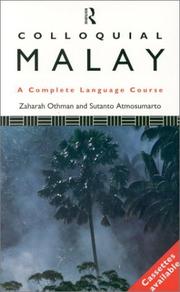
Colloquial Malay by Zaharah Othman is the course to lead with. Like the rest of the Colloquial series it is dialogue-first with audio, grammar notes, and exercises with a key, and it deliberately teaches the spoken register alongside the standard — which is the right emphasis, since the gap between the two is where beginners get stranded.
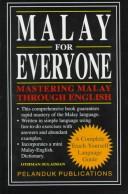
Malay for Everyone by Othman Sulaiman is a strong second pass rather than a redundancy. It is more systematically grammar-focused, with clear treatment of the affix system and plenty of pattern practice. Working one course for spoken confidence and a second for structural clarity is a better use of time than doing one course twice, and this pair divides the labour cleanly.
The dictionary, with a caveat
A Malay-english Dictionary by R. J. Wilkinson is a historic work and should be understood as such. Wilkinson compiled it in the colonial period, and it is a rich record of classical and early modern Malay vocabulary, including Jawi-script forms and literary usage you will not find in a modern pocket dictionary. That makes it valuable if you intend to read older texts. It is not the dictionary you want on your phone for everyday lookups — get a current Malaysian dictionary for that, and keep Wilkinson for depth and etymology.
Then understand the language politically
The last two books are academic works by Asmah Haji Omar, Malaysia's foremost linguist, and they are not learning materials — they are the explanation of why the language behaves as it does.
Concepts of conflict, war, and peace in the Malay language examines how a specific semantic domain is structured in Malay, which is a far better window into how the language carves up meaning than any vocabulary list. Language and society in Malaysia is the more broadly useful of the two: it covers the position of Malay as a national language alongside Chinese, Tamil, and English, the role of language policy in education, and the dialect and register variation across the country. If you plan to live or work in Malaysia, this book explains the situations you will actually be in — when Malay is expected, when English is, and what the choice signals.
Read in this order and you get a usable spoken language, a systematic grasp of affixation, and an understanding of where and how Malay is really used. Compare it with other language paths if you are choosing between them.
Follow the full ordered path here: Learning Malay and Indonesian: Books in Reading Order.
Ready to learn something deeply?
Build a reading path — free