Learn Incident Response: The Best Cybersecurity Books
This curriculum builds a rigorous, practitioner-grade mastery of incident response — starting from structured IR methodology and escalating through forensic analysis, threat hunting, and adversary emulation. Because the learner starts at an intermediate level, early stages sharpen process and tooling fundamentals before moving into the deep technical and strategic layers that separate competent responders from elite ones.
IR Methodology & Playbook Foundations
IntermediateInternalize the full incident response lifecycle (preparation, detection, containment, eradication, recovery, lessons learned) and understand how to build and execute structured playbooks.
▸ Study plan for this stage
Pace: 6–8 weeks, ~40–50 pages/day (mix of dense technical content and practical frameworks)
- The six phases of incident response: preparation, detection, containment, eradication, recovery, and lessons learned—and how each phase informs the others
- Network security monitoring (NSM) as the detection foundation: visibility, collection, and analysis of network traffic to identify intrusions
- Playbook design principles: standardized procedures, decision trees, escalation paths, and role assignments that enable consistent, rapid response
- Evidence preservation and chain of custody during incident response to maintain forensic integrity and support legal proceedings
- Containment strategies (segmentation, isolation, access controls) and their trade-offs between stopping spread and preserving evidence
- Root cause analysis and post-incident review processes that convert incidents into organizational learning and prevention improvements
- Tools and technologies for NSM (packet capture, IDS/IPS, log aggregation) and their integration into a cohesive monitoring architecture
- Incident classification, severity assessment, and communication protocols that align technical response with business impact and stakeholder needs
- Describe the six phases of incident response and explain how preparation directly enables effective detection and containment.
- What is network security monitoring (NSM) and why is it essential for the detection phase? How does NSM differ from traditional intrusion detection?
- What are the key components of an effective incident response playbook, and how should playbooks be structured to support rapid decision-making under pressure?
- Explain the tension between containment speed and forensic preservation. How would you design a containment strategy that balances both concerns?
- Walk through a post-incident review process: what artifacts should you collect, what questions should you ask, and how do you translate findings into preventive controls?
- How should incident severity be classified, and why is clear severity definition critical for playbook execution and stakeholder communication?
- Build a complete incident response playbook for a specific attack scenario (e.g., ransomware, data exfiltration, insider threat). Include detection triggers, containment steps, roles/responsibilities, communication templates, and recovery procedures.
- Design a network security monitoring architecture for a sample environment: identify what data sources you need (NetFlow, packet capture, logs), where to place sensors, and how to correlate signals for early detection.
- Conduct a tabletop exercise simulating a multi-phase incident: walk through preparation (pre-incident), detection (alert triage), containment (isolation decisions), eradication (threat removal), recovery (restoration), and lessons learned (post-mortem).
- Create an evidence handling and chain-of-custody procedure for your organization. Document what gets collected, who handles it, how it's stored, and how it's preserved for forensic analysis and legal review.
- Analyze a real-world incident case study (from the books or public sources): map the incident to the six IR phases, identify what went well and what failed, and propose playbook improvements.
- Develop a severity classification matrix for your environment that maps incident characteristics (scope, data sensitivity, business impact) to response urgency and escalation triggers.
Next up: This stage grounds you in the end-to-end IR lifecycle and playbook mechanics; the next stage will deepen your ability to execute each phase with advanced technical tools, threat intelligence, and real-time decision-making under adversarial conditions.

Establishes the detection-first mindset that underpins all effective IR work; teaches NSM principles so responders understand what data they have before an incident even begins.

The canonical end-to-end IR textbook — covers the full lifecycle with practical checklists and methodology, giving the learner a repeatable framework to anchor everything that follows.
Digital Forensics & Evidence Collection
IntermediateDevelop hands-on skills in host and memory forensics so you can accurately scope an incident, identify attacker artifacts, and preserve evidence for containment decisions.
▸ Study plan for this stage
Pace: 6–8 weeks, ~40–50 pages/day (with 2–3 days/week for hands-on labs)
- Memory acquisition techniques and volatility: understanding RAM capture methods (live acquisition, crash dumps, hibernation files) and why timing matters for evidence preservation
- Memory analysis frameworks: using Volatility to parse kernel structures, process trees, network connections, and malware artifacts from memory dumps
- Host forensics fundamentals: file system analysis, timeline reconstruction, artifact interpretation (MFT, journal logs, prefetch, registry hives) across Windows and Linux systems
- Evidence chain of custody and preservation: maintaining forensic integrity through hashing, write-blocking, and proper documentation during acquisition and analysis
- Attacker artifact identification: recognizing indicators of compromise in memory (injected code, hidden processes, rootkits) and on disk (suspicious binaries, lateral movement traces, persistence mechanisms)
- Open-source forensic tools ecosystem: hands-on proficiency with Volatility, Autopsy, The Sleuth Kit (TSK), and log2timeline for evidence collection and analysis
- Incident scoping through forensics: using memory and host artifacts to determine attack scope, affected systems, timeline of compromise, and containment priorities
- Evidence correlation: linking memory findings to disk artifacts and logs to build a coherent incident narrative for containment decisions
- What are the advantages and limitations of live memory acquisition versus crash dump analysis, and how do you choose between them during an incident?
- How would you use Volatility to identify a hidden process or injected code in a memory dump, and what kernel structures would you examine?
- Walk through the process of extracting and analyzing a Windows registry hive or MFT from a forensic image to identify persistence mechanisms or lateral movement.
- How do you maintain forensic integrity and chain of custody when collecting evidence from a live system, and what tools enforce write-blocking?
- Given a memory dump and disk image from a suspected compromised host, how would you correlate artifacts (e.g., process execution in memory with file creation on disk) to scope the incident?
- What are the key differences between analyzing Windows and Linux systems forensically, and what open-source tools are best suited for each?
- Acquire a memory dump from a Windows VM using Volatility's acquisition methods (or use a provided sample), then run imageinfo, pslist, and pstree to identify running processes and build a process tree.
- Analyze a memory dump for injected code or suspicious network connections using Volatility plugins (malfind, netscan, connscan) and document your findings.
- Perform a full disk forensic analysis on a Linux or Windows image using Autopsy and The Sleuth Kit: extract the file system, examine the MFT/inode table, and identify recently modified files.
- Build a timeline of events by correlating memory artifacts (process creation times) with disk artifacts (file modification times, registry timestamps) using log2timeline or manual analysis.
- Set up a write-blocked forensic workstation using a USB adapter or forensic bridge, acquire an image from a test drive, and document the chain of custody.
- Simulate an incident: inject a malicious process into a test VM, acquire memory and disk, then use Volatility and Autopsy to detect the artifact and scope the compromise.
Next up: This stage equips you with the forensic tools and techniques to detect and scope incidents at the host and memory level; the next stage will teach you how to escalate findings into containment and eradication strategies across your infrastructure.
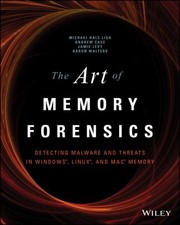
Memory is where attackers live; this is the definitive guide to volatile-memory analysis with Volatility, and must be read before tackling advanced threat hunting.

Grounds forensic technique in freely available tooling, reinforcing methodology over vendor lock-in and bridging the gap between theory and real-world triage.
Threat Hunting & Attacker Tradecraft
IntermediateShift from reactive response to proactive threat hunting — learning to model adversary behavior, build hypotheses, and find threats that evade automated detection.
▸ Study plan for this stage
Pace: 6–8 weeks, ~40–50 pages/day, with 2–3 days per week dedicated to hands-on lab work
- Network security monitoring (NSM) as a discipline: collection, detection, and analysis of network traffic to identify intrusions and anomalies
- The intelligence-driven incident response model: using threat intelligence and adversary TTPs to inform hunting hypotheses
- Attacker tradecraft and behavior patterns: understanding common attack chains, lateral movement techniques, and persistence mechanisms
- Hypothesis-driven threat hunting: formulating testable assumptions about adversary presence based on threat models and environmental baselines
- Data collection and normalization: building reliable data pipelines from network, endpoint, and log sources for consistent analysis
- Detection engineering and tuning: creating and refining detection rules to catch evasive threats while minimizing false positives
- Elastic Stack architecture and workflow: using Elasticsearch, Kibana, and related tools for large-scale log aggregation, search, and visualization
- Behavioral analytics and anomaly detection: identifying deviations from baseline activity to surface threats that bypass signature-based detection
- What are the three pillars of network security monitoring, and how do they differ from traditional IDS/IPS approaches?
- How do you formulate a threat hunting hypothesis, and what role does adversary tradecraft play in shaping it?
- Describe the intelligence-driven incident response (IDIR) model and explain how it shifts the focus from reactive to proactive security.
- What are the key components of an Elastic Stack deployment for threat hunting, and how do they interact to support hypothesis testing?
- How would you design a detection rule to catch a specific attacker behavior (e.g., lateral movement via SMB), and what metrics would you use to evaluate its effectiveness?
- What are common evasion techniques used by adversaries, and how can behavioral analysis help detect them when signatures fail?
- Read and annotate Part 1 of 'The Tao of Network Security Monitoring' (NSM fundamentals), then create a one-page summary of how NSM differs from traditional perimeter defense.
- Map out a threat model for your organization (or a hypothetical environment): identify 3–5 high-risk adversary TTPs relevant to your industry, then write 2–3 hunting hypotheses for each.
- Set up a basic Elastic Stack lab environment (Elasticsearch, Kibana, Beats) on a VM or cloud instance; ingest sample network and syslog data, and verify you can search and visualize it.
- Using 'Threat Hunting with Elastic Stack' as a guide, build 3–5 detection rules targeting specific attacker behaviors (e.g., suspicious process execution, unusual network connections); test them against sample data and document false positive rates.
- Conduct a simulated threat hunt: given a scenario (e.g., 'Find evidence of lateral movement in the past 7 days'), formulate a hypothesis, write Elasticsearch queries to test it, and document your findings in a brief report.
- Review a real-world incident report or MITRE ATT&CK case study; identify the attacker's TTPs, then design a set of detection rules and hunting queries that would have caught the attack earlier in the kill chain.
Next up: This stage equips you with the mindset and tools to hunt proactively for threats, preparing you to move into deeper specializations such as malware analysis, forensic investigation, or advanced threat intelligence integration, where you'll apply these hunting techniques to specific attack scenarios and adversary groups.

Deepens detection theory with a data-centric, analyst-driven approach; provides the conceptual vocabulary needed to hunt purposefully rather than alert-chase.

Translates hunting theory into concrete, repeatable queries and workflows using a widely deployed SIEM/analytics stack, bridging concept to daily practice.
Adversary Emulation & Red-Blue Integration
ExpertUnderstand attacker techniques at the depth needed to anticipate, detect, and contain sophisticated threats — including APTs — and integrate red-team intelligence into IR processes.
▸ Study plan for this stage
Pace: 6–8 weeks, ~40–50 pages/day with 2–3 days/week for hands-on labs and exercises
- Attacker reconnaissance and information gathering techniques (passive/active) and how to detect them in network traffic and logs
- Initial access vectors (phishing, watering holes, supply chain, exploits) and their forensic signatures
- Post-exploitation movement: lateral movement, privilege escalation, and persistence mechanisms used by APTs
- Command & control (C2) communication patterns, beaconing behavior, and evasion techniques (encryption, domain fronting, DNS tunneling)
- Data exfiltration methods and detection strategies (DNS exfil, HTTPS tunneling, steganography)
- Operator tradecraft: how professional attackers structure campaigns, maintain operational security, and adapt to defenses
- Red-team simulation design: translating attacker techniques into controlled exercises that test IR capabilities
- Integration of adversary emulation into IR playbooks: mapping MITRE ATT&CK techniques to detection rules and response procedures
- What are the primary reconnaissance techniques an attacker uses before launching an attack, and what artifacts would each leave in your logs and network telemetry?
- How would you design a red-team exercise based on a specific APT group's known TTPs (tactics, techniques, procedures) to test your IR team's detection and response capabilities?
- Describe the lifecycle of a typical APT campaign from initial access through data exfiltration, and identify 3–5 critical detection opportunities at each stage
- What are the differences between living-off-the-land attacks and tool-based attacks, and how should your detection strategy differ for each?
- How do you translate operator tradecraft and attacker evasion techniques into defensive controls and IR procedures that don't create alert fatigue?
- What role does adversary emulation play in validating your IR processes, and how do you measure the effectiveness of a red-blue exercise?
- Read through a real APT report (e.g., from Mandiant, CrowdStrike, or MITRE ATT&CK) and map each technique to chapters in The Hacker Playbook 3; document what artifacts each technique would generate
- Set up a lab environment (VirtualBox or cloud sandbox) and execute 3–4 attack chains from The Hacker Playbook 3 (e.g., phishing → reverse shell → lateral movement); capture all logs and network traffic, then analyze what a defender would see
- Design a red-team playbook for one specific scenario (e.g., 'Simulate a supply-chain compromise leading to C2 beaconing') using techniques from both books; include detection rules, response steps, and success/failure criteria
- Build a detection rule (Sigma, Yara, or Splunk SPL) for 2–3 post-exploitation techniques (e.g., Kerberoasting, DCSync, WMI lateral movement) described in the books; test it against your lab traffic
- Conduct a tabletop IR exercise with your team where you walk through an attack scenario step-by-step, using the Operator Handbook as a reference for realistic attacker behavior and decision points
- Document an operator profile: select one APT group, extract their known TTPs from public reports, cross-reference with The Hacker Playbook 3 chapters, and create a 1-page 'operator card' for your IR team
Next up: This stage equips you with the attacker's mindset and operational patterns, enabling the next stage to focus on building scalable, automated detection and response systems that can handle the sophistication and speed of real adversaries.

Adopts the attacker's perspective on red-team TTPs mapped to MITRE ATT&CK, giving IR practitioners the adversary intuition needed to write better detections and containment plans.

A dense, field-reference compendium of attacker and defender commands across platforms; read last in this stage as a consolidating reference that ties together all prior attacker knowledge.
Enterprise IR Leadership & Resilience
ExpertOperate and lead IR at organizational scale — designing programs, managing major incidents under pressure, communicating with executives, and building durable resilience.
▸ Study plan for this stage
Pace: 4–5 weeks, ~40–50 pages/day, with 2–3 days per week reserved for hands-on playbook drafting and team workshops
- Playbook-driven IR: designing repeatable, documented processes that scale across teams and reduce decision latency during incidents
- Organizational alignment: mapping IR playbooks to business objectives, risk appetite, and stakeholder communication needs
- Incident classification and severity frameworks: establishing clear criteria for triage, escalation, and resource allocation
- Cross-functional coordination: structuring roles, responsibilities, and handoffs between security, ops, legal, communications, and executive leadership
- Playbook automation and tooling: embedding detection, response, and containment logic into SOAR platforms and orchestration workflows
- Resilience through preparation: using tabletop exercises, runbooks, and post-incident reviews to harden IR capabilities and organizational muscle memory
- Executive communication and decision-making: translating technical incident data into business impact narratives and risk-informed recommendations
- Continuous improvement: establishing metrics, feedback loops, and iterative playbook refinement based on real incidents and simulations
- What are the core components of an effective IR playbook, and how does each component reduce response time and human error?
- How do you design incident classification and severity frameworks that align with your organization's risk tolerance and business continuity priorities?
- What role do cross-functional playbooks play in coordinating between security, legal, communications, and executive teams during a major incident?
- How can you embed automation and tooling into playbooks to enable faster detection, containment, and recovery without sacrificing human judgment?
- What metrics and feedback mechanisms should you establish to measure playbook effectiveness and drive continuous improvement?
- How do you communicate incident status, business impact, and remediation progress to non-technical executives and board-level stakeholders?
- Audit your current IR processes: map existing incident response workflows, identify gaps, bottlenecks, and decision points where a playbook could reduce latency
- Draft a playbook for a critical incident type (e.g., ransomware, data exfiltration, supply chain compromise): define detection triggers, escalation criteria, roles, and communication templates
- Design an incident classification matrix: establish severity levels (critical, high, medium, low) with clear criteria tied to business impact, data sensitivity, and recovery time objectives
- Create a cross-functional playbook: document handoffs and communication protocols between security, legal, PR, and executive teams for a major incident scenario
- Build or enhance a SOAR/automation runbook: identify 3–5 manual IR tasks that can be automated (e.g., evidence collection, containment actions, notification workflows) and prototype the logic
- Conduct a tabletop exercise: simulate a realistic incident scenario using your playbooks; measure response time, identify gaps, and refine playbooks based on lessons learned
Next up: This stage equips you to design and operationalize IR at scale; the next stage will deepen your ability to lead through complex, multi-stage incidents and evolve your IR program in response to emerging threats and organizational change.

Closes the curriculum by teaching how to institutionalize everything learned — building detection logic, playbooks, and metrics that make IR repeatable and continuously improving.
Discussion
Keep reading
Paths that share books, cover the same subject, or open a related topic.