Gnosticism: The Best Books to Read, in Order
This curriculum takes an intermediate learner on a focused journey from the historical and textual foundations of Gnosticism, through the primary sources themselves, into the theological controversies they sparked, and finally into advanced scholarly interpretation of Gnostic cosmology and secret knowledge traditions. Each stage builds the conceptual vocabulary and historical context needed to make the next stage fully intelligible.
Orienting the Landscape
IntermediateGain a reliable historical and conceptual map of Gnosticism — who the Gnostics were, what they believed, and why their texts matter — before touching the primary sources.
▸ Study plan for this stage
Pace: 6–8 weeks, ~40–50 pages/day. Start with Pagels (approx. 150 pages, 3–4 weeks), then move to Rudolph (approx. 300+ pages, 4–5 weeks). Allocate 1 week for review, synthesis, and exercises.
- The historical context of Gnosticism: emergence in the 2nd century CE, relationship to early Christianity and Greco-Roman philosophy
- Core Gnostic cosmology: the demiurge, the pleroma, and the material world as fundamentally flawed or evil
- The role of gnosis (knowledge) as salvific: direct, experiential knowledge of the divine as the path to liberation
- The Gnostic reinterpretation of biblical figures and texts: how Gnostics read the Old Testament, Jesus, and the resurrection differently than orthodox Christianity
- The discovery and significance of the Nag Hammadi library: how these texts were lost, found, and what they reveal about Gnostic diversity
- Major Gnostic schools and figures: Valentinus, Basilides, and other key teachers and their theological variations
- The orthodox Christian response: how and why the Church condemned Gnosticism as heresy, and the role of texts like Irenaeus's *Against Heresies*
- Gnosticism as a religious phenomenon: its appeal, social organization, and relationship to asceticism and ethics
- What is gnosis, and why did Gnostics believe it was essential for salvation? How does this differ from orthodox Christian views of faith and grace?
- Who was the demiurge in Gnostic thought, and how did Gnostics reinterpret the God of the Old Testament?
- What were the major Gnostic schools (e.g., Valentinianism, Basilideanism), and what distinguished their teachings from one another?
- Why did the early Church condemn Gnosticism as heresy? What were the key theological and institutional conflicts?
- How did the discovery of the Nag Hammadi library change our understanding of Gnosticism, and what do these texts reveal about Gnostic diversity and practice?
- How did Gnostics reinterpret Jesus, the resurrection, and the role of the material body compared to orthodox Christianity?
- Create a visual timeline (poster or digital) mapping the emergence of Gnosticism (2nd century), key figures (Valentinus, Basilides), the Nag Hammadi discovery (1945), and the orthodox response. Use both Pagels and Rudolph as sources.
- Construct a cosmological diagram showing the Gnostic pleroma, the demiurge, and the material world. Label key entities and explain the relationship between them using specific examples from the texts.
- Compare and contrast: Write a 2–3 page essay comparing how Gnostics and orthodox Christians understood Jesus, the resurrection, and salvation. Ground your argument in specific passages from Pagels and Rudolph.
- Create a 'Gnostic schools comparison chart' listing Valentinus, Basilides, and other major teachers, their key doctrines, and their differences. Use Rudolph's systematic treatment as your primary source.
- Annotate a passage from the Nag Hammadi texts (e.g., the *Apocryphon of John* or *Gospel of Thomas*, as discussed in Pagels) explaining how it reflects Gnostic cosmology and soteriology.
- Write a 1–2 page reflection: 'Why did the Church fear Gnosticism?' Use Pagels's analysis of the institutional and theological stakes to support your answer.
Next up: This stage equips you with a solid conceptual and historical foundation—the "who, what, and why" of Gnosticism—so you can now engage directly with primary Gnostic texts with confidence, understanding their theological stakes, cosmological assumptions, and historical context.
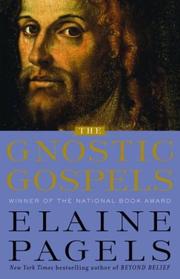
The single best entry point for an intermediate reader: Pagels unpacks the Nag Hammadi discovery and its challenge to orthodox Christianity in clear, compelling prose, establishing the key themes (secret knowledge, divine spark, feminine divine) you will encounter everywhere else.
The definitive scholarly overview of Gnostic religion across all its major schools and texts; reading it second gives you the taxonomic framework — Sethian, Valentinian, Mandaean, Manichaean — that organizes everything that follows.
The Primary Sources: Nag Hammadi
IntermediateRead the actual Gnostic scriptures in reliable translation, developing direct familiarity with their mythological language, literary forms, and theological claims.
▸ Study plan for this stage
Pace: 8–10 weeks, ~40–50 pages/day (with annotation time). Begin with Meyer's introduction and selections from the Nag Hammadi Scriptures (weeks 1–6), then transition to the complete Gospel of Thomas (weeks 7–10).
- The Nag Hammadi library as a historical artifact: its discovery, contents, and significance for understanding Gnostic diversity
- Mythological cosmology in Gnostic texts: the pleroma, aeons, the demiurge, and the nature of creation as flawed or malevolent
- Sophia and the fall: how divine wisdom becomes fragmented and trapped in matter, and its role in generating the material world
- The Gnostic redeemer figure: Christ/Jesus as revealer of hidden knowledge (gnosis) rather than savior through sacrifice
- Dualism in Gnostic thought: the opposition between spirit/light and matter/darkness, and the human soul's entrapment in the body
- Sayings and aphorisms as literary form: how the Gospel of Thomas uses sparse, enigmatic teachings to convey esoteric meaning
- Textual interpretation strategies: recognizing layers of meaning, symbolic language, and the role of interpretation itself in Gnostic texts
- Gnostic anthropology: the divine spark within humans, the distinction between pneumatics (spiritual), psychics (soulish), and hylics (material)
- What is the Nag Hammadi library, and why is its discovery significant for understanding Gnosticism?
- Describe the Gnostic cosmology: what is the pleroma, and how does the demiurge relate to creation?
- How does the figure of Sophia function in Gnostic mythology, and what is the significance of her fall?
- What is gnosis in the Gnostic texts, and how does the redeemer figure (Christ) function differently than in orthodox Christianity?
- Explain the dualistic worldview in Gnostic thought: how do spirit and matter relate, and what is the human condition?
- What is distinctive about the Gospel of Thomas as a literary form, and how do its sayings differ from the canonical gospels?
- Create a visual map of the Gnostic pleroma and cosmology based on Meyer's introduction and selections from the Nag Hammadi Scriptures, labeling key aeons and the role of the demiurge.
- Select 5–7 passages from the Nag Hammadi Scriptures that illustrate the fall of Sophia; annotate each with notes on symbolic language and theological implications.
- Write a 2–3 page comparative analysis: choose one saying from the Gospel of Thomas and compare its meaning to a parallel saying in a canonical gospel (Matthew, Mark, Luke), noting what the Thomas version emphasizes differently.
- Compile a glossary of Gnostic terms as you read (pleroma, aeon, demiurge, pneuma, psyche, hyle, gnosis, etc.), with definitions drawn directly from Meyer's translations and commentary.
- Read Meyer's introduction to the Gospel of Thomas carefully, then write a short essay (3–4 pages) on why this text was excluded from the New Testament canon and what its inclusion would mean for Christian theology.
- Practice close reading: select one complex passage from the Nag Hammadi Scriptures or Gospel of Thomas, and write out 2–3 different interpretations of its meaning, explaining how Gnostic dualism shapes each reading.
Next up: This stage grounds you in the actual language, imagery, and theological claims of Gnostic texts themselves, preparing you to engage critically with scholarly debates about their origins, influences, and relationship to early Christianity in subsequent stages.

The most accessible modern scholarly translation of the complete Nag Hammadi library with introductions to each text; start here so you encounter the myths in readable English with just enough annotation to follow them.
Reading the Gospel of Thomas as a standalone volume with Meyer's focused commentary lets you slow down on the most studied and debated Gnostic gospel before moving to more esoteric texts like the Gospel of Philip or the Secret Book of John.
The Heresiologists: Orthodox Responses
IntermediateUnderstand how early Church Fathers defined and attacked Gnosticism as heresy, which in turn reveals how Gnostic ideas were understood by their opponents and why they were suppressed.
▸ Study plan for this stage
Pace: 6–8 weeks, ~40–50 pages/day. Start with Irenaeus's *Against the Heresies* (weeks 1–4, focusing on Books I–II), then transition to Ehrman's *Lost Christianities* (weeks 5–8). Allocate 1–2 days per week for review and synthesis.
- Irenaeus's polemic strategy: how he uses genealogy, apostolic succession, and scriptural interpretation to delegitimize Gnostic systems
- The Gnostic cosmology as described by Irenaeus: the demiurge, pleroma, emanations, and the material world as fallen creation
- Irenaeus's doctrine of recapitulation (anakephalaiosis) as the orthodox counter-narrative to Gnostic soteriology
- Ehrman's historical framework: how diverse early Christianities competed for authority before 'orthodoxy' solidified
- The role of textual authority: how Irenaeus weaponizes the four-Gospel canon and apostolic tradition against Gnostic scriptural claims
- Gnostic Christology as interpreted by heresiologists: docetism, the separation of Christ from Jesus, and rejection of bodily resurrection
- The political and social dimensions of heresy-making: how orthodoxy was constructed through exclusion and institutional power
- Irenaeus's anthropology and soteriology: the material body as redeemable, versus Gnostic dualism and the trapped divine spark
- What are the main cosmological claims Irenaeus attributes to Gnostic systems, and how does he use them to attack Gnostic theology?
- How does Irenaeus's doctrine of recapitulation function as a theological response to Gnostic dualism and their understanding of creation?
- What role does apostolic succession and the four-Gospel canon play in Irenaeus's strategy to establish orthodox authority against Gnostic claims?
- According to Ehrman, how did early Christian diversity exist before the emergence of 'orthodoxy,' and what factors led to the suppression of alternative Christianities?
- What are the key differences between Gnostic and orthodox Christology as presented in these texts, particularly regarding the nature of Christ's body and resurrection?
- How do Irenaeus and Ehrman (implicitly) reveal that 'heresy' was a constructed category rather than a self-evident deviation from original Christianity?
- Create a detailed chart mapping the Gnostic cosmology (pleroma, aeons, demiurge, material world) as Irenaeus describes it in *Against the Heresies* Book I, then annotate it with Irenaeus's critiques of each element
- Write a 2–3 page comparative analysis of how Irenaeus and Ehrman each explain why Gnosticism was deemed heretical—what does each author emphasize, and where do their explanations diverge?
- Select one Gnostic text or system that Irenaeus critiques (e.g., the Valentinian system) and reconstruct both Irenaeus's account and Ehrman's historical context for it; identify what Irenaeus omits or distorts
- Trace the argument for apostolic succession through Irenaeus's *Against the Heresies* Book III; outline how this argument functions as a rhetorical weapon and assess its logical strength
- Compile a glossary of key Gnostic and orthodox theological terms as used in both texts (e.g., pleroma, demiurge, recapitulation, docetism), noting how definitions shift between Irenaeus's polemical framing and Ehrman's historical reconstruction
- Write a dialogue or debate between an imagined Gnostic teacher and Irenaeus on a specific theological point (e.g., the nature of creation, Christ's body, salvation), using direct quotes and paraphrases from the texts to ground both positions
Next up: This stage equips you with the heresiological lens—understanding Gnosticism through its opponents' eyes—which is essential before encountering primary Gnostic texts themselves, where you can now read them critically, aware of both what the heresiologists preserved and what they distorted.
Irenaeus's 2nd-century refutation is the most important heresiological source and preserves detailed summaries of Valentinian and other Gnostic systems; reading it now, after the primary texts, lets you evaluate his characterizations critically.
Ehrman surveys the full spectrum of early Christian diversity — Gnostic, Marcionite, Ebionite — and explains how orthodoxy won out, giving essential historical context for why the Nag Hammadi texts were buried and forgotten.
Deeper Theology: Cosmology and Secret Knowledge
ExpertEngage with the sophisticated theological and philosophical systems at the heart of Gnosticism — the Demiurge, the Pleroma, Sophia, and the mechanics of salvific gnosis.
▸ Study plan for this stage
Pace: 8–10 weeks, ~40–50 pages/day (Jonas first: 4–5 weeks; Churton second: 4–5 weeks). Allocate 2–3 days per major section for reflection and note-taking.
- The Demiurge as a flawed or malevolent creator-god distinct from the transcendent true God, and the cosmological implications of this dualism
- The Pleroma as the fullness of divine being and the hierarchical emanation of aeons within it
- Sophia (Wisdom) as a fallen aeon whose error or passion generates the material cosmos and the Demiurge
- Gnosis as salvific knowledge that reveals the true nature of the self, the cosmos, and the path to liberation from material existence
- The mechanics of salvation: how divine sparks trapped in matter are awakened and redeemed through gnosis
- The distinction between the material world (created by the Demiurge) and the spiritual realm (the domain of the true God)
- The role of the Savior figure (often identified with Christ in Christian Gnosticism) as the revealer of gnosis
- How Jonas and Churton differ in their philosophical frameworks and interpretations of Gnostic metaphysics
- What is the Demiurge in Gnostic cosmology, and how does its nature differ fundamentally from the true God?
- Explain the concept of the Pleroma and describe the emanation of aeons. How does this structure relate to the creation of the material world?
- What role does Sophia play in Gnostic mythology, and how does her fall or error lead to the emergence of the Demiurge and the cosmos?
- Define gnosis in the Gnostic system. How is it understood as salvific, and what does it reveal about the human condition?
- How do divine sparks become trapped in matter, and what is the mechanism by which gnosis liberates them?
- Compare Jonas's phenomenological and existential approach to Gnosticism with Churton's philosophical and historical methodology. Where do they converge and diverge?
- Create a detailed cosmological diagram mapping the Pleroma, the aeons, Sophia's fall, the Demiurge, and the material world. Use Jonas's descriptions to ground it, then refine it with Churton's insights.
- Write a 1,500–2,000 word essay comparing Jonas's existential reading of the Demiurge (as expressing alienation and anti-cosmic rebellion) with Churton's more systematic philosophical treatment.
- Construct a glossary of 15–20 key Gnostic terms (Pleroma, aeon, Sophia, Demiurge, gnosis, hylic, psychic, pneumatic, etc.) with definitions drawn directly from both texts.
- Trace the concept of gnosis through both books: identify how Jonas emphasizes its existential dimension while Churton emphasizes its philosophical content. Write a synthesis document.
- Select one major Gnostic system (e.g., Valentinianism, Sethian Gnosticism) discussed in both books and write a 1,000-word analysis of how each author explains its cosmology and soteriology.
- Create a comparative table analyzing how Jonas and Churton each explain the mechanics of salvation: the role of the Savior, the awakening of the divine spark, and the path to liberation.
Next up: This stage equips you with the sophisticated theological and philosophical architecture of Gnosticism—the cosmological systems, the metaphysics of divinity and matter, and the theory of salvific knowledge—preparing you to examine how these ideas were expressed in actual Gnostic texts, communities, and historical contexts in the next stage.
Jonas's philosophical masterwork remains the deepest analysis of Gnostic existential thought — alienation, the alien God, the imprisoned divine spark — and connects Gnosticism to Neoplatonism and existentialism; essential for serious understanding.
Churton traces the lineage of Gnostic ideas from antiquity through the Renaissance Hermeticists and into modernity, showing how the tradition of secret knowledge persisted and transformed across centuries.
Discussion
Keep reading
Paths that share books, cover the same subject, or open a related topic.