Family Therapy: The Best Books on Systemic Practice, in Order
Family therapy made one move that changed what a symptom is: it stopped treating the person who is suffering as the patient and started treating them as the family's identified patient — the member carrying something the whole system is doing. A daughter's eating disorder becomes information about how a household handles conflict; a son's delinquency becomes a way of keeping two parents talking. That reframe came out of cybernetics rather than psychology, which is why the founding literature reads like communication theory and why the different schools disagree so sharply about what to do next. This path opens with two books that show the work rather than describe it, takes the survey texts that map the schools, goes back to the cybernetic roots, then reads the four founding traditions in their own words, and finishes with the tools and the later turns. It covers the model and its history; it is not a treatment plan.
Watch It Happen First
BeginnerSee a family in the room, over months, before reading any theory. After this stage you should be able to explain the identified-patient idea to someone else without using the word system.
▸ Study plan for this stage
Pace: About three weeks. The Family Crucible is 301 pages of continuous narrative and reads at the speed of a novel, so a week is comfortable. The New Peoplemaking runs 400 pages but is written for families rather than clinicians, in short chapters you can put down, so give it two. Napier and Whitaker's b
- The identified patient. In The Family Crucible the family arrives about Claudia, the sixteen-year-old, and the therapy is only usable once the Brices can hear that Claudia is carrying something the household is doing.
- The whole-family requirement. Whitaker refuses to start until every member attends, including the eleven-year-old the parents think is irrelevant, and the refusal is itself an intervention rather than a scheduling preference.
- Co-therapy. Two therapists in the room let one enter the family's emotional field while the other stays outside it, and the book is written by the junior of the pair about the senior.
- The migration of the problem. Trace where the focus moves across the sessions: from the daughter, to the parents' marriage, to Carolyn's isolation and David's absence, to the grandparents.
- Satir's four incongruent communication stances, placating, blaming, super-reasonable and irrelevant, against the fifth, congruent, and the physical postures she assigns to each.
- Self-worth as the thing being defended. Satir's whole model reads symptoms as protection of a low sense of worth, which is a different first cause from anything Whitaker proposes.
- Family rules nobody states, and Satir's distinction between rules a family can discuss and rules it cannot acknowledge having.
- Two founding temperaments. Whitaker is deliberately provocative and works by unbalancing; Satir is warm and works by making people feel safe enough to speak. Both are foundational, and the survey texts in the next stage will flatten this difference.
- Can you explain the identified-patient idea to a non-clinician in 150 words without using the word system?
- At what point in The Family Crucible does the therapy visibly stop being about Claudia, and what do Napier and Whitaker actually do in the session where it turns?
- Why does Whitaker refuse to begin when a family member is missing, and what does he say is at stake in that refusal?
- Name Satir's four incongruent stances and, for each, the situation in a family it is protecting the speaker from.
- Where would Satir and Whitaker disagree about how a therapist should behave in the first session, and what does each think the warmth or the provocation is for?
- Keep a running session log as you read The Family Crucible: for each session note who spoke most, which family member the therapists pushed, and what had changed by the end. Reading your own log afterwards makes the structure of the case visible in a way the continuous prose does not.
- Go back through the Brices with Satir's stance list in hand and assign a stance to each of Carolyn, David, Claudia and Don, citing the exchange that fits. Note the places where a person switches stance and what triggered it.
- Napier writes the book and Whitaker is the senior therapist, so every judgement about Whitaker comes from someone who trained under him. Mark three passages where Napier reports his own uncertainty, and three where he narrates Whitaker's confidence, and decide what the account would look like written the other way round.
- Write the identified-patient explanation from the first question out in full and read it to someone who has no clinical background. Rewrite it wherever they ask what you mean.
Next up: You have now watched two of the field's founders work, and formed a picture of what family therapy looks like from inside the room, which is exactly the concrete grounding the survey texts assume and do not supply.
Napier and Carl Whitaker's blow-by-blow account of one family's therapy, and the standard entry point to the whole field — still the book most training programmes assign first. It shows the co-therapy, the refusal to start until everyone attends, and the moment the presenting problem turns out to belong to the marriage rather than the teenager.

Satir's popular book, written for families rather than clinicians, and the warmest thing in the literature: self-worth, communication stances and the family rules nobody states. Read it second as the humanistic counterweight — the field's other founding temperament, before the theory in the next stage flattens the differences.
The Map of the Schools
IntermediateLearn that family therapy is not one method but half a dozen incompatible ones, and get the vocabulary — boundaries, triangles, circular questioning, homeostasis, double bind — that the primary texts use without defining.
▸ Study plan for this stage
Pace: Four to five weeks, and read the two side by side rather than one after the other. Nichols is 601 pages of textbook prose and is the one to work through chapter by chapter, roughly a school per sitting. The Goldenbergs' Family Therapy: An Overview is the reference volume; read its history and theory
- The vocabulary the primary texts use without defining: boundaries, subsystems, triangles, homeostasis, circular versus linear causality, first- and second-order change, circular questioning, the double bind.
- That family therapy is not one method. Structural, strategic, Bowenian, experiential, Milan systemic, behavioural and narrative are separate traditions with incompatible accounts of what a symptom is and what should be done about it.
- How each school answers the same three questions: what causes the problem, what does the therapist do, and how do you know the therapy worked.
- The evidence position of each model. The Goldenbergs report the outcome research alongside each approach, and it is uneven across the schools in ways their founding texts never acknowledge.
- Where the two surveys disagree. Nichols is more willing to say a model has not held up; the Goldenbergs are broader and more even-handed. The disagreements between them are the most informative thing in this stage.
- The historical sequence: the Palo Alto cybernetics group, the founding schools of the 1960s and 1970s, the feminist and multicultural critiques, and the postmodern turn of the late 1980s.
- Where you already are. You have read Whitaker and Satir; find each of them placed in the taxonomy and check whether the textbook description matches what you actually watched.
- For structural, strategic, Bowenian and Milan systemic therapy, can you state in one sentence each what causes the presenting symptom and what the therapist does first?
- Which of the models covered do Nichols and the Goldenbergs treat differently, and on what grounds does each judge it?
- What does homeostasis mean in this literature, and what does it imply about why a family resists change it says it wants?
- How does Nichols describe the experiential tradition Whitaker and Satir belong to, and does that description match what you saw in the two books you have read?
- Which of these schools has the strongest outcome evidence behind it as the surveys report it, and which has the weakest?
- Build a one-page comparison table from Nichols with a row per school and columns for founder, unit of attention, view of the symptom, the therapist's stance, and the signature technique. Fill it in from Nichols, then go to the Goldenbergs and add a column for what the outcome evidence says.
- Take the Brice family from The Family Crucible and write, in a paragraph each, what a structural therapist, a strategic therapist and a Bowenian therapist would have done differently in the first three sessions. Use Nichols's descriptions of the techniques, not your own invention.
- Find three terms you have now met in both surveys and write down each book's definition side by side. Where the wording differs, decide whether it is the same idea phrased differently or a real disagreement.
- Locate the point in each survey where the authors say a school has not survived scrutiny, and note whether the other book says the same. Keep the list; you will read the primary texts of some of these schools in stage four.
Next up: With the taxonomy and the vocabulary in place you can now go back to the source and read the cybernetic material the founding schools were all built on, which the surveys summarise in a paragraph and which the primary texts assume in full.

The Goldenbergs' survey, and the broadest single map: history, theory and each major model, with the research evidence for each. Read it first here — it is the reference you will keep returning to as the founders in stage four contradict one another.
The other standard survey, and the better-written one: Nichols is sharper on what each school actually does in session and more willing to say where a model has not held up. Read both — the disagreements between the two surveys are themselves informative.
The Cybernetic Roots
IntermediateGo back to the source. Family therapy came out of the Palo Alto group's work on communication and feedback, and the founding schools are unreadable at depth without it.
▸ Study plan for this stage
Pace: Three to four weeks. Read Pragmatics of Human Communication straight through first if you prefer the clinically usable version early; it is 296 pages, tightly written, and readable in about ten days. Steps to an Ecology of Mind is 541 pages of collected essays across anthropology, evolution and psyc
- Feedback and circular causality. The move that makes family therapy possible is the replacement of a cause-and-effect chain with a loop in which each party's behaviour is a response to the other's.
- The double bind as Bateson states it: a contradiction between levels of message, in a relationship that cannot be left, where the contradiction cannot be commented on. All three conditions matter, and the popular use of the term drops the last two.
- Logical types and levels of message. Bateson's distinction between a message and a message about a message is the machinery underneath the double bind and underneath reframing.
- The Palo Alto axioms in Watzlawick, Beavin and Jackson: one cannot not communicate; every message carries a content and a relationship aspect; punctuation of a sequence is arbitrary and disputed; symmetrical and complementary interaction.
- Symmetrical escalation and complementary rigidity as the two ways a relationship pattern runs away with itself.
- First-order versus second-order change: change within the rules of a system versus change of the rules. This is the concept the strategic tradition in the next stage is built on.
- That the double bind was originally a hypothesis about schizophrenia and has not held up as an aetiology of it. Bateson's framework survived; the specific clinical claim did not, and the surveys in the last stage say so.
- State the double bind in Bateson's own terms, with all of its conditions, and explain why a merely contradictory instruction is not one.
- What does it mean to say that one cannot not communicate, and what does Watzlawick argue follows from it for a family member who refuses to speak?
- Explain the punctuation axiom using the nagging-and-withdrawing sequence Watzlawick uses, and say why the disagreement about who started it cannot be settled from inside.
- What is the difference between first-order and second-order change, and which one does a family usually arrive asking for?
- Which parts of the double-bind hypothesis did the field keep, and which did it abandon?
- Read the double-bind papers in Steps to an Ecology of Mind and then write out the definition as a numbered list of conditions. Test it against three ordinary situations of your own and discard the ones that fail a condition. Most will.
- Take Watzlawick's five axioms and, for each, find the corresponding moment in The Family Crucible where it is visibly operating. Where you cannot find one, say whether the axiom is unobservable or simply absent from that case.
- Diagram one escalating exchange from Pragmatics as a loop rather than a line, marking where each party believes the sequence began. Then do the same for an exchange from The New Peoplemaking.
- Compare Watzlawick's chapter on paradoxical communication with Bateson's original essays and note precisely what Watzlawick added to make the theory usable in a session. That addition is the whole strategic tradition in embryo.
Next up: The founding schools you are about to read in their own words each take the cybernetic material as given and build a different clinical practice on it, so the disagreements ahead are disagreements about what to do with these ideas rather than about the ideas themselves.
The intellectual origin of the whole field: Bateson's essays on feedback, learning, and the double bind — the hypothesis that a schizophrenic symptom could be a coherent response to contradictory demands. Difficult, and read selectively; the double-bind papers are the ones that matter here.

Watzlawick, Beavin and Jackson turning Bateson into something clinically usable — one cannot not communicate, content versus relationship, symmetrical versus complementary escalation. Read it directly after Bateson: it is the bridge from theory to the interventions in the next stage.
The Founding Schools, in Their Own Words
IntermediateRead the primary texts of the traditions that still define practice — structural, strategic and Milan systemic — and compare how differently each one would handle the same family.
▸ Study plan for this stage
Pace: Six to eight weeks for the four. Families and Family Therapy is 268 pages and Family Therapy Techniques 303, and the pair should be read back to back over about three weeks since the second is the operational manual for the first. Uncommon Therapy is 314 pages of Erickson case reports and reads quic
- Minuchin's structural vocabulary: subsystems, boundaries on a scale from disengaged to enmeshed, hierarchy, alliances and coalitions, and the family map drawn as a diagram.
- Joining and accommodation, then unbalancing. The structural therapist deliberately enters the family's system in order to have the leverage to disturb it, which is not the same as being neutral.
- The specific manoeuvres in Family Therapy Techniques: enactment, boundary making, intensity, unbalancing, reframing, complementarity. Each is defined and then shown in transcript.
- The psychosomatic family. Minuchin's claim, developed with children with diabetes and anorexia, that certain family structures maintain physical symptoms, and the evidence position of that claim today.
- Haley's strategic stance: the therapist is responsible for solving the presented problem, uses directives given between sessions, and does not require the family to understand anything.
- The family life cycle in Uncommon Therapy. Haley organises Erickson's cases around transitions, courtship, childbirth, children leaving, and reads symptoms as a stuck transition.
- The Milan interventions: positive connotation of the symptom, the counterparadox, and the ritual prescribed to the whole family, delivered by a team behind a screen rather than by the therapist alone.
- Where they contradict each other. Minuchin wants the structure changed and understood; Haley wants the symptom gone and is indifferent to insight; the Milan team wants the family's own paradox turned back on it.
- Draw the structural map Minuchin would draw for the Brice family and justify each boundary you mark from evidence in The Family Crucible.
- What is an enactment, how does Minuchin set one up in Family Therapy Techniques, and why does he prefer it to asking the family to describe what happens at home?
- Haley is writing about Erickson rather than reporting his own cases. What does that do to the evidential status of Uncommon Therapy, and how would you check any claim in it?
- What is positive connotation, what is it for, and why does the Milan team connote the symptom rather than the person?
- Take one family from any of these four books and say concretely what the other three approaches would have done with it in the first two sessions.
- Which of these four books is trying to teach a reproducible technique and which is trying to describe a way of thinking? Cite the structure of each book, not its claims.
- Work through the transcripts in Family Therapy Techniques with the manoeuvre list beside you and label each therapist turn with the technique it belongs to. Where a turn fits two labels or none, write down which and why, because those are the places the model is being applied rather than followed.
- Take one case from Uncommon Therapy and rewrite the intervention as Minuchin would have staged it, using only the manoeuvres Minuchin actually names. The rewrite usually fails at a specific point, and that point is the real difference between the two schools.
- Write out the Milan team's positive connotation for two cases in Paradox and Counterparadox in your own words, then attempt a third for a case from a different book on this path. Compare yours with the team's wording and note how much of the effect is carried by the exact phrasing.
- Read Families and Family Therapy and Family Therapy Techniques in that order and list every claim the earlier book makes about family structure that the later book turns into a specific therapist action. The claims left over are theory Minuchin never operationalised.
- Keep a running list of every place these four authors contradict one another on the same point, with the page in each. You will use it against the multicultural and narrative critiques in the final stage.
Next up: Having read the founders arguing with each other, you are in a position to read the two things that came next, the mapping tool the whole profession adopted regardless of school, and the critiques that ask whose norms the founders were measuring families against.
The founding text of structural family therapy and the most influential single book in the field: subsystems, boundaries, enmeshment and disengagement, and the therapist joining the family in order to unbalance it. Read it first — structural thinking is the default language of the profession.
Minuchin and Charles Fishman's practical follow-up, and deliberately read second: it takes the structural model apart into specific manoeuvres — enactment, boundary making, intensity, reframing — with transcripts. This is where the theory becomes something a trainee can attempt.
Haley's account of Milton Erickson's work, and the origin of the strategic tradition: brief, directive, symptom-focused, organised around family life-cycle transitions. Read it after Minuchin for the sharpest contrast in the field — Haley wants the problem solved, not the structure understood.

The Milan team's book, and the strangest thing in this path: positive connotation, the therapeutic paradox, and the ritual prescription, developed with families where nothing else worked. Read it last in this stage, once you can see what tradition it is reacting against.
The Tools and the Later Turns
IntermediatePick up the instrument the whole profession actually uses day to day, then follow the field past its founders — into multigenerational theory, culture, and the narrative move that questioned systems thinking itself.
▸ Study plan for this stage
Pace: Six to seven weeks, but the page counts are misleading. Genograms is 326 pages and part of it is worked examples you draw rather than read. Family Evaluation is 400 pages of dense theory and is the slowest thing here after Bateson. Ethnicity and Family Therapy is 796 pages and is a reference handboo
- Genogram notation as a shared professional standard: the symbols, three generations minimum, and the difference between the structural facts and the relationship lines drawn over them.
- Bowen's core concepts as Kerr states them: differentiation of self, the triangle as the smallest stable relationship unit, emotional cutoff, the family projection process, and multigenerational transmission.
- Why the genogram and Bowen theory belong together. The tool was built to display exactly the multigenerational patterns Bowen theory claims to matter, which is also its limitation as a neutral instrument.
- The cultural critique in McGoldrick's Ethnicity and Family Therapy: enmeshment, appropriate distance, deference to elders and expression of emotion are all judged against a norm, and the founding texts rarely say whose.
- That a structural reading can be a reading of the therapist. The book asks the clinician to locate their own family norms before applying the words from stage four to anyone else.
- White and Epston's externalising move: the problem is separated from the person in the language used, and the work becomes finding the events the problem-saturated story cannot account for.
- Unique outcomes, re-authoring, and the therapeutic letter as a written record given to the family, which is a different account of what the therapy consists of.
- The break with systems thinking. Narrative therapy denies that the family is a system maintaining a symptom, which is the premise every earlier book on this path shares. Reading it last is what makes that visible.
- Can you draw a standard three-generation genogram from a case description, using the correct notation for structure, and then add relationship lines without confusing the two layers?
- What does differentiation of self mean in Kerr and Bowen, and how is it different from independence or emotional distance?
- How does a triangle stabilise a two-person relationship, and what does Bowen theory predict happens to a triangle under stress?
- Take three judgements from the founding texts in stage four, one from Minuchin, one from Haley and one from the Milan team, and say what Ethnicity and Family Therapy puts in question about each.
- State White and Epston's account of what a symptom is, and say exactly which claim of the earlier schools it contradicts.
- Both McGoldrick and White are writing against the founders. Are they making the same criticism? Say where the two critiques agree and where they are incompatible.
- Construct a full three-generation genogram of a family you know well, using the notation in McGoldrick, Gerson and Petry exactly. Then compare it against the worked genograms of well-known families in the book and note which of your relationship lines you could actually evidence and which you inferred.
- Read the Bowen concepts in Family Evaluation and then go back over your own genogram marking every triangle, cutoff and repeated pattern the theory predicts. Then mark the places where the theory offers a reading and you can see an equally good alternative one.
- Take one chapter from Ethnicity and Family Therapy on a group whose norms differ from your own, and rewrite one page of Minuchin's Families and Family Therapy as that chapter would have it read. The sentences that will not survive the rewrite are the ones carrying an unstated norm.
- Take a problem description written in ordinary language and rewrite it three ways: as Minuchin would state it, as the Milan team would connote it, and as White and Epston would externalise it. Keep all three; the exercise is the comparison, not any one version.
- Write out the single claim that Narrative Means to Therapeutic Ends denies and that every other book on this path asserts, in one sentence, then find the page in two earlier books where that claim is stated most plainly.
Next up: This is the end of the path, and it closes with the field arguing about its own founding premise rather than with a settled method, which is the accurate picture of family therapy as a discipline and the right state in which to read anything published since.
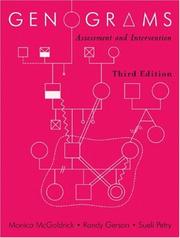
The standard reference on the field's one universal tool — McGoldrick, Gerson and Petry on constructing and interpreting a three-generation family map, illustrated with genograms of well-known families. The most immediately usable book on this path, and the natural pairing with the Bowen volume below.
Kerr and Murray Bowen's statement of Bowen theory: differentiation of self, triangles, emotional cutoff and the multigenerational transmission process. The tradition that thinks in generations rather than in the current household, and the theory the genogram was built to serve. Read it directly after Genograms.
The corrective the founding texts needed: what counts as enmeshed, appropriate distance or normal deference varies enormously by culture, and a structural reading of a family can be a reading of the therapist's own norms. Read it after the founders, so you can see exactly which of their judgements it puts in question.

White and David Epston's break with systems thinking: the problem is not a function of the family structure but a story the family has been recruited into, and the work is externalising it. The most influential post-founder development in the field, and the right closing book because it disputes the premise everything before it shares.
Discussion
Keep reading
Paths that share books, cover the same subject, or open a related topic.