Dune Reading Order: Where to Start and When to Stop
This curriculum guides you through the complete Dune saga in the order Frank Herbert intended, starting with the foundational novel and building through his increasingly philosophical and complex sequels. A final stage offers honest guidance on the Brian Herbert/Kevin J. Anderson continuation novels, so you can decide for yourself whether to continue beyond the original six.
The Foundation: Where It All Begins
BeginnerImmerse yourself in the world of Arrakis, meet the core characters, and absorb the political, ecological, and religious themes that underpin the entire saga.
▸ Study plan for this stage
Pace: 8–10 weeks total. Read "Dune" first (roughly 412 pages) at ~25–30 pages/day over 3 weeks, then "Dune Messiah" (~220 pages) at ~25 pages/day over 1.5 weeks, then "Children of Dune" (~408 pages) at ~25–30 pages/day over 3 weeks. Reserve the final week for review, re-reading key passages, and completin
- Arrakis as the center of the universe: the desert planet's ecology, the spice melange, and why control of Dune equals control of the Imperium
- The Bene Gesserit sisterhood: their centuries-long breeding program, the Missionaria Protectiva, and the manufactured messianic myth that shapes Paul's destiny
- Paul Atreides' transformation: from ducal heir to Muad'Dib to reluctant god-emperor, and the burden of prescience
- The political web of the Imperium: the balance of power among House Atreides, House Harkonnen, the Padishah Emperor, and the Spacing Guild
- Jihad and the dangers of charisma: how Paul's rise unleashes a galaxy-wide holy war he cannot stop, explored across Dune and Dune Messiah
- Leto II and Ghanima as Pre-Born Abominations: the concept of ancestral memory, the risks of inner possession, and Leto's conscious choice of the Golden Path in Children of Dune
- Ecological transformation: Liet-Kynes' dream of terraforming Arrakis and the tension between environmental change and the survival of Fremen culture and the sandworms
- Religion as a tool of power: how myth, prophecy, and ritual are deliberately constructed and weaponized throughout all three novels
- By the end of Dune, why does Paul feel his victory over the Emperor is also a defeat — and what does this foreshadow for Dune Messiah?
- What is the Missionaria Protectiva, and how does it both help and trap Paul and Jessica on Arrakis?
- How does Dune Messiah use the Tleilaxu, the Spacing Guild, and the Bene Gesserit conspiracy to argue that even a god-emperor is vulnerable to political manipulation?
- What is the 'Golden Path,' who first perceives it in Children of Dune, and why does Leto II believe it is the only way to save humanity from extinction?
- How does the concept of 'Abomination' apply to Alia in Children of Dune, and what does her fate warn us about the seduction of power and inner voices?
- In what ways do the sandworms, the spice cycle, and the Fremen way of life form an interdependent ecological and economic system — and what threatens that system across the three books?
- Map the power structures: After finishing Dune, draw a diagram showing the relationships among House Atreides, House Harkonnen, the Padishah Emperor Shaddam IV, the Spacing Guild, and the Bene Gesserit. Annotate each connection with the motivation (spice, political leverage, breeding program, etc.) and update the diagram as you finish each subsequent book.
- Keep a 'Prescience Journal': Each time Paul (or later Leto II) has a vision or dream, write a brief entry summarizing what he sees and whether it comes true. At the end of all three books, reflect on how Herbert uses prescience as a trap rather than a gift.
- Character voice comparison: Choose one scene featuring Paul from Dune and one featuring Leto II from Children of Dune that mirror each other thematically (e.g., both facing a moment of choosing their destiny). Write a one-page comparison of how their inner voices, fears, and choices differ — and what that says about Herbert's evolving argument.
- Ecological timeline: Create a chronological list of every deliberate change made to Arrakis' environment across the three books (planting windtraps, introducing moisture, shifting weather patterns). Note who drives each change and what is gained or lost culturally and economically as a result.
- Glossary deep-dive: The appendices and glossary in Dune are part of the text. Read them actively and select 10 terms (e.g., Kwisatz Haderach, Mahdi, Shari-a, Sietch, Tau) — write a two-sentence definition in your own words for each and find one passage in the novels where the concept is dramatized rather than explained.
- Thematic debate prompt: Write a one-page response to the question: 'Is Paul Muad'Dib a hero, a villain, or a warning?' Use specific evidence from all three books, paying particular attention to the shift in Herbert's framing between Dune and Dune Messiah.
Next up: Completing these three novels gives you the full arc of the Atreides myth — its rise, corruption, and transformation into the Golden Path — which is the essential foundation for understanding the far-future, god-emperor civilization that the next stage of the curriculum will explore.
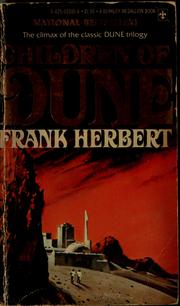
The starting point and masterpiece — read it first, slowly, and let the glossary at the back be your friend. Everything in the saga grows from the seeds planted here.
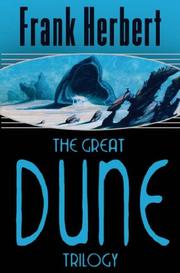
Herbert's deliberate deconstruction of the hero he built in Book 1; read it immediately after Dune while the events are fresh, as it reframes everything you just read.
The Empire Expands: Children and God
IntermediateFollow the saga thousands of years forward, grapple with Herbert's deepest warnings about charismatic leaders and religious power, and develop the patience the later books demand.
▸ Study plan for this stage
Pace: 4–5 weeks, ~25–30 pages/day (God Emperor of Dune is ~500 pages and intentionally slow-paced; allow extra time for reflection and re-reading dense philosophical passages)
- The Golden Path: Leto II's 3,500-year plan to scatter humanity across the universe and prevent its extinction through enforced stagnation followed by explosive dispersal
- The God Emperor as the ultimate cautionary tale: Leto II embodies Herbert's warning that even a well-intentioned, prescient ruler becomes a tyrant — the very thing Paul feared becoming
- Prescience as a trap and a prison: Leto's near-total foresight has robbed him of spontaneity, joy, and genuine human connection, illustrating the cost of certainty
- The human-sandworm hybrid: Leto's physical transformation into a worm-human chimera is a literal and symbolic sacrifice of his humanity in service of a long-term vision
- The Ixian Rebellion and the role of surprise: Siona and Duncan Idaho represent the unpredictable, 'no-room' humans who are invisible to prescience — Herbert's argument that humanity's salvation lies in its capacity to surprise
- Religion as a tool of control: Leto has deliberately constructed a stifling theocracy around himself to make humanity so desperate for freedom that it will never again submit to a single leader
- The cyclical nature of Duncan Idaho: The repeated ghola of Duncan serves as a mirror for Leto, a conscience, and a symbol of humanity's stubborn, recurring resistance to domination
- Patience and slow narrative as form matching content: Herbert's deliberately dense, dialogue-heavy prose mirrors Leto's own millennia-long perspective — learning to read this book IS part of the lesson
- What is the Golden Path, and why does Leto II believe it is the only way to save humanity from extinction — even if it requires thousands of years of tyranny?
- How does Leto II's reign serve as Herbert's most explicit critique of charismatic, messianic leadership, and in what ways does it extend the warnings already present in the earlier Dune books?
- What is the significance of Siona's genetic trait of being invisible to prescience, and what does Herbert suggest this means for the future of humanity?
- Why does Leto II keep recreating Duncan Idaho as a ghola, and what does Duncan's repeated resistance and eventual role in Leto's death symbolize?
- How does Herbert use Leto's physical transformation — the loss of his human body — as a metaphor for the moral and emotional costs of absolute power and long-term vision?
- By the end of God Emperor of Dune, has Leto II succeeded or failed? What evidence from the text supports your reading?
- Keep a 'Leto's Logic' journal: each reading session, write 2–3 sentences summarizing Leto's stated justification for his actions that day. At the end of the book, review the full journal and write a one-page verdict — do you find his reasoning compelling, monstrous, or both?
- Map the Golden Path: draw a simple timeline or flowchart showing Leto's plan as he reveals it across the novel. Include: the problem he is solving, the mechanism of his solution (stagnation → dispersal), and the role Siona plays as the endpoint. Annotate with page references.
- Character contrast essay (500–700 words): Compare Leto II and Duncan Idaho as foils. How does Duncan's repeated resurrection and rebellion function as a structural device? What does Herbert want the reader to feel about each man?
- Philosophical stress-test: Choose one of Leto's monologues or diary entries (the 'Stolen Journals' chapters are ideal) and write a formal rebuttal from the perspective of a citizen living under his rule. Use evidence from the novel to argue against his reasoning.
- Prose pacing exercise: Select a 10-page dialogue-heavy passage between Leto and a character of your choice. Re-read it slowly and annotate: What is each character really arguing? What is left unsaid? What does Herbert reveal through subtext rather than action?
- Thematic callback: Write a one-page comparison between Paul Atreides (from the earlier Dune books) and Leto II. Both had access to prescience and faced the Golden Path — why did Paul refuse it, and what does Leto's choice to embrace it say about Herbert's evolving thesis on power?
Next up: God Emperor of Dune ends with Leto's death and the unleashing of the Scattering — a humanity deliberately flung into chaos — which sets the stage for the next books in the saga to explore what that dispersed, leaderless humanity actually becomes, and whether Herbert's prescription for freedom truly worked.
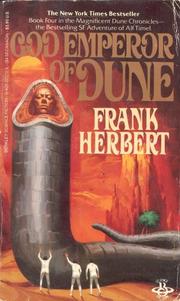
The most philosophically dense novel in the series, set 3,500 years later; Children of Dune is required preparation for its ideas about power, time, and human evolution.
The Final Vision: Heretics and Chapterhouse
ExpertExperience Herbert's late-career, wildly ambitious conclusion to the saga — a radical shift in scope and style that rewards everything you have built up to this point.
▸ Study plan for this stage
Pace: 8–10 weeks, ~25–30 pages/day; treat Heretics of Dune as weeks 1–5 and Chapterhouse Dune as weeks 6–10, leaving buffer days for the dense philosophical interludes and the deliberately open-ended finale
- The Scattering and its consequences: how humanity's explosive diaspora across the universe fundamentally reshapes the political and biological landscape Herbert established in earlier books
- The Bene Gesserit as protagonists: for the first time the Sisterhood moves to center stage — study how Herbert reframes their breeding program, political maneuvering, and internal culture as both heroic and deeply flawed
- The Honored Matres as dark mirror: understand the Honored Matres as a corrupted, trauma-driven inversion of the Bene Gesserit, raising questions about power, sexuality as control, and institutional violence
- Miles Teg and the archetype of the military genius: Teg's arc in Heretics explores the tension between loyalty to institution and personal conscience, culminating in a radical physical and metaphysical transformation
- The 'no-ship' and no-room as metaphors: the technology of hiding from prescience literalizes Herbert's recurring theme that true freedom requires invisibility to deterministic forces
- Murbella and the synthesis arc: her journey from Honored Matre to Bene Gesserit leader in Chapterhouse embodies Herbert's thesis that survival demands the merging of opposites rather than the annihilation of enemies
- The 'Thinking Machine' threat and the unnamed Enemy: the shadowy force hunting the Bene Gesserit in Chapterhouse reintroduces the Butlerian Jihad's original fear — that humanity may have never truly escaped machine consciousness
- Radical narrative openness: Chapterhouse Dune ends without resolution by design — analyze Herbert's refusal of closure as a philosophical and political statement about the dangers of final answers
- How does the Scattering, as depicted in Heretics of Dune, both fulfill and undermine the Golden Path Paul and Leto II sacrificed everything to set in motion?
- In what specific ways do the Honored Matres represent a distorted reflection of the Bene Gesserit, and what does Herbert suggest about how trauma and defeat corrupt institutions?
- How does Miles Teg's transformation in Heretics of Dune function as a commentary on the limits and dangers of the Bene Gesserit's control over human potential?
- What is the significance of the no-ship and the 'net' the unnamed Enemy casts in Chapterhouse Dune — what do these images say about prescience, determinism, and escape?
- How does Chapterhouse Dune reframe the entire Bene Gesserit breeding program in light of what the reader now knows about the Honored Matres' origins and the threat of the Thinking Machines?
- What is Herbert arguing by ending Chapterhouse Dune on an unresolved, open escape into the unknown — and how does this conclusion recontextualize the themes of the entire six-book saga?
- Institutional autopsy: After finishing Heretics of Dune, write a two-page analysis comparing the Bene Gesserit and the Honored Matres as institutions — map their shared origins, divergent methods, and what Herbert implies about how power structures evolve under existential pressure
- Character transformation log: Track Miles Teg across all of his appearances in Heretics of Dune in a running journal. Note each moment his loyalty, identity, or physical nature shifts, then write a closing paragraph on what his arc says about the relationship between individual will and institutional purpose
- Thematic callback exercise: Choose three major themes from the earlier books in the saga (e.g., the dangers of charismatic leaders, ecological transformation, the misuse of religion) and find at least two specific passages in Heretics or Chapterhouse that either resolve, subvert, or complicate each theme — compile these as annotated quotes
- The Enemy speculation essay: Before looking up any supplementary material, write a one-page argument identifying who or what the unnamed Enemy in Chapterhouse Dune is, using only textual evidence from both books. Then reflect on whether Herbert's deliberate ambiguity strengthens or weakens the narrative
- Murbella synthesis map: Draw or diagram Murbella's ideological and physical journey from Honored Matre to Bene Gesserit leader. At each major turning point, annotate what she gains, what she loses, and what Herbert seems to be saying about synthesis versus conquest as a survival strategy
- Saga-wide closing reflection: Write a personal essay (2–3 pages) responding to the question: 'Does the Dune saga, as concluded by Chapterhouse Dune, ultimately trust humanity to survive its own power?' Draw on specific scenes from both Heretics and Chapterhouse, and situate your answer within the arc of the full series you have read
Next up: Mastering Herbert's deliberately unresolved ending and his late-career thematic density equips the reader to critically evaluate how other authors — including Brian Herbert and Kevin J. Anderson in their continuation novels — attempt to answer the questions Chapterhouse Dune purposefully left open, making the contrast between authorial visions immediately legible.
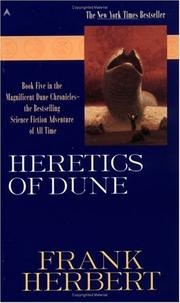
Set 1,500 years after God Emperor, this book reinvents the universe again with new factions and a new hero; the payoff requires the full context of the previous four novels.

Herbert's final novel, left deliberately unfinished at his death in 1986 — read it last among his six to experience his true, uncompromised vision, cliffhanger ending and all.
Beyond Herbert: The Continuation Novels — An Honest Assessment
ExpertUnderstand what the Brian Herbert and Kevin J. Anderson books offer and what they lack, so you can make an informed, eyes-open choice about whether to continue.
▸ Study plan for this stage
Pace: 3–4 weeks, ~40–50 pages/day — read both novels back-to-back since they form a single continuous narrative split across two volumes; plan for a mid-point reflection pause between the two books before pushing on to the conclusion
- The 'Omnius Scourge' and the Thinking Machine War as a narrative framework — how Hunters of Dune reactivates the Honored Matres/Bene Gesserit conflict and ties it to a machine-intelligence threat that Frank Herbert only gestured at in Chapterhouse
- Ghola resurrection as a plot engine — the systematic cloning of iconic characters (Paul, Leto II, Jessica, Stilgar, Duncan Idaho, etc.) and how this device revisits Dune's legacy while raising questions about authenticity and soul
- The 'Marty and Daniel' revelation — the authors' interpretation of the mysterious characters from Chapterhouse: Dune as Face Dancers, and how this resolves (or forecloses) one of Frank Herbert's most deliberately open mysteries
- Tonal and stylistic contrast with Frank Herbert — recognizing the shift from dense, layered prose and philosophical ambiguity toward plot-driven, accessible adventure fiction, and evaluating what is gained and lost in that shift
- Thematic dilution vs. thematic extension — tracking which of Frank Herbert's core themes (the dangers of hero-worship, ecological consciousness, the misuse of prescience, the critique of religion) are carried forward meaningfully versus which are simplified or abandoned
- Closure as a double-edged sword — understanding how Sandworms of Dune provides a definitive ending to the Dune universe and why some readers find that satisfying while others find it reductive
- Authorial intent and estate continuations — the ethical and literary questions surrounding continuation novels, including the use of Frank Herbert's notes and the difference between 'authorized' and 'faithful'
- Reader agency and canon — developing a personal, defensible framework for deciding what belongs in your Dune 'canon' and why that choice matters for how you engage with the original six novels
- How do Hunters of Dune and Sandworms of Dune resolve the cliffhanger ending of Chapterhouse: Dune, and does that resolution feel consistent with the direction Frank Herbert was signaling in his final novel?
- What is the narrative and thematic function of the ghola program? Does resurrecting Paul, Leto II, and others enrich the universe's mythology, or does it undercut the finality and meaning of their original story arcs?
- How do Brian Herbert and Kevin J. Anderson handle the Thinking Machine threat — does it feel like a natural outgrowth of the universe's history, or does it impose a more conventional science-fiction conflict onto Dune's unconventional framework?
- In what specific ways does the prose style, pacing, and dialogue in these two novels differ from Frank Herbert's writing, and how do those differences affect your engagement with the story?
- Is the 'Marty and Daniel' resolution satisfying as a literary answer to Chapterhouse's ambiguity? What does it suggest about the two authors' relationship to mystery and open-endedness as narrative tools?
- After finishing Sandworms of Dune, what is your personal verdict: do these books enhance, diminish, or simply exist separately from the original Dune hexalogy — and what criteria are you using to make that judgment?
- Side-by-side passage analysis: Select one page of description or internal monologue from Hunters of Dune and find a thematically comparable passage from Chapterhouse: Dune. Write a one-page comparison of sentence structure, philosophical density, and emotional register — no value judgment required, just close observation.
- Ghola tracking chart: Create a table listing every ghola introduced across both novels, the character they replicate, the plot purpose they serve, and whether their arc resolves in a way that honors or contradicts the original character's thematic role in Frank Herbert's books.
- The 'Marty and Daniel' verdict essay: Write 400–600 words arguing either FOR or AGAINST the authors' interpretation of these characters, using specific textual evidence from Sandworms of Dune and from Chapterhouse: Dune to support your position.
- Theme survival audit: Take the five themes you identified as most central to Frank Herbert's hexalogy (from earlier stages of your curriculum) and score each one in these two books on a simple 3-point scale: Carried Forward Faithfully / Present but Simplified / Absent or Contradicted. Write two sentences of justification for each score.
- Personal canon statement: After finishing Sandworms of Dune, write a one-paragraph 'canon declaration' — a clear, reasoned statement of which books you consider part of your Dune universe and why. Revisit and revise this after the next stage of the curriculum.
- Recommendation letter exercise: Write a 200-word honest recommendation (or non-recommendation) of Hunters of Dune and Sandworms of Dune addressed to a fellow reader who has just finished Chapterhouse: Dune. Be specific about what kind of reader will find value in them and what kind will not.
Next up: Completing this critical assessment of the continuation novels equips the reader with a fully formed, evidence-based perspective on the entire Dune universe — original and extended — which is the essential foundation for the next stage's work of synthesis, re-reading, and constructing a lasting personal relationship with the series as a whole.
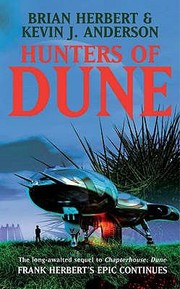
Directly continues Chapterhouse and claims to be based on Frank Herbert's notes; if you felt the cliffhanger demanded resolution, start here — but expect a noticeably more action-oriented, less philosophical tone than the original six.

Concludes the Hunters arc and wraps up the saga's loose ends; read it only if Hunters satisfied you, and go in knowing this is a different creative sensibility than Frank Herbert's.
Discussion
Keep reading
Paths that share books, cover the same subject, or open a related topic.