Start with the first novel, Dune, which this catalogue holds inside the three-book omnibus Dune, Dune Messiah, Children of Dune. There is no clever alternative here: Frank Herbert's 1965 original is self-contained, it is the reason anyone reads the rest, and it ends at a genuine resting point. If you never read another word of the series you will not feel cheated.
The one warning worth giving before you begin is about the opening. Dune drops you into a political situation with an invented vocabulary — Bene Gesserit, Kwisatz Haderach, Landsraad, CHOAM — and explains almost none of it for a hundred pages. There is a glossary at the back; use it, and trust that the terms resolve. Readers who abandon Dune almost always abandon it in the first fifth.
The Herbert sequels, in order
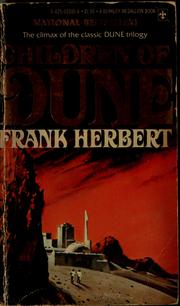
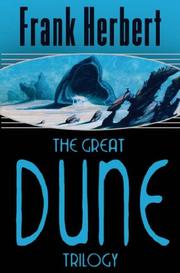
The omnibus Dune, Dune Messiah, Children of Dune gives you the first three in one volume, and Children of Dune is also catalogued separately if you want it on its own. Read them in publication order; there is no chronological alternative worth considering, because the series moves relentlessly forward in time.
Dune Messiah is short, bleak, and deliberately anticlimactic. Herbert wrote it to correct what he saw as readers misreading the first book as a heroic triumph — it is an argument that the messiah of book one is a catastrophe. A lot of readers dislike it for exactly that reason. It is also the key to everything after, so if you intend to continue, you cannot skip it.
Children of Dune restores some of the scale and momentum of the original and is the better sequel of the two. Together, the first three make a coherent trilogy and are the most common place for readers to stop.
God Emperor, the great divider
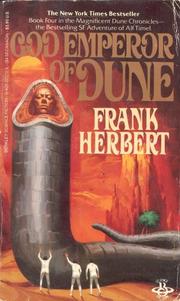
God Emperor of Dune jumps three and a half thousand years forward and is essentially a philosophical dialogue conducted by a man who has become a giant worm. Very little happens. Long sections are Leto II lecturing his companions about power, ecology, memory and the long-term breeding of humanity out of its own tendencies.
This is the book that splits the readership. A significant minority regard it as the most interesting thing Herbert wrote; a larger group finds it a static, sermonising slog. Both reactions are honest. If you enjoyed the political and ecological argument of the first three more than the action, you will probably find it the best of them.
Heretics and Chapterhouse
Heretics of Dune and Chapterhouse Dune jump another fifteen hundred years and swing back toward plot and intrigue — new factions, a genuine sense of threat, and a much faster read than God Emperor of Dune. They are better than their reputation.
The problem is the ending. Chapterhouse Dune finishes on an unresolved cliffhanger. Herbert died in 1986 before writing the seventh book, and the series simply stops mid-story. Knowing that going in is the difference between a frustrating experience and an acceptable one.
The continuations, and an honest opinion
Hunters Of Dune and Sandworms of Dune, by Brian Herbert and Kevin J. Anderson, complete the story from Frank Herbert's notes. They resolve the cliffhanger. They are also written in a plainly different register — faster, more conventional, far less dense — and a large share of long-time readers consider them a poor fit with what came before. That judgement is contested rather than settled, and the counter-argument is simple: they are the only existing answer to a question the series otherwise leaves open.
Where to stop
Three defensible stopping points. Stop after Dune if you wanted a great adventure novel and got one. Stop after Children of Dune if you want a complete trilogy with a real ending. Stop after God Emperor of Dune if you came for the ideas — it is the fullest statement of them. Only continue to the end if you specifically want the cliffhanger closed.
Follow the full ordered path here: Dune Reading Order: Where to Start and When to Stop.