Clarice Lispector Reading Order: Where to Start
Clarice Lispector is one of the most singular voices in 20th-century literature — dense, interior, and philosophically charged. This curriculum begins with her most accessible and celebrated novel to build intuition for her style, moves through her essential short fiction and mid-career masterworks, and culminates in the late, visionary writing that defines her legacy. Each stage deepens familiarity with her language of consciousness, mysticism, and radical interiority.
The Entry Point
IntermediateGrasp Lispector's essential voice — her stream-of-consciousness prose, her obsession with selfhood and epiphany — through her most widely read and structurally accessible novel.
▸ Study plan for this stage
Pace: 3–4 weeks, ~8–12 pages/day — the crônicas are short, self-contained pieces, so read 3–5 per sitting to allow reflection between entries rather than rushing through them as a single block
- The crônica as a form: a Brazilian hybrid of newspaper column, lyric essay, and prose poem that Lispector bends toward philosophical self-inquiry
- Stream-of-consciousness in miniature: how Lispector captures the flow of thought, sensation, and perception within the compressed space of a single short piece
- Epiphany and the ordinary: the recurring pattern in which a mundane object, animal, or daily encounter suddenly cracks open into existential revelation
- Selfhood and interiority: Lispector's obsessive return to the question of what it means to be a conscious 'I' — her narrators are always watching themselves think
- The instability of language: her explicit distrust of words to capture lived experience, and her use of paradox, contradiction, and silence as stylistic tools
- The animal gaze: how non-human creatures (cockroaches, chickens, dogs) function as mirrors that destabilize human self-certainty
- Autobiographical ambiguity: the crônicas blur the line between Clarice-the-journalist and Clarice-the-fiction-writer, raising questions about persona and authenticity
- Brazilian modernity and the feminine voice: how her columns navigated a mass-market newspaper context while smuggling in radical, avant-garde interiority
- How does Lispector transform the everyday subject matter expected of a newspaper column into a vehicle for existential and philosophical inquiry — and can you point to two or three specific crônicas as evidence?
- What techniques does she use to render stream-of-consciousness within a piece that may be only one or two pages long? How is this different from stream-of-consciousness in a novel?
- How does Lispector treat language itself as a theme? Where in the Selected Crônicas does she explicitly question whether words can hold the truth of an experience?
- What role do animals play across multiple crônicas, and what does the human narrator's encounter with them reveal about Lispector's conception of selfhood?
- How does the 'I' of the crônicas function — is it a stable autobiographical self, a literary persona, or something more unstable? Use specific pieces to support your answer.
- In what ways do the crônicas serve as a laboratory or sketchbook for the larger obsessions you would expect to find in a full Lispector novel?
- Keep a 'crônica journal': after each reading session, write one paragraph in Lispector's style — take a mundane object in your immediate environment and follow your associative thoughts about it until you arrive at an unexpected emotional or philosophical landing point
- Annotate for epiphany structure: mark the exact sentence or moment in at least ten crônicas where the tone shifts from observation to revelation; then write a one-sentence description of what triggers each shift and compare them for patterns
- Select one crônica and rewrite it in conventional journalistic prose (clear topic sentence, factual development, tidy conclusion); then write a short reflection on what is lost and what Lispector's version achieves that yours cannot
- Trace the animal motif: collect every crônica in the selection that features a non-human creature, summarize how the animal is described, and write a one-page synthesis of what these pieces collectively say about the boundary between human and non-human consciousness
- Practice reading aloud: choose three crônicas and read them aloud slowly, paying attention to rhythm, sentence length, and where Lispector uses fragmentation or run-ons; note how the sound of the prose reinforces or complicates its meaning
- Write a brief comparative note (one page) on two crônicas that seem to contradict each other — perhaps one that celebrates language and one that despairs of it — and argue what that tension reveals about Lispector's overall worldview
Next up: By mastering Lispector's voice, obsessions, and structural instincts in the compressed laboratory of the crônicas, the reader is now equipped to follow those same currents — stream-of-consciousness, epiphany, the unstable self, the treachery of language — as they expand and intensify across the full architecture of her longer fiction.
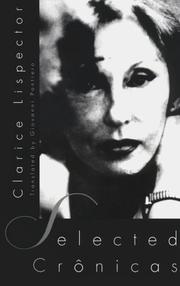
These brief newspaper columns — meditations on daily life, animals, and existence — offer a relaxed, conversational Lispector that builds intuition for her themes before tackling her denser fiction.
The Short Stories
IntermediateMaster Lispector's short fiction — the form in which she is arguably most powerful — and see the full range of her obsessions across decades of work.
▸ Study plan for this stage
Pace: 8–10 weeks, ~20–25 pages/day (roughly 5–6 stories per sitting, 4–5 days/week) — The Complete Stories spans ~600 pages and 85+ stories, so grouping by original collection (Family Ties, The Foreign Legion, etc.) works better than reading straight through; allow one slower "reflection week" mid-way.
- The epiphany structure: Lispector's stories hinge on a single moment of rupture or revelation — often mundane in trigger, cosmic in consequence
- Stream of consciousness and free indirect discourse: the narrator bleeds into the character's interiority so that thought, sensation, and event become indistinguishable
- The 'it' (o it): Lispector's recurring pronoun for the unnameable — a pre-linguistic, animal, or divine force that erupts into ordinary life
- Domestic space as existential arena: kitchens, apartments, and family routines are the stage for radical ontological crisis
- The female body and subjectivity: women's consciousness, desire, and self-erasure are central; Lispector refuses both sentimentality and easy feminist resolution
- Animal encounters as philosophical events: cockroaches, chickens, dogs, and fish function as mirrors of the human — and as threats to the human's self-definition
- Chronological range and evolution of style: tracing the arc from the early, more realist stories through the increasingly fragmented, lyrical late work reveals a writer in constant formal reinvention
- The short story as a form of controlled explosion: Lispector treats compression not as limitation but as the ideal vessel for her brand of intensity
- How does Lispector use a single, ordinary object or creature (an egg, a chicken, a cockroach) to destabilize a character's — and the reader's — sense of reality?
- In what ways does free indirect discourse in The Complete Stories make it difficult to locate a stable narrative 'voice,' and what is the effect of that instability?
- Compare an early story (e.g., 'Obsession' or 'The Triumph') with a late one (e.g., 'The Departure of the Train' or 'But It's Going to Rain'): how does Lispector's prose style and thematic focus shift across decades?
- What does Lispector's treatment of domestic women — wives, mothers, daughters — reveal about her understanding of identity, freedom, and self-annihilation?
- How do animal stories in The Complete Stories function philosophically? What is at stake when a human character confronts an animal's radical otherness?
- What formal techniques does Lispector use to create the sensation that language is failing — or barely adequate — to capture the experience being described?
- Mapping the epiphany: For 10 stories spread across different decades, write a one-paragraph 'rupture map' — identify the trigger event, the moment of crisis, and whether the character returns to equilibrium or remains undone. Look for patterns.
- Close-reading drill: Choose any two pages from 'The Imitation of the Rose' and rewrite them in plain, journalistic prose. Then write a paragraph on what is lost — this makes Lispector's stylistic choices viscerally concrete.
- Thematic constellation: Create a handwritten or digital diagram grouping stories by obsession (animals, marriage, children, the body, God, language). Note which obsessions cluster in which life-periods of her career.
- Voice experiment: Write a 300–500 word original flash fiction imitating Lispector's free indirect style — pick a domestic scene and let a character's interiority overwhelm the external action. Then annotate your own draft: where did you succeed? Where did you default to conventional narration?
- Comparative reading journal: After finishing each original collection's worth of stories (Family Ties, The Foreign Legion, etc.), write a one-page journal entry answering: What is the dominant mood? What formal risk does Lispector take here that she didn't take before?
- Translation comparison: Select one story available in an older translation and compare it side-by-side with the Benjamin Moser-edited version in The Complete Stories. Note three specific moments where word choices diverge and argue which better captures Lispector's tone.
Next up: Mastering the compressed, epiphany-driven intensity of the short stories gives the reader the interpretive vocabulary — the rupture structure, the interior voice, the animal encounters, the domestic uncanny — needed to sustain and deepen that reading across the longer, more architecturally complex space of Lispector's novels.
The definitive gathering of all her short fiction in one volume — use it to fill gaps, revisit favorites, and appreciate the full arc of her development as a story writer.
The Major Novels
ExpertRead the two mid-career novels that show Lispector at her most formally ambitious, expanding her interior monologue into longer, more demanding structures.
▸ Study plan for this stage
Pace: 3–4 weeks, ~15–20 pages/day — Near to the Wild Heart is dense and rewards slow, attentive reading; plan for re-reading key passages and journaling time alongside the primary read
- Interior monologue as structure: Lispector abandons conventional plot architecture in favor of Joana's unbroken stream of consciousness, making the protagonist's inner voice the primary organizing principle of the novel
- The proto-self and identity fluidity: Joana resists fixed social roles (daughter, wife, lover) and exists in a perpetual state of becoming — the novel interrogates whether a stable self is possible or even desirable
- Language as sensation: Lispector treats prose style itself as phenomenological — sentences are crafted to produce feeling before meaning, demanding the reader experience rather than decode the text
- Time as subjective and non-linear: chronological narrative is dissolved; childhood memories, present moments, and imagined futures coexist without hierarchy, reflecting Joana's consciousness rather than external clock-time
- The female body and desire: Joana's physicality, sexuality, and hunger are rendered with radical frankness for the period, positioning the body as a site of both freedom and social constraint
- Influence of modernist predecessors: the novel openly dialogues with Virginia Woolf and James Joyce in its stream-of-consciousness technique, while forging a distinctly Brazilian and feminine voice
- Epiphany and the 'it': Lispector's recurring use of an unnamed, ineffable 'it' (isso) anticipates her later mystical prose — moments of sudden, wordless revelation punctuate Joana's interior journey
- Isolation and otherness: Joana is constitutively unable to fully connect with other characters; her radical interiority is simultaneously her power and her exile
- How does Lispector use the structure of interior monologue in Near to the Wild Heart to replace conventional plot, and what effect does this have on your experience of narrative time?
- What does Joana's resistance to social roles (wife, daughter, woman) reveal about Lispector's engagement with questions of female identity and freedom in mid-20th-century Brazil?
- How does Lispector's prose style function sensorially — can you identify specific passages where the sound or rhythm of a sentence produces an emotional or physical effect before its meaning is fully processed?
- What is the significance of the recurring, unnamed 'it' (isso) in the novel, and how does this device anticipate the mystical and philosophical dimensions of Lispector's later work?
- In what ways does Near to the Wild Heart both inherit and depart from the European modernist tradition (Woolf, Joyce), and what makes Lispector's voice distinctly her own?
- How does the novel treat the relationship between Joana's inner world and the external characters (Otávio, Lídia, the father) — are those characters fully realized, or do they function primarily as mirrors or pressures on Joana's consciousness?
- Close-reading journal: Select one passage per reading session (roughly one page) that feels most resistant or most electric, copy it out by hand, and write 150–200 words on what Lispector is doing at the level of the sentence — syntax, rhythm, imagery, and the feeling it produces before meaning settles
- Stream-of-consciousness imitation: After finishing a chapter, write 1–2 pages of unbroken interior monologue in Lispector's mode — no plot, no dialogue tags, only sensation, memory, and associative thought bleeding into one another; then compare your passage to hers and note the differences
- Timeline deconstruction: Create a visual map of Near to the Wild Heart that attempts to reconstruct a chronological order of events from Joana's life; then write a short reflection on what is lost or distorted when the novel's non-linear structure is 'corrected'
- Modernist comparison exercise: Choose one passage from Near to the Wild Heart and place it alongside a passage from Virginia Woolf's Mrs Dalloway or James Joyce's A Portrait of the Artist as a Young Man (outside texts for reference); write a one-page comparative note on technique, voice, and what each author's interior monologue reveals about their respective protagonist's gender and selfhood
- Character-as-mirror analysis: For each named character who interacts with Joana (Otávio, Lídia, the father, the aunt), write a short paragraph describing what aspect of Joana's identity or desire that character seems to reflect, resist, or threaten — then assess whether Lispector grants them independent interiority
- Epiphany catalogue: Mark every moment in the novel that functions as an epiphany or sudden revelation — including the appearances of 'it' (isso) — and compile them into a list with a one-sentence gloss for each; at the end, write a paragraph on whether these moments form a pattern or arc across the novel
Next up: Mastering the interior monologue and the fluid, sensation-first prose of Near to the Wild Heart equips the reader with the perceptual and stylistic vocabulary needed to navigate Lispector's later, even more radically fragmented and metaphysically extreme works, where these techniques are pushed to their absolute limits.
Her debut novel, written at 23, is a stunning early statement of her method — stream-of-consciousness and lyrical fragmentation — and reads with new depth once you know where her career goes.
The Late Vision
ExpertEncounter Lispector's final, most radical writing — texts that dissolve genre entirely into meditation, myth, and pure language, representing the culmination of her life's work.
▸ Study plan for this stage
Pace: 2–3 weeks, ~10–15 pages/day (Água viva is short but dense; slow, meditative re-reading of key passages is essential — plan at least one full re-read of the entire text)
- Dissolution of genre: Água viva resists classification as novel, prose poem, or essay — it is all and none, a deliberate dismantling of literary form
- The 'it' (o it): Lispector's central, untranslatable concept — a pre-linguistic, pre-rational mode of being and perception that the text strains toward but can never fully capture
- Painting as textual model: the narrator is a painter who has abandoned canvas for words, and the text performs the logic of visual art — simultaneity, color, texture — rather than narrative linearity
- The present instant (o instante): time in Água viva is not chronological but phenomenological; each sentence exists as its own absolute present, making plot and causality irrelevant
- Language at its own limit: Lispector pushes syntax and semantics to the edge of meaning, using repetition, paradox, and self-contradiction to gesture at what words cannot say
- The body and sensation as epistemology: knowing in this text is visceral, not intellectual — the reader is asked to feel the text rather than decode it
- Myth and the inhuman: animals, darkness, and primordial imagery recur as Lispector reaches toward a pre-human or trans-human consciousness
- The reader as co-creator: the text addresses a 'you' directly and collapses the distance between writer, narrator, and reader, making meaning a shared, unstable act
- What does Lispector mean by 'o it' and why does she insist it cannot be named or fully articulated — how does the structure of Água viva enact this impossibility?
- How does the narrator's identity as a painter shape the text's relationship to time, sequence, and form — in what ways does Água viva read more like a painting than a novel?
- How does Lispector use the 'present instant' as both subject matter and formal principle — can you identify specific passages where the prose itself performs instantaneity?
- What role do animals, insects, and non-human life play in the text's philosophical and mythic vision — what does Lispector seem to be reaching for through these images?
- How does Água viva position the reader — who is the 'you' being addressed, and what does this direct address demand of the person holding the book?
- In what ways does this text represent a culmination or radicalization of themes present throughout Lispector's career — and what makes it feel like a final, irreducible statement?
- Close-reading journal: Select 5 passages of no more than a paragraph each that feel most opaque or most electric to you. Write one full page on each — not summarizing, but describing what the language is doing at the level of syntax, image, and rhythm.
- Imitation writing: Write 1–2 pages in the style of Água viva, addressed to a 'you,' in which you attempt to capture a single present instant (a sound, a light, a texture) without narrating it — only circling it. Afterward, reflect on where language failed you.
- Mapping 'o it': Go through the text and mark every passage where Lispector invokes 'it' or gestures at the unsayable. Write a one-paragraph synthesis: what portrait of 'it' emerges from the accumulation of these attempts?
- Comparative re-read: On your second read-through, read Água viva alongside a piece of abstract visual art (a Rothko, a Cy Twombly, a Kandinsky). Pause every 10 pages and note: which painting does this passage most resemble, and why?
- Temporal analysis: Identify at least 6 moments in the text where conventional time (past, future, causality) is explicitly refused or subverted. Write a short essay (300–500 words) arguing how this refusal is itself a philosophical claim about consciousness.
- Discussion or written reflection: Argue either FOR or AGAINST the following proposition — 'Água viva is not a novel and should not be read as one.' Use specific evidence from the text, and consider what is gained or lost by each framing.
Next up: Água viva's total dissolution of narrative into pure, present-tense consciousness establishes the outermost boundary of what literary language can attempt, equipping the reader to engage critically with Lispector's legacy, her influence on world literature, and the broader tradition of radical modernist and post-modernist prose she both belongs to and transcends.
A plotless, ecstatic monologue addressed to a painter — closer to prose poetry than novel — and one of the purest expressions of her mature vision; it demands everything the earlier reading has built.
Discussion
Keep reading
Paths that share books, cover the same subject, or open a related topic.