C++ reading path: from core syntax to modern, high-performance code
This four-stage curriculum takes a beginner from zero C++ knowledge to writing fast, safe, idiomatic modern C++ code. Each stage builds directly on the last: you first learn the language mechanics, then master memory and resource management, then unlock the power of templates and the STL, and finally absorb the full sweep of C++11–C++20 features and professional best practices.
Foundations
BeginnerUnderstand core C++ syntax, control flow, functions, classes, and basic object-oriented programming well enough to write and compile non-trivial programs from scratch.
▸ Study plan for this stage
Pace: 12–14 weeks, ~40–50 pages/day (C++ Primer: ~900 pages over 6–7 weeks; Programming: Principles and Practice: ~1000 pages over 6–7 weeks)
- Variables, types, and type safety: understanding fundamental types (int, double, string, bool), type conversions, and const/constexpr qualifiers from C++ Primer chapters 2–3
- Control flow and program logic: mastery of if/else, loops (for, while, do-while), and switch statements to direct program execution (C++ Primer chapter 5)
- Functions and scope: writing reusable functions with parameters, return values, default arguments, and understanding local vs. global scope (C++ Primer chapter 6)
- Containers and iterators: using vectors, arrays, and strings as fundamental data structures, and iterating through them safely (C++ Primer chapters 3–4, 9–10)
- Classes and object-oriented design: defining classes with member variables and functions, constructors, access specifiers (public/private), and encapsulation (C++ Primer chapters 7–13, Stroustrup chapters 8–9)
- Pointers and references: understanding memory addresses, pointer dereferencing, and references as safer alternatives (C++ Primer chapter 2.3, chapter 13)
- Input/output and streams: reading from and writing to console and files using iostream and fstream (C++ Primer chapter 1, 8; Stroustrup chapter 10)
- Design principles and testing: writing clean, maintainable code with meaningful names, modularity, and basic debugging techniques (Stroustrup chapters 5–7, 11–12)
- What is the difference between a pointer and a reference, and when would you use each in a C++ program?
- Explain how constructors and destructors work in a class, and why they are important for resource management.
- Write a function that takes a vector of integers, modifies it in place, and returns the count of elements that meet a condition—what are the design trade-offs?
- Design a simple class (e.g., BankAccount or Student) with appropriate member variables, constructors, and methods; explain your choice of public vs. private members.
- What happens when you pass a large object (like a vector) to a function by value vs. by reference, and how does this affect performance?
- Describe the relationship between arrays, pointers, and vectors in C++, and explain why vectors are generally preferred for modern C++.
- Complete all 'Try It' exercises and end-of-chapter problems in C++ Primer chapters 2–6 (variables, control flow, functions) to build syntax fluency.
- Implement a simple calculator program that reads two numbers and an operator, then performs the operation—practice control flow, input/output, and function decomposition.
- Create a Grade class with member variables (student name, scores) and methods (add_score, compute_average, print_report); test it with multiple student objects.
- Write a program that reads a list of integers from a file into a vector, computes statistics (mean, median, min, max), and writes results to an output file.
- Refactor a procedural program (e.g., a game or simulation from Stroustrup's examples) into a class-based design; document the improvements in encapsulation and reusability.
- Debug and fix a provided program with intentional errors (pointer misuse, off-by-one loops, incorrect class design) to strengthen error-detection skills.
Next up: This stage establishes the syntactic and conceptual foundation—classes, functions, and basic OOP—that the next stage will build upon by introducing inheritance, polymorphism, templates, and the Standard Library in depth, enabling you to write more complex, reusable, and efficient C++ applications.
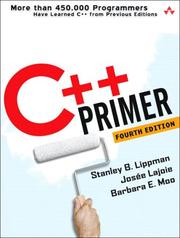
The most thorough beginner-to-intermediate introduction to C++, covering the entire language including early exposure to modern C++11 idioms. Reading it first gives you the complete vocabulary you need for every later stage.
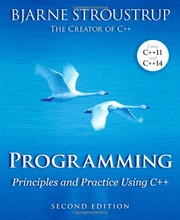
Written by C++'s creator as a first programming course, it reinforces fundamentals with an emphasis on good design habits and real problem-solving — the perfect complement to Lippman's reference-style coverage.
Memory, Resources, and Object Lifetime
IntermediateMaster manual and automatic memory management, RAII, smart pointers, move semantics, and the rules that govern object lifetime — the skills that separate safe C++ from dangerous C++.
▸ Study plan for this stage
Pace: 8–10 weeks, ~25–30 pages/day (alternating between deep study of items and hands-on coding)
- Resource Acquisition Is Initialization (RAII): the fundamental pattern that ties resource lifetime to object lifetime, ensuring cleanup happens automatically
- Manual memory management pitfalls: new/delete, ownership semantics, and why they are error-prone without discipline
- Smart pointers (unique_ptr, shared_ptr, weak_ptr): how they automate memory management and prevent leaks and dangling pointers
- Move semantics and rvalue references: how to efficiently transfer ownership and avoid unnecessary copying of expensive objects
- The Rule of Five (and Rule of Zero): when and how to define destructors, copy constructors, copy assignment, move constructors, and move assignment operators
- Object lifetime and scope: automatic storage, dynamic storage, and static storage duration; initialization and destruction order
- Exception safety and RAII: how RAII guarantees strong exception safety and prevents resource leaks even when exceptions are thrown
- Const-correctness and ownership: using const to express intent and prevent accidental modifications that violate resource ownership contracts
- What is RAII, and why is it considered the most important C++ idiom for resource management?
- Explain the differences between unique_ptr and shared_ptr, and when you would use each one.
- What are rvalue references, and how do move semantics improve performance compared to copying?
- What is the Rule of Five, and why must you define all five special member functions if you define any one of them?
- How does RAII guarantee exception safety, and what does 'strong exception safety' mean?
- Why is manual new/delete considered dangerous, and what problems does it create in real codebases?
- What is a weak_ptr, and why is it necessary when using shared_ptr?
- How do you determine the appropriate storage duration (automatic, dynamic, or static) for an object in your design?
- Refactor a legacy C++ program that uses raw new/delete to use smart pointers (unique_ptr and shared_ptr) instead; verify no memory leaks occur.
- Implement a custom class with proper RAII: acquire resources in the constructor, release them in the destructor, and define all five special member functions correctly.
- Write a move-enabled class (with move constructor and move assignment operator) and benchmark it against a copy-only version to measure performance gains.
- Create a circular reference scenario with shared_ptr and solve it using weak_ptr; explain why the weak_ptr breaks the cycle.
- Implement exception-safe code using RAII: write a function that allocates multiple resources and throws an exception partway through; verify all acquired resources are cleaned up.
- Analyze a provided C++ codebase and identify ownership violations, dangling pointers, and memory leaks; propose RAII-based fixes.
- Write a template class that manages a dynamically allocated array with proper move semantics, copy semantics, and exception safety.
- Implement a simple smart pointer class (like unique_ptr) from scratch to understand how move semantics and ownership transfer work internally.
Next up: Mastering memory, resources, and object lifetime gives you the foundation to write safe, efficient C++ code; the next stage will build on this by exploring advanced design patterns, template metaprogramming, and concurrency—all of which depend on rock-solid understanding of ownership and lifetime.
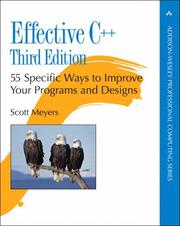
55 concrete, battle-tested guidelines covering constructors, destructors, copying, and resource management; establishes the mental model of 'thinking in C++' before tackling move semantics.

Picks up exactly where Effective C++ leaves off, focusing on C++11/14 features — move semantics, perfect forwarding, smart pointers, and lambdas — with the same item-by-item clarity.
Templates, Generic Programming, and the STL
IntermediateWrite and reason about function and class templates, understand template metaprogramming basics, and use the full Standard Template Library (containers, iterators, algorithms) fluently and efficiently.
▸ Study plan for this stage
Pace: 8–10 weeks, ~40–50 pages/day. Start with "The C++ Standard Library" (weeks 1–4, focusing on containers, iterators, and algorithms), then transition to "C++ Templates: The Complete Guide" (weeks 5–10, covering function templates, class templates, and template metaprogramming).
- STL containers (vector, list, deque, set, map, unordered_map) and their performance characteristics
- Iterators as the abstraction layer connecting containers to algorithms
- STL algorithms (sort, find, transform, accumulate, etc.) and their iterator requirements
- Function templates: syntax, instantiation, template argument deduction, and specialization
- Class templates: definition, member functions, static members, and partial specialization
- Template metaprogramming: compile-time computation, SFINAE, enable_if, and type traits
- Template instantiation model and the two-phase lookup process
- Variadic templates and parameter packs for generic, flexible code
- What are the time and space complexity trade-offs between vector, list, and deque, and when should you choose each?
- How do iterators enable algorithms to work generically with different container types? What are the five iterator categories?
- How does template argument deduction work in function templates, and when must you explicitly specify template arguments?
- What is SFINAE and how can you use enable_if to write templates that only instantiate under certain conditions?
- How do class template specialization (both full and partial) allow you to customize behavior for specific template arguments?
- What is template metaprogramming and how can you use it to perform computations at compile time?
- Build a small project that uses multiple STL containers (vector, map, set) and justify your choice for each based on access patterns and performance requirements.
- Write a generic function template that works with any STL container and uses iterators to process elements (e.g., a custom find_if or transform variant).
- Implement a simple class template (e.g., a Stack or Pair) with member functions, static members, and both full and partial specializations.
- Write a template function using SFINAE and enable_if to create overloads that only compile for integral types, floating-point types, or containers.
- Create a compile-time type traits utility (e.g., is_integral, is_pointer) and use it in template code to conditionally enable functionality.
- Implement a variadic template function that accepts a variable number of arguments and performs an operation on each (e.g., a generic print or sum function).
- Refactor a concrete, non-template class into a class template and verify that it works correctly with multiple instantiations.
- Write a template metaprogramming example that computes a value at compile time (e.g., factorial or Fibonacci) and verify the result with static_assert.
Next up: Mastery of templates and the STL provides the foundation for advanced topics like move semantics, perfect forwarding, and modern C++ design patterns, which enable you to write efficient, expressive code that leverages the full power of the language.
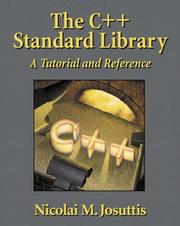
The definitive reference and tutorial for the STL and standard library, updated through C++17; reading it now gives you the practical toolkit that templates are designed to power.

The canonical deep-dive into template mechanics — function templates, class templates, variadic templates, and SFINAE — providing the theoretical foundation needed to write truly generic, reusable code.
Modern C++ Mastery and Professional Practice
ExpertInternalize C++17 and C++20 features (concepts, ranges, coroutines, modules), understand the design philosophy behind the language, and write code that is simultaneously fast, correct, and idiomatic.
▸ Study plan for this stage
Pace: 8–10 weeks, ~40–50 pages/day (A Tour of C++: 3–4 weeks; The Design and Evolution of C++: 5–6 weeks)
- C++17 and C++20 core features: structured bindings, if constexpr, concepts, ranges, coroutines, and modules
- The design philosophy behind C++: zero-overhead abstraction, type safety, and the principle of 'you don't pay for what you don't use'
- Generic programming with concepts: writing constrained templates that express intent and catch errors at compile time
- Ranges library: composable, lazy algorithms that replace traditional iterator-based code
- Coroutines and asynchronous programming: understanding suspension points, awaiters, and structured concurrency
- Module system: organizing large codebases with explicit dependencies and avoiding the preprocessor
- Idiomatic modern C++: RAII, move semantics, smart pointers, and functional composition patterns
- The evolution of C++ design decisions: understanding trade-offs, backwards compatibility, and the rationale for language features
- What are structured bindings and if constexpr, and how do they improve code clarity and compile-time computation?
- How do concepts constrain templates, and what are the advantages over traditional SFINAE-based approaches?
- Explain the ranges library: how do range adaptors compose, and how do they differ from traditional STL algorithms?
- What is a coroutine in C++20, and how do co_await, co_yield, and co_return enable asynchronous and generator patterns?
- How does the module system improve on the preprocessor-based #include model, and what are the benefits for large projects?
- What is the core design philosophy of C++, and how do features like zero-overhead abstraction and type safety reflect this?
- How do move semantics, smart pointers, and RAII combine to write code that is both fast and correct?
- Refactor a traditional C++11/14 codebase to use structured bindings, if constexpr, and auto type deduction; measure clarity improvements
- Write a concept that constrains a template function (e.g., Sortable, Hashable, Drawable); use it to catch template errors at compile time
- Build a small data processing pipeline using ranges: filter, transform, and reduce a collection without intermediate allocations
- Implement a simple coroutine: a generator that yields Fibonacci numbers, or an async task wrapper with co_await
- Refactor a header-heavy project to use C++20 modules; document the dependency graph and measure compilation time improvements
- Analyze a design decision from 'The Design and Evolution of C++' (e.g., why virtual functions, why exceptions, why templates); write a 1–2 page reflection on the trade-offs
- Write a small library using modern idioms: RAII, move semantics, smart pointers, and concepts; ensure it compiles with -Wall -Wextra -Werror
- Compare an iterator-based algorithm with a ranges-based equivalent; discuss performance, readability, and composability
Next up: This stage establishes mastery of modern C++ idioms, design philosophy, and cutting-edge features, positioning you to tackle specialized domains (systems programming, high-performance computing, embedded systems, or library design) where you can apply these principles to solve real-world problems at scale.

A concise, high-velocity survey of the entire modern language by its creator; at this stage it serves as a consolidating review that ties together everything learned and introduces C++20 features in context.
A focused, practical walkthrough of every significant C++17 addition — structured bindings, std::variant, parallel algorithms, and more — bridging the gap between C++14 and the C++20 era.
![The design and evolution of C[plus plus]](https://covers.openlibrary.org/b/id/135125-M.jpg)
Understanding why the language was designed the way it was is the final unlock for expert-level intuition; this book explains the rationale behind every major feature so you can reason about trade-offs, not just memorize rules.
Discussion
Keep reading
Paths that share books, cover the same subject, or open a related topic.