Best Books to Learn Algebraic Topology, in Order
Algebraic topology converts shapes into groups so that questions you cannot answer geometrically — can this space be deformed into that one, does this map have a fixed point, can a sphere be combed flat — become computations. The subject has an unusually good literature and an unusually bad reputation for self-study, because the standard modern text is written for a reader who already has a point-set course and a semester of group theory. So this path front-loads the prerequisites, teaches the fundamental group and covering spaces from books that go slowly, builds homology from the two classic treatments, and only then arrives at Hatcher, which is where most people wrongly begin.
Point-Set Groundwork
BeginnerGet the topology you need before any algebra appears — compactness, connectedness, quotient spaces, the classification of surfaces — and see the first invariants in action.
▸ Study plan for this stage
Pace: Four to six months, and skipping it is the single most reliable way to fail at this subject. Munkres's Topology is 537 pages in two parts; Part I, the point-set course, is roughly the first 260 pages and is what this stage is for, at a pace of one section every two or three days with the exercises d
- Topology given by open sets, and the fact that continuity becomes a statement about preimages rather than about distances
- The subspace, product and quotient topologies, with the quotient topology carrying most of the later weight — every CW complex is a quotient
- Compactness and its equivalent forms, and connectedness versus path-connectedness
- Hausdorff and the other separation axioms, and what breaks in their absence
- The classification of compact surfaces, which is the first theorem in this subject with a genuinely geometric answer
- Homotopy of maps and homotopy equivalence of spaces — the equivalence relation the whole field is built on, and it is coarser than homeomorphism
- Deformation retraction as the practical tool for replacing a space by a simpler one with the same invariants
- The first invariants in Armstrong: Euler characteristic and the fundamental group, seen concretely before anything is proved in general
- Give the quotient topology definition and use it to describe the torus, the Klein bottle and RP^2 as quotients of a square.
- State the classification of compact surfaces and identify which surface a given edge-word polygon produces.
- What is the difference between homotopy equivalence and homeomorphism, and give two spaces that are the first but not the second?
- Why is compactness the right generalisation of closed and bounded, and where does the Heine-Borel characterisation fail?
- Deformation retract the punctured plane, the Möbius band and a solid torus onto their cores, and say what each retraction proves about their invariants.
- Work the exercises in Munkres sections 12 through 22 in full. This is the material every later book silently assumes, and there is no reading substitute for having produced the proofs.
- Take Armstrong's polygon edge-words and identify the surface each one produces, then compute the Euler characteristic of each by triangulating the polygon directly.
- Construct explicit deformation retractions — as formulas, not as gestures — for at least four spaces, including the punctured plane onto the circle and the Möbius band onto its core circle.
- Build the torus, the Klein bottle and RP^2 as quotients of the square in Munkres's framework, and for each verify by hand which points get identified and whether the result is Hausdorff.
Next up: With quotients, homotopy and the surface classification secure, you are ready for the first genuine invariant — loops up to deformation — without the point-set arguments underneath it being a distraction.
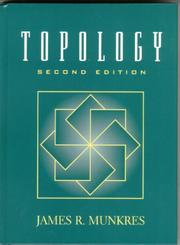
The standard point-set text, and the prerequisite half of it is Part I. Its second part is a first course in algebraic topology, so it also serves as a gentle preview of the fundamental group. Work Part I properly; almost every self-study failure downstream traces back to skipping it.
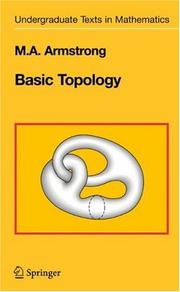
A short, geometric, deliberately intuitive alternative that gets to surfaces, the fundamental group and simplicial homology in under 250 pages. Read it alongside Munkres rather than instead: it supplies pictures where Munkres supplies rigour.
The Fundamental Group and Covering Spaces
IntermediateMaster the first real invariant — loops up to deformation — together with the covering space correspondence that makes it computable.
▸ Study plan for this stage
Pace: Six to eight months for three books that cover overlapping ground on purpose. Massey's Algebraic Topology: An Introduction spends its entire length on surfaces, the fundamental group, free products with amalgamation and covering spaces, and never reaches homology — that narrowness makes it the most
- The fundamental group as homotopy classes of loops, and the dependence on basepoint that vanishes for path-connected spaces
- Functoriality: a continuous map induces a group homomorphism, which is what converts topological questions into algebraic ones
- Van Kampen's theorem, and the free-product-with-amalgamation machinery needed to state and use it
- Covering spaces and the lifting criterion, and the correspondence between covers and subgroups of the fundamental group
- The universal cover, deck transformations, and the Galois-theoretic shape of the whole correspondence
- Computing π1 of surfaces from their polygon presentations, which ties directly back to the surface classification
- Winding number and degree in Fulton's route, which make the invariants feel like answers to concrete questions rather than definitions
- CW complexes as the class of spaces on which all of this is actually computable
- State van Kampen's theorem including its hypotheses, and use it to compute the fundamental group of a wedge of two circles and of the closed orientable surface of genus 2.
- State the lifting criterion, and use it to prove that a map from the sphere to the circle is null-homotopic.
- What is the correspondence between covering spaces of a space and subgroups of its fundamental group, and what hypothesis on the space does it need?
- Describe the universal cover of the figure eight, and explain why it is a tree.
- Prove the Brouwer fixed point theorem in dimension two using only the fundamental group of the circle.
- Compute π1 for at least eight spaces by van Kampen: wedges of circles, the torus, the Klein bottle, genus-2 and genus-3 surfaces, the complement of a point in each, and RP^2. Write each computation out fully rather than quoting the answer.
- Enumerate and draw all connected covering spaces of the figure eight with two and three sheets, and identify the subgroup of the free group on two generators corresponding to each.
- Construct the universal cover of the Klein bottle explicitly and identify the deck transformation group, checking that it matches the fundamental group you computed.
- Work Fulton's winding number proof of the Jordan curve theorem for a polygonal curve, following his argument step by step and supplying the details he compresses.
- Take each surface from the classification theorem, write down its polygon presentation, and derive its fundamental group presentation from the edge word. Do all of them; the pattern is the point.
Next up: The fundamental group runs out at dimension one — it cannot distinguish the 2-sphere from the 3-sphere — and homology is the machinery built to go higher, which is the next stage.
Massey's 1967 book spends its whole length on surfaces, the fundamental group, free products with amalgamation and covering spaces, and never reaches homology. That narrowness is the point: it is the most thorough treatment of the first chapter of the subject in print.

Lee builds the same material with manifolds as the running example and unusually careful proofs, including the CW and covering space theory in full. Read it after Massey if the algebra of group presentations is where you are struggling; Lee is the most patient writer in the field.
Fulton comes at the subject through winding numbers, the Jordan curve theorem and de Rham cohomology rather than through simplices — an idiosyncratic route that makes the invariants feel like answers to concrete questions. Catalogued as Algebraic topology, so check the author.
Homology
IntermediateBuild singular and simplicial homology from the ground up, prove the Eilenberg-Steenrod axioms, and learn to actually compute with exact sequences.
▸ Study plan for this stage
Pace: Eight months to a year for three books that deliberately overlap. Rotman's An introduction to algebraic topology is 433 pages and develops the homological algebra alongside the topology instead of assuming it, which makes it the right primary text if the algebra is the hard part for you; four to fiv
- Chain complexes and the definition of homology as cycles modulo boundaries, stated for an arbitrary complex before any topology is attached
- Simplicial homology, which is computable by hand, and singular homology, which is manifestly a topological invariant — plus the theorem that they agree
- The Eilenberg-Steenrod axioms, which say what homology is by what it does rather than by how it is constructed
- The long exact sequence of a pair, and excision, which together are the entire computational toolkit
- Mayer-Vietoris, which is how homology of a space is assembled from pieces, and the direct analogue of van Kampen
- Cellular homology on CW complexes — the practical method by which almost every actual computation gets done
- Cohomology, and why it carries a ring structure the homology does not: the cup product
- Poincaré duality for closed orientable manifolds, and the role of orientation in stating it
- Compute the simplicial homology of the torus and the Klein bottle from an explicit triangulation, and explain where the torsion in the Klein bottle's H_1 comes from.
- State the Eilenberg-Steenrod axioms and explain which one excision is and what it buys you computationally.
- Use Mayer-Vietoris to compute the homology of the n-sphere by induction, writing out the sequence at each stage.
- What does the cup product detect that homology alone cannot? Give two spaces with the same homology and different cohomology rings.
- State Poincaré duality precisely, and say what fails for a non-orientable manifold and what replaces it.
- Compute the simplicial homology of the torus, the Klein bottle and RP^2 by hand from explicit Δ-complex structures — write down the chain groups, the boundary maps as matrices, and reduce them. Do it fully at least once; every later computation is an abbreviation of this.
- Compute the cellular homology of RP^n for n up to 4 from the standard CW structure, tracking the degrees of the attaching maps.
- Run Mayer-Vietoris on at least four spaces of your own choosing beyond the sphere — a genus-2 surface, a wedge, a torus decomposed into two cylinders, and a space with a non-trivial connecting map.
- Prove that the boundary map squares to zero for the singular chain complex by direct computation on the face maps, rather than quoting it. It is a bookkeeping argument and doing it once fixes the sign conventions.
- Work the cup product structure on the cohomology of the torus explicitly, and use it to distinguish the torus from the wedge of two circles and a 2-sphere, which have identical homology.
Next up: With homology, cohomology and duality in hand you have exactly the background Hatcher assumes on page one, which is why the standard text comes next rather than first.

Rotman is an algebraist, and this is the book that develops the homological algebra alongside the topology instead of assuming it. The most structured course on this path and the best choice if the algebra is what you find hard.

Munkres's sequel to his point-set book, and the definitive slow treatment of simplicial and singular homology, cohomology and duality. It is long and it proves everything; use it as the reference you check when a later book waves at a step.

A compact graduate introduction covering singular homology, cohomology, products and duality in about 200 pages. Read it after Munkres as the condensed version that shows you what the essential skeleton was.
The Standard Modern Course
BeginnerWork through the text the field currently teaches from, and reach cohomology and homotopy theory as a coherent whole.
▸ Study plan for this stage
Pace: A year to eighteen months, and honest expectation-setting matters here. Hatcher's Algebraic Topology is 544 pages, is the text the field currently teaches from, and is freely available from the author's website — but it is the destination of this path, not its entry: it assumes the fundamental group
- Hatcher's geometric style: proofs are constructed from pictures and explicit homotopies rather than from diagram chases, which is a genuinely different way to hold the subject
- The universal coefficient theorems, relating homology and cohomology with arbitrary coefficients
- Künneth, and the homology of a product of spaces
- Higher homotopy groups, their abelianness above degree one, and why they are so much harder to compute than homology
- Fibrations, the homotopy lifting property, and the long exact sequence of a fibration
- The Hurewicz theorem connecting the first non-vanishing homotopy group to homology
- Poincaré duality proved properly, with orientations and cap products, in the form the rest of the subject uses
- Bredon's contribution: transversality, Morse theory, and the ways homology is actually deployed in differential geometry
- State the universal coefficient theorem for cohomology and use it to compute H^*(RP^2; Z/2) from its integral homology.
- Give the long exact sequence of a fibration and use it to compute π_n(S^1) for all n and π_2(S^2).
- State the Hurewicz theorem with its connectivity hypothesis, and explain what it does and does not tell you about π_3(S^2).
- Why are higher homotopy groups so much harder than homology, given that they look like a more natural definition?
- How does Bredon's transversality argument produce homological information, and what does that route give you that the CW-complex route does not?
- Work Hatcher's chapter 0 in full before anything else. It is the geometric vocabulary — CW pairs, homotopy extension, mapping cylinders — that the entire rest of the book takes for granted, and it is the chapter most often skipped.
- Do at least twenty exercises from Hatcher chapters 1 and 2, chosen across the sections rather than clustered. The exercises carry material the text does not, which is a deliberate feature of the book.
- Take a proof in Hatcher you find too compressed, find the same result in Massey's basic course, and write out the fuller argument. Do this at least three times; comparing two expositions of one theorem is the skill this stage should leave you with.
- Compute the homotopy groups of the circle and of S^3 through the Hopf fibration, writing out the long exact sequence explicitly and identifying every map in it.
- Following Bredon, use transversality to compute the intersection form of a closed orientable surface and confirm it agrees with the cup product structure you computed in the previous stage.
Next up: You have completed the standard first course; the last stage covers what that course leaves out and introduces the reference works the research literature actually cites.
The standard modern graduate text, geometric in style, generous with pictures and exercises, and freely available from the author. It is the destination of this path rather than the entry to it — start here without the fundamental group and homology already in hand and you will stall in chapter two.
Massey's later, comprehensive volume, covering singular homology through cohomology and duality with the same deliberate pace as his introduction. The best second opinion to read next to Hatcher when a proof there is too compressed.
The manifold-flavoured route: differential topology, transversality and Morse theory sit alongside the homology, which is how the subject is actually used in geometry. Read it after Hatcher if you are heading toward manifolds rather than toward homotopy theory.
Beyond the First Course
BeginnerReach the material a first course omits — de Rham theory, spectral sequences, surgery — and meet the older reference works the field still cites.
▸ Study plan for this stage
Pace: A year or more, and this material is genuinely second-year graduate work. Bott and Tu's Differential forms in algebraic topology is 331 pages, unusually pleasant for an advanced book, and assumes calculus on manifolds — differential forms and Stokes's theorem — rather than heavy algebra; three to fi
- De Rham cohomology, and the de Rham theorem identifying it with singular cohomology over the reals
- The Mayer-Vietoris argument reappearing in the smooth category, which is Bott and Tu's organising device
- Spectral sequences, introduced by Bott and Tu about as gently as the subject permits, and the Leray-Hirsch and Gysin sequences that follow
- Sard's theorem and regular values, which is the technical foundation of everything differential-topological
- Degree of a map defined by counting preimages of a regular value, and its agreement with the homological definition
- The Poincaré-Hopf theorem relating vector field indices to Euler characteristic — the hairy ball theorem as a special case
- Characteristic classes: Chern and Stiefel-Whitney classes as invariants of vector bundles rather than of spaces
- Obstruction theory and surgery as the tools of classification, and what the research frontier of the subject actually looks like
- State the de Rham theorem and explain what is lost by working over the reals rather than the integers.
- Compute the de Rham cohomology of the n-sphere by Bott and Tu's Mayer-Vietoris argument.
- State Sard's theorem and use it to prove that a smooth map from a lower-dimensional manifold cannot be surjective.
- Define the degree of a smooth map by regular values and prove that it is independent of the chosen regular value.
- What does a characteristic class do that a homology group cannot, and what is the Stiefel-Whitney class obstructing?
- Compute the de Rham cohomology of S^n, the torus and a genus-2 surface by the double complex and Mayer-Vietoris methods Bott and Tu set up, writing the covers and the forms explicitly.
- Work Bott and Tu's first spectral sequence example completely, drawing every page and every differential. A spectral sequence has to be drawn at least once before it becomes usable.
- Prove the hairy ball theorem from Milnor's degree argument, and then again from Poincaré-Hopf, and compare the two proofs. The whole book is 64 pages and both routes are inside it.
- Follow Milnor's proof of the fundamental theorem of algebra by degree. It is two pages, it uses nothing beyond regular values, and it is the clearest demonstration on this path that these invariants compute things.
- Use Davis and Kirk to write a one-page map of the field: name obstruction theory, characteristic classes, spectral sequences and surgery, and for each write one sentence on what problem it exists to solve. That map, not a complete read, is what the book is for at this stage.
Next up: This closes the path: you have the point-set foundations, both classical invariants, the standard modern course, and enough of the second-year material to choose between homotopy theory, differential topology and geometry as the direction you go next.
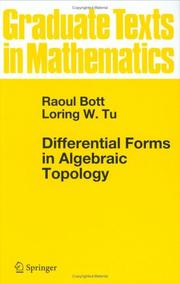
Bott and Tu develop the whole subject through de Rham cohomology, with the clearest introduction to spectral sequences anyone has written. It assumes calculus on manifolds rather than heavy algebra, so it is an unusually pleasant advanced book.
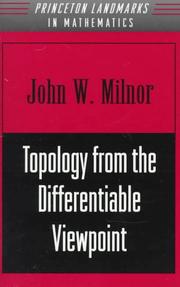
Sixty pages that prove Sard's theorem, the degree of a map and the Poincare-Hopf theorem using smooth manifolds instead of any algebra at all. Read it after Bott and Tu as the shortest demonstration that the same invariants have a completely different derivation — and as the standard entry to differential topology, which is where most people go next.
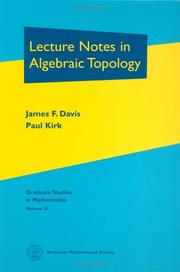
Davis and Kirk pick up exactly where a first course stops — fibrations, obstruction theory, characteristic classes, spectral sequences, surgery — and are explicit that this is second-year material. The right last book, because it tells you what the rest of the field looks like.
Discussion
Keep reading
Paths that share books, cover the same subject, or open a related topic.