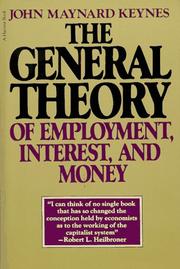
The general theory of employment, interest and money
John Maynard Keynes · 1935 · 403 pages
As an Amazon Associate we earn from qualifying purchases. Some book links are affiliate links; you pay the same price and we may earn a small commission.
About this book
"The General Theory of Employment, Interest, and Money by John Maynard Keynes. The book published in the thirty's, it sought to bring about a revolution, commonly referred to as the "Keynesian Revolution", in the way economists thought - especially in relation to the proposition that a market economy tends naturally to restore itself to full employment after temporary shocks. The book challenged the established classical economics and introduced important concepts such as the consumption function, the multiplier, the marginal efficiency of capital, the principle of effective demand and liquidity preference. The level of employment is determined by the spending of money . Keynes argues that it is wrong to assume that competitive markets will, in the long run, deliver full employment or that full employment is the natural, self-righting, equilibrium state of a monetary economy. On the contrary, under-employment and under-investment are likely to be the natural state unless active measures are taken."
Appears in these reading paths

Understanding John Maynard Keynes: Best Books to Read in Order
Related reading guides
Reader reviews
Ratings and notes from readers — tagged with how deep into the subject they were.
Loading reviews…