Yoruba religion is written about by three kinds of people who rarely agree, and the most useful thing a reading order can do here is keep them apart. There are academic ethnographers who observed the tradition from outside. There are Nigerian scholars and babalawo raised inside it. And there are diaspora practitioners in Cuba, Brazil and the United States for whom it is a living initiatory religion rather than a subject of study. Each book below is labelled with which it is.
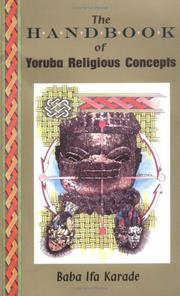
Start with The handbook of Yoruba religious concepts. Baba Ifa Karade's short book is a practitioner source, organised by concept and written by an initiate for readers approaching the religion as something to enter rather than to study. It gives you the vocabulary — ori, ashe, egun, the orisha by name — that everything later assumes. Read it knowing that it presents the tradition as a coherent system rather than as a historical object. The next two books complicate that straight away.
The orisha, and what the tradition claims
Yoruba beliefs and sacrificial rites is the scholarly counterpart. J. Omosade Awolalu was a Nigerian religious-studies scholar working from Yoruba-language sources and fieldwork, and this is still the standard academic account of ebo: what sacrifice is for, who receives it, how the rites are actually performed.
Olodumare is the most influential and the most argued-over book in the field. E. Bolaji Idowu, a Nigerian theologian, reads Yoruba belief as fundamentally monotheistic, with the orisha subordinate to Olodumare — a reading many later scholars regard as shaped by his own Christian training. Read it here for the theology and hold the objection until the third stage, where it is made properly and with archives behind it.
Ifa: divination, the babalawo, the odu
Ifa Divination is the classic ethnography, by the American anthropologist William Bascom, who worked in Nigeria from the 1930s. It explains the mechanics — the palm nuts, the divining chain, how a figure is cast and read — with a precision nothing since has matched. Read it first in this stage; everything else assumes you know what an odu is and how one is arrived at.
Ifa divination poetry (Traditional African literature) sits in a category of its own. Wande Abimbola is both a professor of Yoruba literature and an initiated awise, so this is a practitioner-scholar presenting the ese Ifa — the verses attached to each odu — in Yoruba with translation. The series name is part of the display title in our catalogue, which is worth knowing when you go looking for it. His fuller study, Ifa: An Exposition of Ifa Literary Corpus, is catalogued only under the bare title Ifa, which is why it is named here rather than listed separately. Bascom shows you the procedure from outside; Abimbola shows you the literature it retrieves.
Sixteen cowries is Bascom's companion volume on erindinlogun, the cowrie-shell divination practised largely by orisha priests and priestesses rather than by babalawo. It matters for the final stage, because the cowrie system rather than the sixteen-palm-nut Ifa is the form most visible in Cuban and Brazilian practice.
Art, altar, and the historical argument
Flash of the spirit is Robert Farris Thompson putting Yoruba aesthetics — the altar, the cool of iwa pele, the visual grammar of the orisha — into art history and tracing it across the Atlantic. It shows the tradition as something made and looked at, not only believed.
Religious Encounter and the Making of the Yoruba is the critical turn and the most important book on the list. J. D. Y. Peel uses the Church Missionary Society archive to argue that Yoruba ethnic and religious identity was substantially forged in the nineteenth-century encounter with Christianity and the slave wars. It is the direct challenge to Idowu, and it goes here rather than earlier so that you meet the tradition before you meet the argument about how it was assembled. The Yoruba diaspora in the Atlantic world is the historians' collection underneath the final stage: who was enslaved, from where, when, and what that meant for what survived.
Across the water: Santeria, Candomble, and Ifa in America
Working the Spirit is the best comparative entry point. Joseph Murphy reads Haitian Vodou, Cuban Santeria, Brazilian Candomble, Jamaican Revival Zion and Black American church practice together as related ceremonial traditions, which gives you the map before the case studies.
Then read a practitioner account and a scholarly one back to back. Santeria: The Religion is Migene Gonzalez-Wippler's insider presentation, popular rather than academic and correspondingly uneven on history; Santeria Enthroned is David Brown's archival and ethnographic history of how Cuban Lucumi religion was actually built — the cabildos, the throne, the objects, the named people who assembled it. The contrast is the clearest demonstration on the path of what a practitioner account can and cannot show you.
Sacred Leaves is Robert Voeks reading Candomble through its plants: which African species crossed, which Brazilian ones were substituted, and how the liturgical botany was rebuilt in a new ecology. Divining the self closes the path with Velma Love on African American practitioners reading the odu as scripture — the newest layer of the tradition, and the one least covered elsewhere.
The ordered path, with a goal for every stage, is at the Yoruba religion reading path.