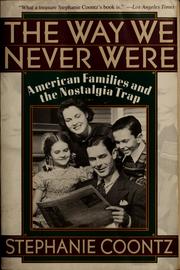
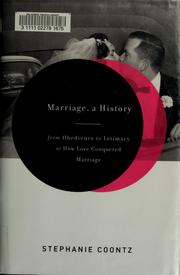
Almost every argument about the family assumes a baseline: the way families used to be, before whatever went wrong. The single most useful thing this literature has established is that the baseline is imaginary. The breadwinner-and-homemaker household with its own house and car, treated as timeless, describes a narrow slice of one country for roughly one generation, and it was underwritten by federal mortgage subsidies, the GI Bill and a wage structure that no longer exists.
So start with Stephanie Coontz and read all three of her books before anything else. The way we never were is the systematic demolition of the nostalgic account. The way we really are takes on what replaced it — divorce, working mothers, single parents — and is careful about separating correlation from cause, which is exactly the discipline this subject demands. Marriage, a history supplies the long view: marriage as a machine for transferring property and forging alliances for most of recorded history, and the recent, destabilising invention of marrying for love. That last claim is the one to carry forward, because a relationship justified by feeling can be ended when the feeling goes.
The older classics, and what survived them
Centuries of Childhood is where the historical study of the family begins: Philippe Ariès arguing from painting and household records that medieval Europe had no concept of childhood as a separate stage. The specific thesis is now widely disputed — critics point to evidence of parental grief and age-graded treatment he passed over — and it is still the necessary starting point. Read The making of the modern family alongside it, Edward Shorter's sentimental revolution turning the household from an economic unit into an emotional one, and with the same caution about how much weight the sources bear.
Family and kinship in East London is the one in this stage that has aged best. Young and Willmott studied Bethnal Green in the 1950s and then what happened when families were rehoused to a new estate: dense mother-daughter networks that made working-class life workable, dissolved by well-intentioned planning. The extended family here is infrastructure rather than sentiment.
Kinship, class and race in practice
Three books on families for whom the standard model was never available, and what they build instead. All our kin: strategies for survival in a Black community — catalogued with its full subtitle — is Carol Stack's ethnography of swapping networks, where kin are defined by exchange rather than blood, and obligations make poverty survivable and accumulation impossible. It remains the best corrective to reading a household roster as a family.
Promises I Can Keep is Edin and Kefalas interviewing poor single mothers and finding the reverse of the conventional story: these women hold marriage in unusually high regard, and put childbearing first precisely because children feel achievable and a good marriage does not. Labor's love lost is Andrew Cherlin on the American working-class family across two centuries, arguing that its mid-century stability rested on industrial wages and unravelled with them — the macroeconomic frame the two ethnographies operate inside, and the least moralised book here.
Work, time and the two-earner household
The second shift named the thing: dual-earner couples in which the woman works a further unpaid month a year, and the family myths both partners maintain to avoid saying so. It is still the model for how to observe a household. The Time Bind is the more unsettling sequel — at a company with generous family policies, employees did not use them, because work had become the sociable, competent, appreciated part of life and home the shift with no end. One catalogue note: our record credits a German edition's editor alongside Hochschild.
The two-income trap is Warren and Tyagi's argument that two incomes did not make families safer but bid up housing in good school districts and removed the reserve earner a one-income family held back. Read the mechanisms in this stage rather than the specific hours: the domestic-labour gap has narrowed since these studies and is measured differently by different methods.
The arrangements the model never covered
Families we choose put chosen family into the sociological vocabulary, from fieldwork with lesbian and gay people in San Francisco in the 1980s — an argument about what kinship is, made before same-sex marriage existed anywhere. Buy it by Kath Weston: our record lists a second name with no evident connection to the book.
Close on The Marriage-Go-Round. Cherlin's comparative finding is the strangest on the path: Americans marry more, divorce more and repartner faster than people in comparable countries, so their children experience more household transitions, and his conclusion is that the churn rather than any particular family form is what the research associates with worse outcomes. That claim is genuinely contested, because selection effects and causal effects are hard to separate here, and it is worth finishing on for that reason.
The ordered path, with each stage's goal and reading schedule, is at /paths/pt_ai_the-sociology-of-the-family.