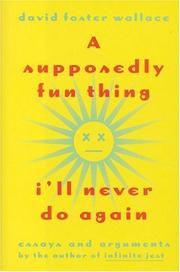
Start with A supposedly fun thing I'll never do again. The title essay is a cruise-ship report that is funny in the first paragraph and desolate by the last, and it carries the whole apparatus you will meet in the novel — the recursive footnotes, the manic specificity, the moral seriousness hiding under the comedy — at a fiftieth of the length. Read fifty pages of it and you will know whether you want the thousand-page version, which is Infinite Jest.
Here is the honest description of the destination. It is around a thousand pages, followed by close to four hundred endnotes, several of which run for pages and some of which have footnotes of their own; you will need two bookmarks. The chronology is deliberately scrambled and the years are named after corporate sponsors rather than numbered, so the first two hundred pages feel like arriving late to someone else's argument. And it does not resolve. If a novel that withholds its ending on purpose sounds like a waste of a season, this is not a book you should be talked into.
The rest of the fiction
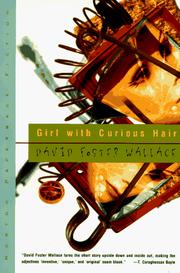
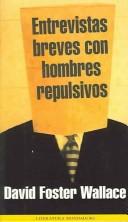
Girl With Curious Hair is the early story collection, uneven and worth reading for the last novella, where Wallace argues with the metafiction he came out of. Brief Interviews With Hideous Men was written after the novel and is the harder, colder book, but it sharpens what the novel is doing with sincerity and self-consciousness. Neither is required; both make the voice familiar, which is most of the battle.
Wittgenstein's mistress is the one outside book here, and it belongs. David Markson's novel is a woman alone in an empty world, told in flat declarative fragments; Wallace wrote a long admiring essay about it and lifted its concerns about language and isolation directly.
Alcoholic's Anonymous : The Big Book is in our catalogue under a mangled title — it is the foundational text of Alcoholics Anonymous, credited to Bill W. Half of the novel takes place in a halfway house whose residents speak in its cadences and argue with its slogans, and the sections land completely differently once you have read the source. It appears here as a literary source text. It is a document of a mutual-aid fellowship, not clinical guidance, and nothing in this path is a substitute for professional help with addiction.
The apparatus
The scholarly half of this path is tools, and tools get used differently from books.
Elegant Complexity is Greg Carlisle's section-by-section guide to the novel, keyed to page ranges, summarising who is where and when. It is not read through — you consult it after a chapter that lost you, or at the end of each of the novel's parts, and it repairs the chronology without editorialising much. David Foster Wallace's Infinite Jest, Stephen J. Burn's short reader's guide, is the compact companion that does the same job in a fraction of the space, plus a critical reading. One of the two is enough; take Carlisle if you want detail and Burn if you want brevity.
Understanding David Foster Wallace by Marshall Boswell is straight literary criticism covering the whole career, and it is the best single account of what Wallace thought irony had done to American fiction. Read it after a first pass, not before.
The biographies, and when to read them
Every love story is a ghost story is D. T. Max's biography, and Although of course you end up becoming yourself is David Lipsky's transcript of a five-day road trip with Wallace on a book tour. Both are absorbing, both are full of the novel's plot, and both will make you read the fiction as autobiography, which is a narrow way to read it. Leave them until afterwards.
Then take the novel a hundred pages at a sitting, keep a finger in the endnotes, and do not look anything up for the first fortnight. Readers who arrive at this page usually have Ulysses somewhere on the list too.
Follow the full ordered path here: What to Read Before Infinite Jest: How to Prepare for Wallace's Novel, in Order.