Venice is the hardest European city to read about seriously, because almost everyone arrives already holding an image of it — carnival, decay, Ruskin's stones, winter fog on the water. That image is a nineteenth-century construction, and if you read the aesthetic books first you will spend the rest of the subject fitting a thousand-year republic into a mood.
So this path inverts the usual order. It begins with Venice as a political and commercial machine, follows the maritime empire that paid for the city you have seen photographs of, looks at how the place actually governed itself, and only at the end lets in the beauty and the myth. By that stage Ruskin and Brodsky read as arguments about a place you know rather than as travel writing, which is much more interesting than reading them as scene-setting.
The republic in one volume
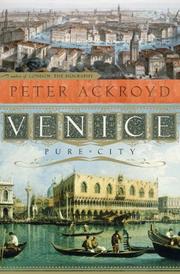
Thomas Madden's Venice, published as Venice: A New History, is the most current single-volume treatment and the least sentimental about the republic's own myth. It is the cleanest possible starting point. Peter Ackroyd's Venice, published as Venice: Pure City, comes second and never first: he works thematically rather than chronologically, through water, trade, secrecy and spectacle, which only sticks once Madden has given you the timeline to hang it on.
The maritime empire
John Julius Norwich's A History of Venice is still the great narrative history of the republic, doge by doge, and the fullest account of its political life. It is popular narrative history rather than academic scholarship and is best read as such — and our catalogue records it under the garbled title Venice a History of, which is a cataloguing artefact rather than a different edition.
City of fortune focuses tightly on the commercial empire — the galleys, the colonies, the sack of Constantinople in 1204 — which is the engine Norwich describes at greater leisure. Empires of the Sea covers the Ottoman and Christian struggle for the Mediterranean that culminated at Lepanto, where Venice was a principal, and explains the strategic squeeze behind the decline you will read about later.
How the city actually worked
Garry Wills's Venice, published as Venice: Lion City, reads the republic through its art and public ritual as deliberate political argument, which turns the paintings most readers skim past into evidence. The Venetian Empire treats the overseas possessions — Crete, Cyprus, the Dalmatian coast — as a coherent imperial system rather than a footnote to the lagoon. Venice incognito is the most surprising book here, a study of masking as a social institution and the best corrective to the assumption that carnival was mainly about licence; our catalogue lists its author in inverted form, as Johnson, James H.
Decline, ruin and the myth
The Stones of Venice is the Victorian book that taught Europe how to look at Venice, and the source of most of the aesthetic assumptions you started with. Read it knowing what it distorts: Ruskin's moral scheme, in which Gothic Venice is virtuous and Renaissance Venice corrupt, is a nineteenth-century argument about nineteenth-century England, not a historical finding. Most readers take it in an abridgement, which is a reasonable choice given the length.
Paradise of Cities is the direct companion, showing the nineteenth-century city as it was experienced by the foreigners who mythologised it, Ruskin included. Watermark is short, cold and the right place to stop, because after ten books it has finally earned the mood everyone else begins with.
Two gaps worth naming, and they are ours: this path is thin on Venetian art history as a subject in its own right, and it has nothing on the Ghetto and the city's Jewish community, which deserves better than a paragraph inside a general history.
Eleven books, machine first and mood last. Follow the full path below.
Follow the full ordered path here: Venice and the Venetian Republic: The Best Books to Read First.