Gandhi is difficult to read honestly because two complete versions of him are available off the shelf. One is the saintly figure of the independence narrative and the international nonviolence tradition. The other is the reactionary of recent criticism: on caste, on race during his South African years, on his treatment of the women around him. Both versions can be assembled from real evidence, which is exactly why the order you read in determines which one you end up with.
This path is arranged to prevent that. His own words first, then the movement he built, then his reception abroad, then serious biography, then the critique that has held up best. Meeting the criticism after the primary sources rather than instead of them is the whole point.
In his own words
Start with the autobiography, An antobiography or the story of my experiments with truth, published in the 1920s and covering his childhood, London studies, South Africa, and the early Indian years. It is candid to the point of discomfort about food, sexuality, and his own failures, and it is a religious document as much as a political one: the experiments are with truth, celibacy, diet, and self-rule in the personal sense.
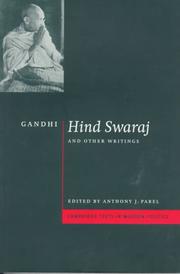
Then Hind swaraj and other writings, the 1909 pamphlet written on a ship and the clearest statement of his politics. It rejects not only British rule but industrial modernity itself, railways, lawyers, and machine civilisation included. Many readers who admire his methods find this text startling, and that reaction is useful information about the distance between Gandhi and his admirers.
Satyagraha in South Africa is his own account of the two decades in which the method was developed, among Indian communities facing discriminatory legislation. Read attentively, it is also where the record of his early attitudes toward Africans sits, which later scholarship has examined closely.
Reception and influence
Stride toward freedom by Martin Luther King Jr. is his account of the Montgomery bus boycott, and it belongs here because it shows the method being translated and adapted by someone who studied it carefully and applied it in a different context. Reading it after Gandhi's own writing shows what transferred and what was rebuilt.
The biographies
Gandhi by Yogesh Chadha is a full single-volume life, thorough and conventional in structure, useful for the chronology. Gandhi by Rajmohan Gandhi, his grandson, is the more searching biography, unusually good on family, politics, and the internal contradictions, and not defensive despite the relation.
Gandhi before India by Ramachandra Guha covers the formative South African decades in detail and is the strongest scholarly treatment of the period when the public figure was assembled. Guha is careful about the racial attitudes of the young Gandhi without either excusing or flattening them.
Great Soul Mahatma Gandhi And His Struggle With India by Joseph Lelyveld is the most contested. Its treatment of his personal relationships provoked a ban in Gujarat and a great deal of argument over whether reviewers had represented the book accurately. Read it late, when you can assess it against the other lives.
The critique
Read Annihilation of caste by B. R. Ambedkar. It is the undelivered 1936 speech arguing that caste cannot be reformed and must be abolished, along with the religious authority underwriting it, and later editions carry Gandhi's response and Ambedkar's reply. The two men disagreed fundamentally, particularly over separate electorates for Dalits and the 1932 Poona Pact. This path does not settle that argument; it insists you encounter both sides of it, in their own words. Follow the full sequence and you get a person with a record, which is more interesting than either statue.
Follow the full ordered path here: Understanding Gandhi: The Books to Read, and in What Order.