Deleuze punishes bad reading order more than almost any philosopher of the last century. Most people begin with the Guattari collaborations because those are the famous ones, hit the opening pages about desiring-machines or rhizomes, and conclude that the difficulty is deliberate obscurity. It usually is not. The vocabulary is built on earlier arguments in the history of philosophy, and without those the terms genuinely are arbitrary.
He also wrote in two modes that need different approaches. There are the monographs on other philosophers, in which he works out his own position through Hume, Bergson, Nietzsche, and Spinoza, and there are the systematic and collaborative works. The monographs are the scaffolding. Skipping them is why so many readers stall.
Start with a guide
Begin with Deleuze by Michael Hardt, which reads the early monographs as a coherent apprenticeship and shows how Bergson, Nietzsche, and Spinoza supply the machinery for everything later. It is short, clear, and it does the single most useful thing a secondary text can do here: it makes the vocabulary earned rather than declared.
The systematic work
Then Difference and Repetition, his major independent book and the one where the philosophical position is stated in full. The target is the primacy of identity in Western metaphysics, and the alternative is a philosophy in which difference is prior and repetition is productive rather than merely echoing. It is dense and it is the necessary text. Expect to reread chapters; the discussions of the three syntheses of time and of the virtual are the load-bearing ones.
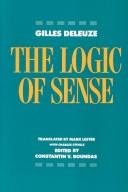
Logic of Sense follows, working through paradox, language, and events by way of the Stoics and Lewis Carroll. It is stranger in form, organised as a series of numbered series rather than chapters, and it sits between the systematic work and the collaborations to come.
The Guattari years
Before the collaborations themselves, read Deleuze and Guattari's Anti Oedipus by Eugene Holland, a chapter-by-chapter guide to a famously hard book. Using it as a companion is not cheating; the primary text assumes fluency in Freud, Lacan, and Marx that most readers do not have.
Then Thousand Plateaus, a, the sprawling second volume, which the authors invited you to read out of order like a record. Its plateaus on the rhizome, the refrain, faciality, nomadology, and smooth and striated space have been taken up across geography, architecture, music, and political theory. Take one plateau at a time and do not attempt linear completion on a first pass.
What is philosophy?, the last collaboration, is the most approachable of the three and a good place to consolidate. It distinguishes philosophy as the creation of concepts from science as the making of functions and art as the composition of percepts and affects, and it retroactively clarifies what the earlier books were doing.
The late specialist works
Cinema 1 The Movement Image and Cinema 2 The Time Image apply a Bergsonian framework to film, dividing the history of cinema around a shift from images organised by action to images in which time appears directly. They are best read after What is philosophy? and are genuinely useful even if your interest is film rather than metaphysics.
Finally, return to the foundations with Expressionism in philosophy : Spinoza, his doctoral work and the deepest of the monographs. Read last, it shows how much of the whole system was already present in his reading of Spinoza on immanence, expression, and affect.
That is the sequence: guide, system, collaborations, applications, origin. Follow the full path and the difficulty stops being noise and starts being argument.
Follow the full ordered path here: How to Read Gilles Deleuze, in Order.