Almost everyone learns ultralight backwards. They read a gear-heavy book first, buy a one-pound shelter and a quilt rated optimistically, and then spend a miserable night discovering that the weight came out of their margin for error rather than out of their pack. The lightest kit in the world only works if the skills, the food planning and the route judgment arrive with it.
The other reason order matters here is that this literature contains a real, unresolved argument. One camp says cut everything, sew your own gear and let higher mileage solve the comfort problem. The other says a pack is a life-support system and that the traditional kit exists for reasons. Reading the short, practical books before the two big philosophical ones means you meet that argument with enough experience to have an opinion about it.
Start with the two short books that reframe packing
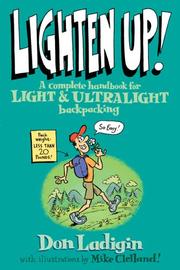
Begin with Lighten Up!, Don Ladigin's roughly hundred-page primer illustrated by Mike Clelland. It is deliberately thin, and that is the point: it teaches the handful of principles — weigh everything, question every item, count the big three first — that make every later book readable. You can finish it in an evening and repack your bag the same weekend.
Follow it with Ultralight backpackin' tips, Clelland's own collection of short, cartooned techniques. It is not a linear read; it is a browsable set of specific moves, from stove choices to the psychology of leaving things at home. Read these two together and you already have the working method. Everything after this is refinement.
Then get systematic about gear and skills
The Ultimate Hiker's Gear Guide, Second Edition by Andrew Skurka is the reference to graduate to. Skurka's contribution is a framework rather than a product list: choose for the conditions and the objective, then let the weight follow. It ages better than gear reviews do because the reasoning is transferable.
Trail Tested by Justin Lichter comes at the same problem from a long-distance practitioner's angle, with more attention to what actually survives thousands of miles. Then sit The Backpacker's Field Manual by Rick Curtis alongside it as the skills backbone — navigation, camp craft, group travel, first aid basics. Curtis is not an ultralight book, and it is the useful counterweight: the things you are cutting weight against still have to be done. If you read Skurka closely, you can skim the gear chapters in Curtis and go straight to the skills sections.
Food is where the weight quietly hides
Two books cover the part most beginners get wrong. Lipsmackin' Backpackin' by Christine and Tim Conners is a recipe collection organised around packability and calorie density, and Trail food by Alan Kesselheim is the shorter, more technical treatment of drying, ration planning and calories per ounce. Read at least one before a trip longer than three days. Food is often the heaviest variable item in the pack and the easiest to plan badly.
The argument, read from both sides
Beyond Backpacking by Ray Jardine is the origin text of the modern movement, and it is unapologetically absolutist: make your own gear, cut what convention says you need, walk further each day so you carry less. The complete walker IV by Colin Fletcher, completed with Chip Rawlins, is the traditional canon — discursive, comprehensive, affectionate about equipment that Jardine would leave at home.
They genuinely disagree, and this path does not pretend otherwise. Jardine's system is proven over enormous mileage but assumes a fit hiker moving fast in reasonably forgiving conditions. Fletcher's is proven over a different kind of trip entirely. Most experienced hikers end up somewhere between them, and where you land depends on your terrain, your season and your tolerance for discomfort. Read both and decide for yourself rather than adopting a camp.
Close with Appalachian Trials by Zach Davis, which is about the head rather than the pack — why long hikes end early, and what to settle before you start. It is the right last book because motivation, not base weight, is what usually ends a thru-hike.
One honest caveat: ultralight logic thins out fast in cold conditions, where the consequences of a marginal kit are much higher — see winter camping before applying any of this in snow. Otherwise, work the full path in order and the weight comes off on its own.
Follow the full reading path →