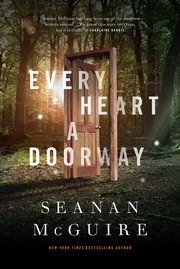
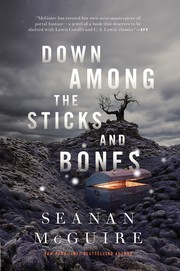
Start with Every Heart a Doorway, and read the nine novellas in publication order. That is not a default recommendation, it is a structural one: the first book is a murder mystery as well as a portal fantasy, and the second book steps backwards to fill in two of its characters. Reading the prequel first tells you the answer before the question has been asked.
The premise is worth having straight before you begin. Children fall through doors into other worlds, live there, and are then sent back to a world that no longer fits them. Eleanor West's Home for Wayward Children is a school for the ones who came back and want to go again, and the adults around them think that wanting is a delusion to be cured. Each novella runs 160 to 200 pages — one long evening each.
The first three
Every Heart a Doorway establishes the school and its classification system: doors are plotted on axes of Nonsense against Logic and Wickedness against Virtue, with minor directions like Rhyme and Linearity. It is a working system rather than set dressing, and later books turn on which world a child belongs to. Nancy, the narrator, is asexual, and the book says so plainly; her world, the Halls of the Dead, is built around stillness. Kade, introduced here, is a trans boy expelled from his fairyland for being a boy when the fairies had taken him as a girl — the series' clearest statement of its recurring idea, that these worlds reject children for who they actually are.
Down among the sticks and bones steps back to the twins Jacqueline and Jillian and is about parents who assign their children fixed roles before they can speak. The neglect is the horror; the gothic world is the consequence. Beneath the Sugar Sky returns to forward motion and introduces Cora, a fat girl who was a mermaid, whose treatment by the world outside the door is handled directly.
One thing that catches readers out: every book centres a different protagonist. There is no series lead, and expecting one is the commonest reason people find the middle uneven — they are reading for Nancy in a book that is not about Nancy.
The middle, where the series finds its range
In an Absent Dream is Lundy's book and the one most readers rate highest. It concerns the Goblin Market, where every transaction must be settled at fair value and unpaid debts are collected from your body. Fair value is a moral system rather than a currency, and the book uses it to ask what a childhood is worth and what a child can legitimately trade away. The answer it reaches is bleak, and the ending is the most argued-over in the series. Give it two or three sittings.
Come Tumbling Down is the direct sequel to Down among the sticks and bones and returns to the Moors — lightning, mad science and a resident vampire, used to make the point that a world can fit a child without being safe. It is the one book that assumes a specific earlier volume rather than the series in general.
Across the Green Grass Fields is a clean standalone with a new protagonist, Regan, and the Hooflands. She is intersex, learns it as a child, and the betrayal that sends her through her door comes from a friend rather than a parent. By this stage the strict one-forward-one-back alternation has loosened, and the series reads better as linked novellas around a shared house than as a serial.
The later books
Where the Drowned Girls Go introduces the Whitethorn Institute, the anti-Eleanor: a school that agrees with the parents, treats the doors as pathology, and sets out to make the children forget. Cora carries it, and her decision to choose Whitethorn is only legible if you remember what happened to her in Beneath the Sugar Sky.
Lost in the Moment and Found opens with an author's note stating that the book contains a stepfather grooming a child and that no sexual abuse occurs on the page. The note is accurate and it is there because the opening chapters are the most distressing writing in the series. Antsy's door leads to a shop where everything lost eventually arrives, and its price is time, paid in years of her own life. Read it back to back with Mislaid in Parts Half-Known, which picks Antsy up at the school and becomes the closest thing to an ensemble adventure, gathering characters from across the run.
Where to stop
The series is ongoing, so the ninth book takes you to the end of the run as it stands rather than to a conclusion. If you want one book and no commitment, read Every Heart a Doorway alone, or read In an Absent Dream, which stands almost entirely by itself. More short-form fantasy is on Discover.
Follow the full ordered path here: The Wayward Children Series Reading Order: Where to Start.