Start with Donald Kagan's The Peloponnesian War. It is the one-volume version of a subject he spent four decades on, and it does the thing a first book has to do: it tells you what happened, in order, at a pace that lets twenty-seven years of war hold together in your head.
The obvious alternative is to begin with Thucydides himself, and it is the wrong move. Not because he is difficult sentence by sentence — he is, in places, but that is survivable — but because he assumes you already know the shape of the war he is narrating. He backtracks, he digresses into constitutional history, he gives you speeches that are arguments rather than reports, and he stops mid-sentence in 411 BC because he died. A reader without a framework experiences all of that as confusion. A reader who has Kagan's narrative in hand experiences it as the greatest work of history ever written.
Get the shape of the war first
Kagan first, then Victor Davis Hanson's A War Like No Other, which reorganises the same events by kind rather than by year — a chapter on the cavalry, a chapter on the sieges, a chapter on the ships. Read in that order the two books do different jobs, and Hanson's thematic cut is much more useful once you already know the chronology it is cutting across.
Then Thucydides, in an edition that helps you
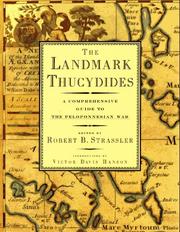
The landmark Thucydides is the one to buy. The text is Richard Crawley's translation, but what you are paying for is the apparatus: maps on nearly every spread, a running marginal chronology, and appendices on the things Thucydides assumes you know — how a trireme worked, what the Spartan constitution actually was, how the Athenian assembly voted. Reading him without that machinery is possible and much harder than it needs to be.
Kagan's Thucydides belongs immediately after, and it is a genuinely uncomfortable book to read straight from the source, because it is Kagan arguing that Thucydides is a partisan writer whose account is shaped to defend a particular reading of Pericles. That argument is not settled, and you should not treat it as settled. What it does is turn you from a reader of Thucydides into someone who can argue with him.
The other ancient voices
Thucydides stops in 411 BC, seven years short of the end. Xenophon's A History Of My Times picks the story up and carries it to the walls of Athens coming down, and the change of register is instructive — he is a lesser historian, and reading him teaches you what Thucydides was doing that ordinary competence does not. Plutarch's The rise and fall of Athens supplies the biographical texture that Thucydides deliberately keeps out: Alcibiades' dogs and his haircuts and his defections, Nicias' piety, the personalities as the ancient world gossiped about them.
Depth: the sea, the money, the four volumes
J. R. Hale's Lords of the sea makes the argument that Athenian democracy and the Athenian navy were the same institution — that a state which needed thousands of poor men to row its ships could not indefinitely refuse those men a vote. Josiah Ober's The rise and fall of classical Greece zooms out further and asks the economic question, using settlement and material evidence to argue that the Greek world was unusually rich and that its wealth came from its fragmentation.
Then, if the subject has taken hold, there is Kagan's original tetralogy: The outbreak of the Peloponnesian War, The Archidamian War, The Peace of Nicias and the Sicilian Expedition and The fall of the Athenian Empire. This is roughly two thousand pages and it is the fullest account in English. Be honest with yourself about whether you want it — the one-volume version exists precisely because most readers do not, and there is no shame in stopping after the Landmark.
Where to stop
Most readers should stop after Xenophon and Plutarch. That is a real command of the subject: the narrative, the primary source, the aftermath, and the gossip. Hale and Ober are for readers who found the questions more interesting than the battles. The tetralogy is for people who have decided this is their subject.
Follow the full ordered path here: The Peloponnesian War: Books to Read, in Order.