The Lebanese Civil War ran from 1975 to 1990 through at least four distinct phases, with alliances that reversed so often that a militia's 1976 enemy could be its 1985 patron. Readers give up on it for a predictable reason: they try to hold the factions in their heads before they understand the sectarian power-sharing system the fighting was about.
There is a second difficulty, and it is more important. There is no neutral history of this war. Every substantial account was written by someone with a position — a Lebanese sect, a political tradition, a national press corps, an army that invaded. That is not a defect to be filtered out; it is the condition of the subject. This path names each author's standpoint rather than pretending to a view from nowhere, and it deliberately does not adjudicate between them. Holding two irreconcilable accounts of the same massacre is closer to understanding Lebanon than picking one.
Get the structure before the fighting
Lebanon is William Harris's history of the country and the most efficient way to acquire the sectarian map: Maronite, Sunni, Shia, Druze, the National Pact of 1943, the confessional distribution of offices, and how a system built for one demographic balance survived into another.
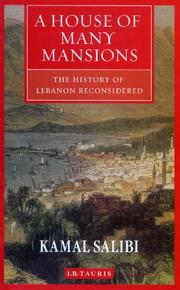
A house of many mansions is Kamal S. Salibi arguing that Lebanon's communities do not share a history — that each carries an incompatible account of the country's origins, and that this, not any single grievance, is the fracture. Salibi wrote as a Lebanese Protestant historian sceptical of all the national myths, including the Maronite one. It is the single most useful book here for understanding why the war was possible.
A History of Modern Lebanon is Fawwaz Traboulsi's account, written explicitly from the Lebanese left: the war read primarily through class, land and the political economy of the sectarian elites rather than through ancient hatreds. He is a participant in the history he narrates. Read him for the frame the Anglophone accounts mostly lack, and with his commitments in view.
The famous accounts, and their politics
Pity the Nation is Robert Fisk's enormous eyewitness history from a correspondent who lived in Beirut throughout. Fisk is openly partisan — sharply hostile to Israeli and American policy and to the Phalange, more sympathetic to Palestinian and Lebanese civilians — and he does not pretend otherwise. His reporting from Sabra and Shatila is a primary document. Read him as a committed witness, which is a real category and not a lesser one.
From Beirut to Jerusalem is Thomas L. Friedman covering the same years for an American newspaper, and it is the book many Americans learned Lebanon from. His frame is liberal-internationalist and centred on what the region means for the United States and Israel; his account of the same events differs from Fisk's in emphasis, sympathy and conclusion. The two together are the most instructive contrast on this path.
Beirut Fragments is Jean Said Makdisi's memoir of living through the war as a civilian, and it does something neither correspondent can: it records what fifteen years of it does to ordinary domestic life. De Niro's game is Rawi Hage's novel, following two young men in West Beirut, and it is the best account here of what the militias offered to teenagers with nothing.
The Israeli invasion
The war for Lebanon, 1970-1985 is Itamar Rabinovich's scholarly account, written by an Israeli historian and later ambassador — a careful book from a clearly Israeli vantage.
Israel's Lebanon War is Ze'ev Schiff and Ehud Ya'ari's investigation, and its significance is that it is a devastating Israeli critique of Israel's own 1982 war, published in Hebrew first. Waltz with Bashir is Ari Folman's graphic memoir of his own suppressed memory as a young Israeli soldier at Sabra and Shatila. All three are Israeli sources examining Israeli conduct, and they should be read alongside Fisk rather than instead of him.
Beware of Small States is David Hirst on Lebanon as the arena where other people's wars are fought — Palestinian, Syrian, Israeli, Iranian. Hirst is another long-serving British correspondent with sympathies close to Fisk's.
What came after
Hezbollah is Augustus Richard Norton's short scholarly history of the movement that emerged from the war and now dominates the state, written by an academic who served as a UN observer in south Lebanon. The Ghosts of Martyrs Square is Michael Young writing as a Lebanese liberal journalist about the 2005 Cedar Revolution and its disappointment. A privilege to die is Thanassis Cambanis reporting from inside Hezbollah's constituency, which is the necessary complement to Young's.
For adjacent civil wars, see The Spanish Civil War.
Follow the full ordered path here: The Lebanese Civil War: The Best Books to Read, in Order.