Reading order matters here for a specific reason: the two standard framings of this war are incompatible, and most books quietly assume one of them. Either the Communists won it or the Nationalists lost it. The military histories tend toward the first, the political and economic studies toward the second, and a reader who meets only one framing will think the question is closed.
There is also a boundary problem. The civil war did not start in 1945. It ran from the 1920s, was suspended and distorted by the Japanese invasion, and resumed with both sides transformed by it. Any account that begins after the Japanese surrender is starting halfway through.
The military and political narrative
Decisive Encounters by Odd Arne Westad is the best single account of the 1946 to 1950 conflict in English, and the place to start. It handles the campaigns, the diplomacy, the American and Soviet involvement, and the political collapse in step with each other rather than in separate chapters.
China's Civil War by Diana Lary is the social history alongside it — refugees, requisitioning, currency collapse, and what the war did to ordinary people in the areas that changed hands repeatedly. Together these two cover the ground most readers want.
Then the central question: why the Nationalists lost
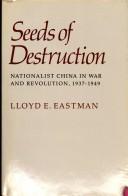
Seeds of destruction by Lloyd E. Eastman is the classic statement of the internal-collapse case: that the Nationalist regime was undone by inflation, corruption, factionalism and a broken relationship with the rural population well before it was defeated in the field. Civil War in China by Suzanne Pepper covers the same period from the political side, with particular attention to the urban middle class the Nationalists lost.
Chiang Kai-shek by Jonathan Fenby is the accessible biography of the man at the centre — sold under more than one title depending on the edition, so check before buying twice. Fenby is not sympathetic, and readers should know that Chiang's reputation has been substantially revised upward by more recent scholarship working from his diaries. That revision is contested in turn. This is one of the liveliest arguments in the field and it is not settled.
Origins of the Chinese revolution, 1915-1949 by Lucien Bianco is the long-view answer, tracing the whole revolutionary process from the end of the empire. It is short, analytical and still one of the best introductions to why the revolution happened at all.
The Communist side, from inside
Red Star Over China - The Rise Of The Red Army — our catalogue holds a bookseller-style listing title for what is simply Red Star Over China — is Edgar Snow's 1937 account of months spent with the Communists at Bao'an. It is a primary source of real importance and it is not a history. Snow was given extraordinary access on terms he partly accepted, the portrait he produced shaped how the outside world understood Mao for decades, and Snow himself revised the text later. Read it as evidence about the party's self-presentation and about Snow, not as a neutral report.
Fanshen by William Hinton is the same problem at village scale: a detailed, sympathetic, participant account of land reform in one Shanxi village. It is invaluable for the mechanics of how land reform actually worked and it is written from a committed position. Both books are worth reading precisely because they are partisan, provided you know it going in.
The campaign that decided it
Manchuria is where the war was won and lost, and two books cover it. The Battle for Manchuria and the Fate of China by Harold M. Tanner is the operational history; Anvil of victory by Steven I. Levine is the political and administrative study of how the Communists built a base there. Tanner if you want the campaign, Levine if you want to understand why it held.
Afterwards
The tragedy of liberation by Frank Dikötter covers the first years of the People's Republic rather than the war itself, and argues that the early 1950s were far more violent than the standard periodisation allows. Dikötter is a forceful and much-debated historian; specialists disagree about his use of archival material and about the framing. It belongs on this path as the aftermath, read with that debate in mind.
If the Japanese invasion that reshaped both armies is where you want to go next, the path on the Second Sino-Japanese War covers it directly.
The full ordered path is below.
Follow the full ordered path here: The Chinese Civil War: Books to Read, in Order.