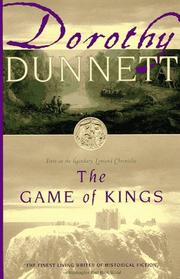
Start with The Game of Kings. It is the first of the six Lymond Chronicles and there is no other entry point, but the useful thing this guide can do is tell you what the first hundred pages are going to be like, because almost everyone who abandons Dunnett abandons her there.
Here is the warning. Dunnett withholds. Her protagonist, Francis Crawford of Lymond, is introduced as an outlaw and a traitor, and for a long stretch of book one you are given his actions without his reasons. He quotes in French, Latin, Spanish and Middle Scots, often without translation, often as a joke you are not in on. Characters arrive without introduction. Motives are revealed hundreds of pages after the acts they explain. This is not clumsiness; it is the entire architecture, and readers who accept it early have a wonderful time.
How to read the opening
Do not look everything up. Resist the annotated companion volumes on a first pass — they exist, they are excellent, and they will flatten the experience by explaining a puzzle Dunnett wants you to sit inside. Read for the shape rather than the detail, accept that you are missing things, and keep going. A large number of Dunnett readers restart The Game of Kings the moment they finish it and find it a completely different book. That is normal and it is arguably the intended reading.
The order
The six books are one continuous novel and must be read strictly in sequence:
- The Game of Kings — Scotland, 1547
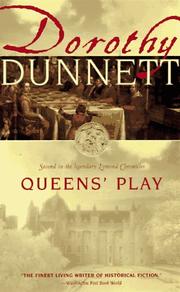
- Queens' Play — the French court
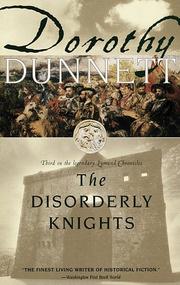
- The Disorderly Knights — Malta and the Knights Hospitaller, and the book where the series turns dark
- Pawn in frankincense — the Ottoman Mediterranean, and the emotional summit of the whole sequence
- The ringed castle — Muscovy under Ivan the Terrible
- Checkmate — France, and the resolution
Lymond or Niccolo first?
Dunnett wrote a second series, the House of Niccolo, set roughly a century earlier and published two decades later. Because it comes first chronologically, some readers propose beginning there.
Read Lymond first. The two series connect, but the connections are late, oblique and written for readers who already know Lymond; taking them in chronological order means encountering a set of revelations backwards. Niccolo is also the harder read of the two — slower to start, more diffuse, and more dependent on trade and finance for its plot. Lymond is the better introduction to Dunnett's method, and if you finish it and want more, Niccolo is waiting. Some devoted Dunnett readers argue for the reverse on the grounds that Lymond spoils Niccolo less than the other way around. It is a genuine minority position, but it is a minority.
The historical background worth having
None of this is required, but Dunnett assumes a reader who knows roughly what was happening in sixteenth-century Europe. Diarmaid MacCulloch's The Reformation is the single most useful companion — it covers the religious politics that drive the plots of books three, five and six. Henri Troyat's Ivan the Terrible covers the Muscovy of The ringed castle.
For the literary texture: Lymond quotes constantly, and The Collected Poems of Sir Thomas Wyatt is the closest single source to his register — Wyatt is the poet of the courtly, dangerous, double-meaning world Dunnett is writing about. Shakespeare comes later than Lymond's period, but our shelf includes an edition of the Merry Wives of Windsor for readers who want the comic-Elizabethan register the later books lean on.
If Dunnett makes you want to think about how the trick is done, John Gardner's The art of fiction and Wayne Booth's The rhetoric of fiction are the two standard treatments of point of view and authorial withholding, which is precisely the technique she is deploying.
Where to stop
There is no stopping point. This is one novel in six volumes, and Checkmate resolves everything the previous five set up. If you finish Pawn in frankincense you will not need persuading to continue.
Follow the full ordered path here: The Lymond Chronicles Reading Order and Guide.