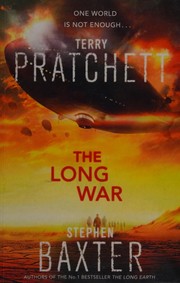
Start with The long earth. The five novels are one continuous story across decades of in-world time and publication order was never optional, so the sequence itself is not the interesting question. The useful thing to settle first is what kind of book you are about to read, because that is where most readers go wrong.
If you are arriving from Discworld expecting jokes, this is not that. The wry sentence-level voice is recognisably Pratchett, but the structure, the interest in deep time and the patient working-out of consequences are Baxter's, and Baxter is the dominant partner across the series overall. Think of it as the economics of a fantasy city rather than the comedy of one: the pleasure is in the working-out, not the punchlines. Readers who calibrate for that enjoy all five; readers who do not usually stop halfway through the first.
The long earth is around 340 pages and reads quickly, at 30 to 40 pages a day.
The premise, and the constraint that makes it work
The plans for a stepper box — a potato, some wire, a switch — are posted online, and anyone can walk sideways into an empty parallel Earth. The premise is deliberately anti-dramatic: land becomes infinite and free, and the real subject is what that does to property, cities, borders, taxation and money.
The one hard constraint is that iron does not step. No guns, no engines, no industry carried across without enormous effort, which is what keeps the frontier a frontier. Around that sit the phobics who cannot step at all, the natural steppers who never needed a box, and the Datum — the original Earth, immediately impoverished as its cities empty and its labour walks away.
The core
The Long War, then The Long Mars, read in order and reasonably close together, because the political situation established in the second book is assumed by everything after it.
Be warned about the title. The Long War is not a war novel and the reader who expects battles will be disappointed on purpose — the long war is a slow institutional argument, about a Datum government trying to tax and govern colonies it physically cannot police, and about the trolls, a non-human intelligence exploited across a thousand worlds with no legal standing anywhere. The joke in the title is the series being honest about its own interests.
The Long Mars opens a second chain of stepwise Marses and multiplies the scale by an order of magnitude. It also introduces the Next, a generation of humans who are genuinely more intelligent than ordinary people and do not pretend otherwise. This is where the Baxter side of the collaboration takes over almost entirely: deep time, vast scale, species-level questions.
The finish
The Long Utopia and The Long Cosmos, read together. The first is the most conventionally plotted of the five, with a concrete escalating problem and the series' only real origin explanation for stepping itself. The second opens on a message received from somewhere out along the chain, and closes on an invitation rather than an answer.
Context worth having: Terry Pratchett had been ill throughout the writing of this series and died in 2015, before The Long Cosmos was published. The final volume was clearly completed by Baxter and it reads that way — the balance, already tipped by book three, is effectively one-sided here. That is a fact to hold while reading rather than a criticism of the book.
The Baxter side, entirely optional
The Time Ships and Evolution are not sequels or prerequisites to anything in the Long Earth. They are context for the collaboration.
The Time Ships is an authorised sequel to Wells's The Time Machine that takes one premise and follows it to the literal end of the universe, and the Long Earth's structure — a single conceptual device pushed relentlessly outward — is visible there in embryo, written nearly twenty years earlier. Evolution tells six hundred million years of primate history in linked episodes with no continuing characters at all.
Both are harder and colder than the Long Earth novels. The tonal difference is the measure of what Pratchett was contributing: warmth, ordinary people, and jokes.
Where to stop
If you were there for Pratchett, stop after The Long Cosmos. If the geological patience appealed to you more than the characters did, the two solo novels are the pure form of it. Other series are laid out the same way here.
Follow the full ordered path here: The Long Earth Reading Order: Where to Start.