The single most important thing to understand about eugenics is that it was not fringe. It was taught at major universities, funded by the largest philanthropies, endorsed by progressive reformers as well as conservatives, written into immigration law, and upheld by the United States Supreme Court in 1927 by a majority of eight to one. Compulsory sterilisation continued in some American states into the 1970s. A reading order that starts with Nazi Germany gets the causation backwards, because a good deal of the influence ran the other way.
So the path below begins with the American legal and political story, moves to the scholarly histories that explain how the science was constructed, and only then reaches Germany. It ends with the argument about measurement, which is where the subject connects to live disputes rather than closed ones.
The case that legalised it
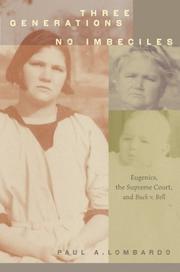
Imbeciles is the entry point, Adam Cohen's narrative of Buck v. Bell and of Carrie Buck, the young woman sterilised under a Virginia statute the Court upheld. Three generations, no imbeciles covers the same case with deeper archival work — Paul Lombardo established that Buck's lawyer had colluded with the other side and that the evidence of her supposed feeble-mindedness was worthless. The two books overlap heavily. Read Cohen for the story and Lombardo for the documentation, or read only Lombardo if you want one.
The Guarded Gate moves to immigration. Daniel Okrent traces how eugenic race science supplied the intellectual justification for the 1924 restriction act, and how that law shaped who could and could not enter the United States for four decades, including refugees from Europe in the 1930s.
The historical scholarship
War Against the Weak is the widely read journalistic account, and it is worth knowing that historians have criticised parts of it for overstating direct causal links and for its polemical framing; the underlying documentation of American eugenic institutions is nonetheless substantial. In the name of eugenics is the standard scholarly history — Daniel Kevles on the movement in Britain and America and on its entanglement with the emergence of human genetics, and it is the single best book on the path.
Controlling human heredity is Diane Paul's short survey and the most efficient overview if you want the argument without the length. Eugenic Nation focuses on California, which sterilised more people than any other state and served as a model elsewhere, and extends the story into the later twentieth century. Better for all the world is the more narrative treatment of the American sterilisation campaigns and the people who ran them.
The transatlantic connection
The Nazi Connection documents the traffic between American eugenicists and German race scientists — honorary degrees, cited statutes, mutual admiration — before and after 1933. Stefan Kuhl's book is short and specific, and it is the correct place for Germany to enter the path rather than the start.
The argument about measurement
The Mismeasure of Man closes the path with Stephen Jay Gould's attack on the history of intelligence measurement and craniometry. It is a famous and influential book, and one part of it is genuinely disputed: Gould argued that Samuel Morton had unconsciously fudged his skull measurements, and a 2011 remeasurement study concluded that Gould's own analysis was the mistaken one, while later work has partly defended him. That dispute is unresolved, and it is a useful demonstration of the book's own thesis about how expectation shapes measurement.
Two limits worth naming. This path is heavily American, and the eugenic movements in Britain, Scandinavia, Japan and Latin America are underrepresented here — that gap is ours. And these are histories, not a guide to current debates in genetics, which are a separate subject with separate literature. The history of economic thought hub covers an adjacent strand, since several prominent economists of the period were active eugenicists.
Read the path in order and the question shifts from how anyone believed this to how respectable it was to believe.
Follow the full ordered path here: The History of Eugenics: The Best Books to Read, in Order.