Go has the simplest rules of any great strategy game and by far the most depth. That gap is exactly why it is hard to learn from the wrong materials: read too much high theory too early and none of it sticks, because you lack the pattern recognition to use it. The path that actually makes players stronger is well known among Go students — learn the rules, then grind problems to build intuition, then layer on the fundamentals of good shape, opening, joseki and fighting. Improvement in Go is remarkably orderly if you follow it.
So read in that sequence. Each stage develops the reading and pattern sense that the next one assumes, and skipping problems for theory is the classic beginner mistake.
Learn the rules and take your first steps
Start with The Way to Go by Karl Baker, a gentle, free-spirited introduction to how the game is played. Then read Go: A Complete Introduction to the Game by Cho Chikun, a professional's clear beginner's guide that covers the essentials properly. Between them you will understand capturing, territory, life and death well enough to start playing and solving.
Build intuition through problems
Now the most important work: problems. Graded Go Problems for Beginners, Volume 1 by Kano Yoshinori drills the basic reading and capturing skills that make everything else possible, and Graded Go Problems for Beginners, Volume 2, also by Kano Yoshinori, continues the ladder. Grinding these is what actually raises your strength, because Go rewards trained pattern recognition over abstract knowledge. Do them repeatedly.
Learn shape and fundamentals
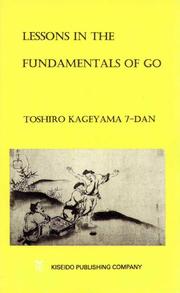
With reading improving, study good moves. The second book of go by Richard Bozulich bridges beginner and intermediate play with essential concepts. Then read the classic Lessons in the fundamentals of go by Toshiro Kageyama, beloved for teaching the disciplined thinking behind strong play. Add 38 Basic Joseki by Kogo Michiko to learn the standard corner sequences that recur in nearly every game.
Master direction, technique and fighting
Finish by putting the pieces together. The direction of play by Takeo Kajiwara teaches whole-board thinking and where stones truly want to go. Tesuji by James Davies drills the clever tactical moves that win local fights. In the beginning by Ikuro Ishigure covers opening strategy, and Attack and Defense by Ishida Akira teaches the crucial middle-game balance of pressuring your opponent while keeping your own groups safe.
How to actually improve
Play often and review your games, especially your losses, ideally with a stronger player or a review tool. Keep solving problems daily, even easy ones, because speed and accuracy in reading is the engine of improvement. Do not memorize joseki mechanically; understand why each move is played. And be patient with your rating, since Go rewards accumulated pattern sense that only comes from steady, deliberate practice.
Ready to learn the ancient game and improve fast, in order? Follow the full reading path, explore the subject hub, or browse related paths.
Ready to learn something deeply?
Build a reading path — free