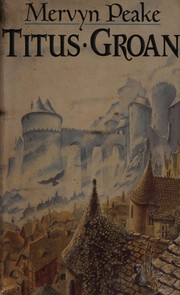
Start with Titus Groan. It is book one, it is the only entry point, and the more useful advice is about how to read it rather than whether to. Peake was a painter and an illustrator before he was a novelist, and Titus Groan is constructed the way a painter constructs: a vast crumbling castle, a ritual-bound family, a kitchen boy with ambitions, all rendered in prose that lingers on rooms and faces for pages at a time. The plot is real but it moves at the speed of a glacier for the first hundred pages.
If you go in expecting a fantasy novel, you will bounce. If you go in expecting something closer to Dickens rewritten by a gothic painter — grotesque comedy, enormous sentences, characters named Swelter and Flay and Prunesquallor — you will have a much better time. There is no magic in Gormenghast, no invented cosmology and no quest. That surprises people who arrive expecting one.
The order
- Titus Groan (1946)
- Gormenghast (1950)
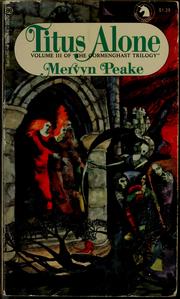
- Titus alone (1959)
Publication order is the only order, and books one and two are effectively a single long novel split in half. Gormenghast is the faster and more conventionally satisfying of the two: the child born at the start of book one is now a boy, the antagonist established in book one is in open motion, and the last third is genuinely gripping.
The real question: should you read Titus alone?
This is where the trilogy gets complicated, and it is worth understanding rather than guessing at.
Titus alone was written while Peake's health was collapsing — he was in the early stages of the illness that would end his life, and his handwriting and control deteriorated during composition. The first published text was heavily cut by an editor working from a difficult manuscript; a restored edition appeared later, and the two read noticeably differently. The book also abandons the castle entirely, sending Titus into a semi-industrial modern world of cars, scientists and surveillance that has almost nothing in common with the first two volumes.
Readers split. Some find it a broken fragment that should be read only for completeness. Others find it a genuinely strange late work whose disorientation is part of its power, and argue that the shift out of the castle is the point of the whole trilogy — that Gormenghast only means something once Titus leaves it. Both readings have serious defenders.
The practical recommendation: read the first two, take a break, and go into Titus alone knowing what it is. If you read it as a third act you will be disappointed. If you read it as an unfinished late work by a failing artist, it is remarkable.
Where to stop
After Gormenghast is a perfectly good place to stop. The book has a climax, a resolution and a genuine ending for its central conflict, and enormous numbers of readers have stopped there for seventy years.
Reading around Peake
The Castle of Otranto by Horace Walpole is the founding gothic novel, and reading it makes clear how much of the machinery Peake inherited and how thoroughly he transformed it. Wolfgang Kayser's The Grotesque in Art and Literature is the standard critical treatment of the aesthetic Peake works in, and is unusually readable for a theory book.
For Peake himself, Malcolm Yorke's Mervyn Peake is the biography, A world away is the memoir by his wife Maeve Gilmore, Peake's progress collects his drawings, verse and shorter prose, and Mervyn Peake : the man and his art by his son Sebastian is the illustrated overview. Start with the drawings — they explain the novels faster than any criticism does.
Follow the full ordered path here: Gormenghast Reading Order and Reading Guide.