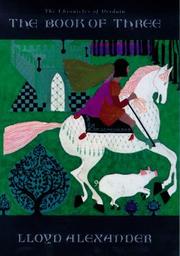
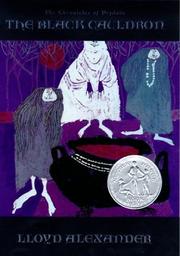
Start with The Book Of Three and read the five books in publication order. Publication order and internal chronology are identical, there is no debate, and the short stories and source material both belong afterwards rather than before.
Be clear on what this is, because the enthusiasm of adult fans can mislead. These are children's books published between 1964 and 1968 for readers of roughly eight to twelve, and they do not pretend otherwise. The prose is plain and quick, there is no worldbuilding apparatus and almost no exposition, and the map at the front is all the geography you get. An adult will finish The Book Of Three in two evenings. Adults love the series because the last two books earn something, not because it is secretly complicated.
One thing to discard first: Disney's 1985 animated film mashes the first two books together and is bad. If it is your only reference point, set it aside before starting.
The first two, read inside a week
The Book Of Three introduces Taran, an Assistant Pig-Keeper who wants to be a hero, and the whole five-book arc is about dismantling that ambition and replacing it with something better. Eilonwy, Gurgi, Fflewddur Fflam and Doli arrive fast, each with one running comic device. Fflewddur's harp string, which snaps whenever he exaggerates, is the best joke in children's fantasy and it pays off properly in book five.
The Black Cauldron is a Newbery Honor book and is where the series first shows its hand: a genuine sacrifice, made by a character you did not expect to care about, with no undoing. Read the two back to back — momentum matters and spacing them out flattens the arc.
Alexander drew names and figures from the Welsh Mabinogion, but the plots are his own invention. This is not a retelling and reading it as one will mislead you.
The turn, which is the whole point
The Castle of Llyr is the lightest of the five and functions as a breather, moving the focus to Eilonwy and to what Taran cannot control.
Then Taran Wanderer, the book adults rate highest and children often find slowest, because it has no villain, no quest object and no battle. Taran walks around Prydain trying to find out who his parents were. The sequence of craftsmen at its heart — the smith, the weaver, the potter — is where the series argues its actual thesis: worth is made by work rather than conferred by birth. The fantasy convention of the secret royal heir is explicitly set up in order to be refused, and the answer Taran finds is delivered quietly rather than as a twist.
Do not skip this one because the description sounds uneventful. It is the volume that changes what the series is, and The High King means nothing without it.
The ending
The High King won the Newbery Medal in 1969 and pays off all four preceding books. Every companion, every running joke and every apparently minor kindness returns with a job to do. It is a war book: Prydain gets a real winter campaign with real losses, and several beloved characters die in ways that are not softened for the age group.
Read it directly after Taran Wanderer — the two are effectively one movement — and read the last sixty pages in one sitting, somewhere you would not mind being visibly affected. The final choice is the reason people carry this series into adulthood, and Alexander does not flinch from its cost or let the reader off with an ambiguity.
Where to stop, and what comes after
The five-book arc is complete and self-contained. Everything after this is context rather than continuation.
The Foundling and Other Tales of Prydain collects eight short stories set before the novels, filling in the background of objects and figures the series treats as given. It is slight and charming and adds nothing you need.
The Mabinogion in Sioned Davies's translation is the actual source material: medieval Welsh prose, not a novel, and it should be read slowly with the introduction and notes. Read after the five books it shows you exactly how little Alexander borrowed and how much he built.
Westmark is Alexander's other major series and is a good demonstration that Prydain was not a one-off. It is set in an invented eighteenth-century European state rather than a mythic one, and it is harder and more political than Prydain.
Browse more fantasy reading paths on Discover.
Follow the full ordered path here: The Chronicles of Prydain Reading Order.