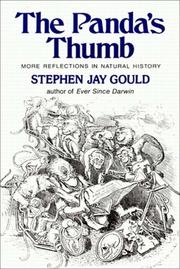
Start with The Panda's Thumb. It is the strongest of the essay collections, and the essays are where Gould's voice is best — digressive, allusive, fond of Gilbert and Sullivan and baseball, and completely unembarrassed about it.
The alternative would be to open with one of the big books, usually The Mismeasure of Man, because it is the most famous. That is a worse start: the sustained arguments assume a comfort with his vocabulary and his habits of mind that the essays build painlessly. Read two collections first and the big books arrive with illustrations you already recognise.
How to read the essays, which matters more than which one
These are collections of a monthly magazine column. Every essay was written to be read on its own with a month's gap after it, and reading them the way they were written is not a stylistic preference — it is the difference between enjoying the voice and finding it tiresome.
Read three or four a week. Work straight through a volume in a fortnight and the recurring moves start to feel like mannerisms, which is a fault of the reading rather than the writing.
Start with the essays
The Panda's Thumb, then Ever since Darwin. The Panda's Thumb is the usual first recommendation and the better book; Ever since Darwin is his first collection and reads second, when you already like the voice.
The Gould essay form is consistent: open on something small and concrete — a snail shell, a baseball statistic, a piece of Victorian nonsense — and open it onto a real argument in evolutionary theory. The title essay's argument is the clean example: imperfect design is the strongest evidence for evolution, because a designer would not have improvised a thumb out of a wrist bone. Adaptation is not optimisation, and the assumption that every trait is a perfect solution is the error he spends a career attacking.
Ten collections exist and they repeat themselves. This path picks the acknowledged strong ones rather than sending you through all of them.
The best of the later collections
Bully for Brontosaurus, then The flamingo's smile. Same discipline, three or four essays a week — the mid-career essays are noticeably longer and the historical scholarship is heavier, so one can take a full sitting rather than twenty minutes.
The history-of-science essays are at their sharpest here: misattributed discoveries, forgotten figures, and the social reasons ideas were accepted or ignored. The flamingo's smile is strong on extinction and sexual selection, and it begins the thinking the Burgess Shale book develops.
The big arguments
Wonderful Life, The Mismeasure of Man, Full House. These are sustained arguments rather than collections, so the essay-pace discipline no longer applies — read them as books, 25 to 30 pages a sitting.
Wonderful Life argues that the Cambrian fauna were far more anatomically various than anything since, and that replaying life's tape would produce something unrecognisable. Contingency is the central claim. Its long descriptive middle section on the fossils themselves is slow and does the evidentiary work the argument rests on, so do not skip it. Note that the reading is contested: other palaeontologists argue the disparity was overstated and that convergence makes outcomes more predictable than Gould allowed.
The Mismeasure of Man is a history of attempts to rank human worth by measurement, from skull-filling to the IQ tradition, built around two named errors — reification and ranking. It is his most cited and most attacked book: a later re-examination of one of his key historical case studies argued that Gould's own analysis was biased, and the dispute is worth chasing rather than ignoring.
Full House argues that evolutionary progress is a statistical illusion, an appearance of advance produced by a spreading distribution against a fixed wall. A buying note: it has been published under a different title in some markets, so check the description rather than the title if you cannot find it.
The historian of science
Time's arrow, time's cycle and Rocks of ages. The first is short, tightly argued and free of the digressive habit — probably his best scholarly book for a general reader, on three figures in the discovery of deep time and how metaphor determined what each could see. Rocks of ages is essentially an extended position paper proposing that science and religion address separate domains; it drew fire from religious critics who found it patronising and atheist critics who found it evasive, and both objections are worth taking seriously.
The completist tail
Ontogeny and phylogeny is 501 pages of academic prose on the long history of the idea that individual development recapitulates evolutionary history — a history of a productive error. The Structure of Evolutionary Theory is 1,464 pages and is a technical monument rather than a book to be read through; reading chapters selectively is more sensible than pretending to a straight read. Neither is required to have understood Gould.
Where to stop
After Full House. Two collections and the three big arguments give you the whole thinker. For science writing with a warmer bedside manner, Oliver Sacks is the adjacent shelf.
Follow the full ordered path here: Stephen Jay Gould Reading Order: Where to Start.