Sociology frustrates self-teachers because there is no obvious first fact to learn. It is a perspective before it is a body of knowledge — the habit of seeing personal experience as patterned by structures the individual did not choose. Start with a textbook survey and you get a catalogue of topics with no organising idea. Start with theory and you drown.
The order that works is: acquire the perspective, meet the three founding theorists who still structure the field's arguments, learn how sociological evidence is actually produced, then read modern studies that show the whole apparatus working on a real problem.
Acquire the perspective
Begin with The Sociological imagination by C. Wright Mills. Its central move — the distinction between personal troubles and public issues — is the discipline in one idea. One person unemployed is a trouble; fifteen per cent unemployment is an issue with structural causes, and no amount of individual explanation will account for it. Mills is also brutally funny about grand theory and abstracted empiricism, which is useful inoculation before you meet either.
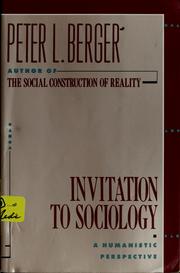
Then Invitation to sociology by Peter Berger is the short, elegant companion: sociology as a form of consciousness, and the unsettling experience of seeing the social scaffolding behind things you thought were natural. Between them, these two are around three hundred pages and will do more than any introductory textbook.
The founders
Capital, the Communist manifesto and other writings gives you Marx in a workable selection — class, the labour process, alienation, and ideology. Read the selection rather than attempting the full Capital first; the arguments you need are in the shorter texts and the excerpted chapters.
Le suicide by Émile Durkheim, published in English as Suicide, is the founding demonstration that a supremely individual act shows stable social patterning — rates varying systematically by religion, marital status, and integration. Its data and some of its inferences have been criticised extensively since, particularly around how suicides were recorded, but as a demonstration of the sociological method it remains unmatched.
The Protestant ethic and the associated writings give you Weber's counter-argument to a purely material account of history, along with his work on rationalisation and bureaucracy. Read Marx and Weber close together — the field has been arguing between them ever since, and each makes far more sense as a reply to the other.
Learn how the evidence is made
The Craft of Research by Booth, Colomb and Williams is a general research-writing book, and it belongs here because it teaches you to move from a topic to a question to a claim supported by evidence. Skipping this step is why a lot of amateur social analysis stays at the level of opinion.
Ethnography by Martyn Hammersley and Paul Atkinson is the methods text for the discipline's signature approach: fieldwork design, access, field notes, reflexivity, and the ethics of writing about people who trusted you. Read it before the field studies below and you will read them as constructed arguments rather than as reportage.
Theory and evidence, together
La distinction by Pierre Bourdieu, published in English as Distinction, is difficult and worth it: taste as a marker and mechanism of class, and the concepts of cultural capital and habitus that most contemporary sociology now assumes. Read the introduction and conclusion first, then work inward.
Then the modern studies. The New Jim Crow by Michelle Alexander argues that mass incarceration functions as a system of racial control — influential, widely taught, and seriously debated by scholars who dispute parts of its causal account. Nature of the second sex gives you Beauvoir's argument that gender is produced rather than given, which underwrites an entire field. Nickel and Dimed by Barbara Ehrenreich is immersive journalism on low-wage work, and Evicted by Matthew Desmond is the finest recent example of the whole method — years of ethnographic fieldwork plus original quantitative data, on housing and poverty in Milwaukee. Close with The truly disadvantaged by William Julius Wilson, whose structural account of concentrated urban poverty set the terms of an argument that is still running.
If crime and punishment is where this pulls you, the criminology path continues from there. Follow the full path to read these in order.
Follow the full ordered path here: How to Learn Sociology from Books, in Order.