Physical chemistry is the branch that explains why chemistry works, and it demands more physics and math than any other part of the subject. Its three pillars — thermodynamics, kinetics, and quantum mechanics — are usually taught in parallel, which can feel like drinking from three hoses at once. Read them in a considered order and each one prepares the ground for the next.
The path below starts with a comprehensive survey, deepens the statistical and thermodynamic foundations, then builds through reaction dynamics into quantum chemistry, the field's mathematical summit.
Survey the whole subject
Start with Atkins' physical chemistry, the standard comprehensive text that covers thermodynamics, kinetics, and quantum theory in one coherent voice and is the reference most chemists learn from. Pair it with Molecular driving forces by Dill and Bromberg, which rebuilds thermodynamics and statistical mechanics from simple, physical reasoning about entropy and probability — the book that makes the ideas finally click for many readers.
Thermodynamics and statistical mechanics
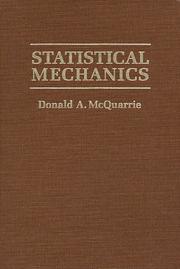
Now go deep on the statistical foundations. Statistical mechanics by McQuarrie is the clear, chemistry-focused introduction to connecting molecular behavior to bulk properties. Thermodynamics and an introduction to thermostatistics by Callen is the rigorous classic on the logical structure of thermodynamics itself. The principles of statistical mechanics by Tolman is the deeper historical treatment, and Statistical Mechanics of Nonequilibrium Processes extends the theory to systems that are not at equilibrium, which is where most real chemistry lives.
Kinetics and quantum chemistry
The last arc turns to change and structure. Chemical kinetics and dynamics by Steinfeld covers reaction rates and mechanisms, and Theories of molecular reaction dynamics by Henriksen goes deeper into the theory of how reactions actually proceed. Then comes the quantum core: Molecular quantum mechanics by Atkins and Friedman is the standard bridge into the subject, Modern quantum chemistry by Szabo and Ostlund is the beloved text on electronic structure methods, and Molecular electronic-structure theory by Helgaker is the exhaustive reference for serious computational work.
Read in this order and physical chemistry stops feeling like three unrelated courses and becomes one theory of matter. Follow the full path from Atkins to the frontiers of quantum chemistry.
Follow the full reading path →
Ready to learn something deeply?
Build a reading path — free