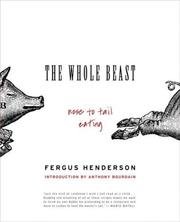
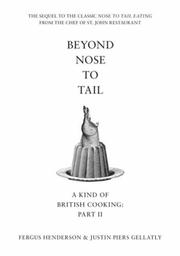
Start with The whole beast. Fergus Henderson published it in 2004 out of St. John in London, our catalogue record runs to about 200 pages, and it is the book that put the phrase into English kitchens. Then read Beyond Nose to Tail, the 2007 sequel written with Justin Piers Gellatly, which is the more useful of the two to actually cook from: longer method, more preserving and baking, and the puddings the first book left out.
Be honest about the first book before you buy it. Henderson's recipes are famously terse — often a single paragraph, with few quantities and fewer timings — because they assume you will taste and adjust rather than measure. That is a pleasure if you can already cook and a wall if you cannot. And a good half of the book depends on a butcher who will sell you a pig's head, a set of trotters, an ox heart or a marrow bone split lengthwise. If your only meat counter is a supermarket, much of it is unbuildable as written, and the ingredient books below will get you cooking faster. One buying note: the two Henderson volumes are also sold bound together as a single omnibus, and the first appeared in Britain under a different title, so it is easy to buy the same text twice.
The founding texts, and the reference they are not
Offal by Anissa Helou is the organ-by-organ reference Henderson never wrote, with technique and recipes from the Middle East, North Africa and the Mediterranean. It fills the real gap in the founding books, which is that Henderson cooks one cuisine, in one city, for one restaurant.
Then the three books that do the actual teaching. Odd Bits is the best single instructional volume on this list: Jennifer McLagan takes liver, heart, kidney, tongue, ear and tail one at a time and explains why each behaves the way it does before any recipe appears. Read it after Henderson and his brevity suddenly makes sense. Bones came earlier but reads better second — stock, marrow and everything built from a skeleton, which is mostly a matter of time and low heat. Fat completes the trilogy on rendering, confit, lard, suet and dripping, and it is the one that changes how you cook everything else.
Getting the animal
You cannot cook a trotter you cannot buy, which is why sourcing gets its own stage. The River Cottage Meat Book is the best general education in meat in English — how animals are raised, how a carcass is broken down, what each cut is for — and at over 500 pages it is a read rather than a manual. Take it before the technical books, because they assume the map it draws.
Whole beast butchery by Ryan Farr is step-by-step photographic butchery of pig, lamb and beef, meant to be propped open with a knife in your hand. Butchering beef by Adam Danforth goes further back — slaughter, chilling and ageing as well as breaking down — and is the more rigorous of the two on food safety; it is the right book only if you are working with whole or half animals. The butcher's guide to well-raised meat, from the Fleisher's shop, is the practical bridge: what to ask a farmer, what the labels mean, how to buy a share of an animal.
Preserving, and whether the argument holds
Whole-animal cooking leaves you with more meat than you can eat, so preservation is not optional. Charcuterie by Michael Ruhlman and Brian Polcyn is the standard English-language text on salting, curing, sausage and terrine. Cooking by Hand is harder and better on the same ground — Paul Bertolli's salumi chapters are the closest thing in English to a theory of curing — and assumes you have already made a sausage that failed.
The art of living according to Joe Beef is the outlier and the most enjoyable book here: the Montreal restaurant's anarchic, funny, genuinely serious take on marrow, smoked meat and the whole animal. Finish with The ethical carnivore, in which Louise Gray spends a year eating only animals she killed herself. It is neither a conversion narrative nor a defence, and it is the only book on the list that actually tests the claim everything else assumes. If the ingredient-led approach appeals more than the butchery, the Provençal and southwest French shelf covers much of the same offal tradition from a different direction.
Work through the full path in order and you will know which of these books belongs in the kitchen and which belongs on the shelf.
Follow the full ordered path here: The Best Books on Nose-to-Tail Cooking, in Reading Order.