Multivariable calculus is where calculus leaves the number line and gets genuinely geometric — partial derivatives, multiple integrals, and a bewildering family of theorems named after Green, Stokes, and Gauss. Students often survive the mechanics but never see the unity behind them, which is exactly what the right reading order can fix.
The path that works is to gain computational fluency first, then build geometric intuition for the vector operators and theorems, and finally reach the rigorous, unified treatment via differential forms and manifolds. Each book below is placed so understanding deepens rather than just accumulating techniques.
Learn the mechanics
Start with a standard course text. Multivariable Calculus, Hybrid by James Stewart is a clear, example-rich introduction that gets you computing gradients, multiple integrals, and line integrals with confidence, and Multivariable calculus, also by Stewart, covers the same ground in the classic full edition. These build the computational fluency everything else assumes.
Build geometric intuition
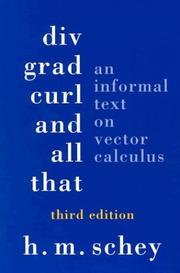
Formulas without intuition fade fast. Div, grad, curl, and all that by H. M. Schey is a beloved, informal book that gives you a physical, geometric feel for the vector operators and the big integral theorems — the "why" behind the symbols. Vector calculus by Jerrold Marsden then reinforces that intuition with a more thorough, structured treatment that bridges toward the rigorous material.
Reach the rigorous unification
The payoff is seeing all those theorems as one. Calculus on manifolds by Michael Spivak is the famous, slim, demanding book that unifies the integral theorems through differential forms — Stokes' theorem in its full generality. Analysis on Manifolds by James Munkres covers similar territory at a gentler pace, making the ideas more accessible. And Vector calculus, linear algebra, and differential forms by the Hubbards weaves linear algebra and calculus together into a unified, rigorous, and unusually readable whole.
Read in this order and multivariable calculus stops feeling like a pile of unrelated theorems. Follow the full path to go from computing your first partial derivative to seeing the deep unity of Stokes' theorem.
Follow the full reading path →
Ready to learn something deeply?
Build a reading path — free