Most people try to fix their phone problem with willpower: delete Instagram, feel virtuous for a week, reinstall it during a boring meeting. The failure isn't personal weakness. You're up against products engineered by thousands of professionals to capture exactly the attention you're trying to protect. Reading your way out works better than white-knuckling — but only if you read in the right order.
Digital Minimalism: Books to Reclaim Your Attention, in Order
July 11, 2026 · 2 min read
Why order matters here
If you start with a lifestyle book, you'll get rules without reasons, and rules without reasons collapse under pressure. The sequence that sticks runs: first understand the machinery of capture, then understand what it costs you, then rebuild deliberately. Each stage makes the next one land harder.
Stage 1: See the machinery
Start with Hooked by Nir Eyal. It was written as a manual for product designers, which is precisely why it's the right first book — you get the trigger-action-reward-investment loop straight from the source, and you'll never look at a notification the same way. Follow it with Irresistible by Adam Alter, which surveys the evidence on behavioral addiction and shows how deliberately these loops are tuned. Interestingly, Eyal later wrote Indistractable, a defense manual from the same author who wrote the playbook; read it here or save it for stage three, and notice how one writer sits on both sides of a live debate about who bears responsibility — the designer or the user.
Stage 2: Count the cost
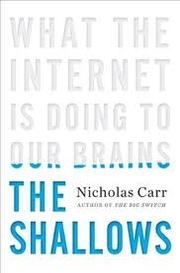
Now the damage report. The Shallows by Nicholas Carr is the classic argument that the internet doesn't just occupy time, it rewires how we think, trading deep reading for skimming. Stolen Focus by Johann Hari widens the lens: attention collapse as an environmental problem — sleep, food, work culture, surveillance — not merely an app problem. Hari's framing is contested in places; treat his broader claims as hypotheses worth weighing rather than settled fact. That skepticism is part of the training.
Stage 3: Rebuild on purpose
This is where the path pays off. Digital Minimalism by Cal Newport gives you the actual protocol — a 30-day declutter followed by intentional reintroduction, where every tool must justify its place. Then Deep Work, also by Newport, turns the reclaimed hours into a professional edge with concrete scheduling rituals. Finish with the philosophical anchors: Flow by Mihaly Csikszentmihalyi explains what attention is for — the absorbed state that makes life feel worth living — and Four Thousand Weeks by Oliver Burkeman reframes the whole project. You are not optimizing a to-do list; you are choosing what a finite life gets spent on.
How to actually study this
Don't just read — run the experiments. After stage one, audit your phone: which apps use which hooks on you? During stage three, actually do Newport's 30-day declutter while reading; the book is a protocol, not a think piece. Keep a one-line daily log of screen time and one deep-work block. Four weeks of data will teach you more than any single chapter.
The full sequence — nine books across three stages, each with a study plan — is the full reading path. For adjacent reading on focus and tech, browse the subject hub, or explore other paths.
FAQ
- What is the best book to start with on digital minimalism?
- Start with Hooked by Nir Eyal — understanding how apps are engineered to capture attention makes every later book, including Cal Newport's protocols, far more effective.
- Is digital minimalism the same as quitting social media?
- No. It's a philosophy of intentional use: every tool must earn its place by serving something you value. Some minimalists keep social media in a constrained role.
- How long does a digital declutter take?
- Cal Newport's protocol runs 30 days: remove optional technologies, rediscover offline activities, then reintroduce only what passes a strict value test.
Get the books
- 1HookedAmazon ↗Nir Eyal
- 2IrresistibleAmazon ↗Adam L. Alter
- 3The ShallowsAmazon ↗Nicholas G. Carr
- 4Stolen FocusAmazon ↗Johann Hari
- 5Digital MinimalismAmazon ↗Cal Newport
- 6Deep WorkAmazon ↗Cal Newport
As an Amazon Associate we earn from qualifying purchases. Some book links are affiliate links; you pay the same price and we may earn a small commission.
Follow the full reading path


Digital minimalism: reclaim your attention
Beginner9books69 hrs4 stages
@wellsherpa♥ 0
Ready to learn something deeply?
Build a reading path — free