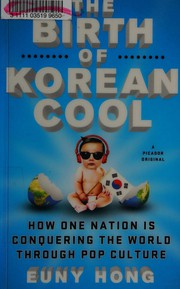
Start with The birth of Korean cool by Y. Euny Hong, a Korean-American journalist's account of the state-backed culture push from the 1997 financial crisis through Gangnam Style. Then read John Lie's K-Pop, the standard academic treatment, which argues the genre is a product of South Korean national identity and export strategy rather than an organically evolved pop tradition.
Order matters here for an unusual reason: K-pop was substantially engineered. A trainee system, a small number of vertically integrated agencies and a government that treated cultural export as industrial policy produced it, and the popular histories explain that machinery in plain language while the academic books assume you already know it. Read the histories first and the scholarship becomes straightforward. Read them the other way round and you will be looking up agency names mid-argument.
Be warned that the English-language literature here is thin and skews academic. There is no serious English-language history of a single group on this list, and the fan-facing books that do exist are mostly uncatalogued or out of print.
The popular histories
Pop goes Korea is Mark James Russell writing from inside the Seoul entertainment industry in the 2000s, covering film, television and music together. Read it second for the industrial detail Hong's narrative moves past. K-POP Now! is the same author in a shorter, more visual format, surveying groups and agencies; treat it as a reference for names and label affiliations rather than as an argument, and note that a 2014 survey of a fast-moving industry is now a period document.
The academic anchor
Lie's K-Pop carries the subtitle Popular Music, Cultural Amnesia, and Economic Innovation, which is a fair summary of its thesis. Follow it with Dal Yong Jin's New Korean wave, an account of the second Hallyu wave in which social media and digital platforms displaced television as the export channel. Jin reads directly as the update to Lie.
The music as a performance system
The industrial histories mostly leave out what the product actually is. Suk-Young Kim's K-pop Live is a performance-studies account of concerts, fan meetings and mediated liveness — the best book here on K-pop as something being consumed rather than manufactured. Chuyun Oh's K-Pop Dance (2022) treats choreography as the genre's core discipline, covering point choreography, cover-dance culture and the physical labour of the trainee body. It is the only sustained English-language treatment of the dance, and it is also the most current book on this path.
Fandom, export and the critical question
Soul in Seoul is Crystal S. Anderson on K-pop's debt to Black American popular music and on how that borrowing is received. It is the sharpest critical book on this list and the one most likely to change how you read everything before it. Anderson makes an argument rather than reporting a consensus, and it is worth reading her case directly rather than in summary.
The Korean Wave Korean Media Go Global is an edited collection, catalogued under its full subtitle, surveying where the wave landed and how differently it was received in Japan, China and the West. Hallyu 2.0, edited by Sangjoon Lee and Abé Markus Nornes, covers the digital-era Korean wave including its transmedia and platform dimensions; read it last, since it assumes the whole path behind it.
A gap worth naming: even the newest book here predates the current era of the industry, so nothing on this list covers the last several years of agency consolidation, contract disputes or the global chart records. Fill that with current journalism. If you want the comparison case of another nationally branded music export, see Afrobeat and African popular music.
Follow the full ordered path here: How to Learn About K-pop from Books, in Order.
Ready to learn something deeply?
Build a reading path — free