Start with Free Trade under Fire by Douglas A. Irwin — an economist writing for non-economists, and the clearest statement of the mainstream case, revised across several editions as the politics changed. Then read Kicking away the ladder by Ha-Joon Chang, which is the strongest historical case against it: that today's rich countries built their industries behind tariffs and subsidies, and now press others not to. Reading those two in that order is most of the value of this path.
Three things trip people up here. Tariff numbers date within months, and none of these books is a source for current rates — for that you need the official schedules, not a book. "Free trade versus protectionism" is not actually the live dispute among economists; near-universal agreement that trade raises aggregate income coexists with real disagreement about who bears the losses, how quickly displaced workers adjust, and whether industrial policy ever works. And this is economics and politics, not compliance guidance: classification, rules of origin and duty liability are legal questions for a specialist, and sit closer to international law than to anything on this list.
The case for, and where it comes from
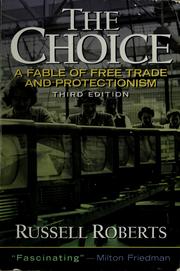
The choice by Russell D Roberts is a short novel in which Ricardo's ghost argues with an American television manufacturer. It is a teaching device and openly advocacy, but it puts comparative advantage into your head in an evening better than any textbook chapter. Free Trade under Fire is the substantive version of the same position. Then go to the source: On the Principles of Political Economy and Taxation by David Ricardo, published in 1817, where the comparative advantage argument is actually made. It is short, hard, and worth reading once in the original rather than in summary.
History
Against the tide is Irwin's intellectual history of the free-trade idea and of the objections raised to it over three centuries. It is notable for being the fairest account of the counterarguments written by someone who rejects them. Clashing over commerce is his other history — roughly eight hundred pages on United States trade policy from independence forward, and the reference that settles most arguments about Smoot-Hawley, the antebellum tariff and the postwar turn.
The critics
Kicking away the ladder is Chang's academic statement; Bad Samaritans is the same argument for a general readership, livelier and less careful with the qualifications. Read one, not both. Has globalization gone too far? by Dani Rodrik appeared in 1997 and anticipated much of the backlash that arrived twenty years later, which is why it is still cited; Straight talk on trade is Rodrik returning to the question after it did.
Trade Wars Are Class Wars by Matthew C. Klein and Michael Pettis is the most genuinely different frame on the list. Their argument is that persistent trade imbalances originate in domestic distributional choices — suppressed household consumption in surplus countries — rather than in trade policy at all, which makes a tariff fight a symptom rather than a cause.
Institutions, and where trade is going
The political economy of the world trading system by Bernard M. Hoekman and Michel Kostecki is the institutional textbook on GATT and the WTO: negotiating rounds, agreements, dispute settlement. It is dry and it is the necessary book if you want to understand what a trade dispute procedurally consists of rather than just who won it. The great convergence by Richard E. Baldwin explains why collapsing communication costs unbundled production into cross-border value chains, and why that changes what a tariff even does when a single product crosses borders repeatedly.
Trade Is Not a Four-Letter Word by Fred P. Hochberg explains trade through specific products — a taco salad, a mobile phone — and is a good popular read, though it is advocacy by someone who ran the United States Export-Import Bank and should be read as such. Six Faces of Globalization by Anthea Roberts and Nicolas Lamp is the best closing book: it maps the competing narratives about trade — establishment, left-populist, right-populist, corporate, geoeconomic, and global-threats — and deliberately declines to declare a winner, which after a dozen partisan books is exactly what you need.
Work the full path in order and read the two sides against each other rather than in sequence-and-forget.
Follow the full ordered path here: How to Read About International Trade and Tariffs, in Order.
Ready to learn something deeply?
Build a reading path — free