Read Elizabeth Fisher's Environmental law first. It is the Oxford Very Short Introduction, it is comparative rather than tied to one country, and it spends its opening chapters on the question the American textbooks skip: what kind of legal subject this is at all, given that it is stitched together from statutes, regulations, international agreements and common-law remnants. After that, go to a national primer.
One thing to state plainly. Almost every book below is about United States federal law, statutes change, agency rules change faster, and case law moves under all of it. Nothing here is legal advice, and no book substitutes for a lawyer admitted in the relevant jurisdiction. Editions matter more in this field than in most — check that the one you buy postdates the major rulings you care about.
The primers
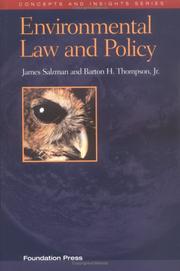
Environmental Law in a Nutshell by Daniel Farber and colleagues is the compact student outline: statute by statute, dense, unlovely, and genuinely efficient. Environmental law and policy by James Salzman and Barton Thompson does the same job at slightly more length and reads far better, with real attention to why each statute was designed the way it was. If you buy one, buy Salzman and Thompson.
Two heavier books come next and serve different readers. Environmental Regulation: Law, Science, and Policy by Robert Percival and co-authors is a law-school casebook — edited judicial opinions with notes and questions, close to a thousand pages, built for a semester and for classroom discussion rather than solo reading. Environmental Law, Policy, and Economics by Nicholas Ashford and Charles Caldart comes from MIT and is organised around technology-forcing regulation and the science underneath it, which makes it the better choice for engineers and scientists who need the law rather than lawyers who need the science.
The narratives
These are where the doctrine acquires stakes, and they are worth reading in parallel with the primers rather than before them. A civil action by Jonathan Harr follows the Woburn, Massachusetts trichloroethylene litigation and is, among other things, an unusually accurate account of how discovery, expert evidence and litigation finance actually decide toxic tort cases. Toms River by Dan Fagin does the same for a New Jersey childhood cancer cluster and is stronger on the epidemiology — how hard it is to prove causation from a cluster, and how often the honest answer is that you cannot.
Exposure is Robert Bilott's own account of the PFOA litigation against DuPont, written by the lawyer who brought it. It is a first-person advocate's narrative and reads as one; that does not make the documentary record it describes less real.
Doctrine at the edges
Should trees have standing? is Christopher Stone's 1972 essay proposing legal rights for natural objects. It was written for a live case, Justice Douglas cited its argument in dissent, and it is short. Defending the environment by Joseph Sax is the companion from the same era, making the case for citizen suits and public trust litigation before either was established practice.
Those two lead directly into the modern arguments. Nature's Trust by Mary Christina Wood is a sustained advocacy for atmospheric public trust doctrine, the theory behind the youth climate suits; it has not so far succeeded in United States federal courts, and the book is arguing for a position, not describing a settled one. Rights of Nature by David Boyd surveys where such rights have been enacted, including in Ecuador, Bolivia, New Zealand and India, and is genuinely comparative.
Breaking the Vicious Circle by Stephen Breyer is the sceptic in the room — a short set of lectures by a sitting federal judge, later a Supreme Court justice, arguing that risk regulation suffers from tunnel vision, a random agenda and inconsistent priorities, and proposing a specialist civil service to fix it. Critics answered that his critique undervalues the reasons the public weighs risks differently from experts. Read it for the argument, not as the last word.
Environmental Policy edited by Norman Vig and Michael Kraft closes the list: a political science volume, revised across many editions, on how these statutes fare in Congress, the agencies and the states.
For the international layer, the international law shelf picks up where this one stops.
Follow the full ordered path here: How to Learn Environmental Law from Books, in Order.