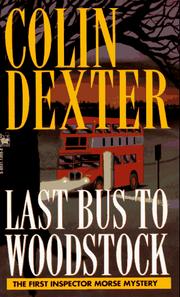
Start with Last bus to Woodstock, the first novel, and read in publication order — Morse ages, Lewis grows into the job, and the final book depends on everything before it. There is no ordering decision to make here.
The useful thing a Morse reading order can tell you is something else entirely: the first two novels are the weakest stretch of the series and the commonest reason readers give up. If you only have appetite for one book before deciding, make it the third, The Silent World of Nicholas Quinn, which is the first genuinely good one. The sequence works better whole, but that is the defensible skip.
Setting expectations
Dexter's Morse is much coarser than the television version. He drinks harder, he is markedly more lecherous, and the early novels carry a leering attitude toward women that has dated badly. It is period texture in some places and it intrudes on the plot in others. Better to know now than to be surprised in chapter four.
The structural signature is that Morse is wrong for most of each book. He constructs a theory, abandons it, constructs another. Lewis exists partly so that someone can be sceptical out loud. Once you see the pattern this becomes the main pleasure rather than a frustration.
The first three
Last bus to Woodstock is worth reading for the introduction rather than the plot. Last Seen Wearing is a cold case Morse inherits, and where Dexter's real trick first shows: the solution reverses several times before it settles. It is also where most readers stall — if you do, skip ahead and come back. The Silent World of Nicholas Quinn establishes the Oxford institutional setting, colleges and examination boards and committees, that the series lives in from then on. Everything before it is a competent 1970s crime novel; everything after is the series people admire.
The Oxford novels
Service of all the dead is a church murder with a famously convoluted solution and won Dexter his first Silver Dagger. The dead of Jericho opens with Morse having already met the victim, which makes a case personal in a way the earlier books never manage. The riddle of the third mile is the densest thing in the series and deserves an evening or two more than its length suggests. This is the series in settled form: crosswords, drink, an Oxford institution, and a plot built to be misread.
One gap to note: Dexter's seventh novel, The Secret of Annexe 3, is not currently in our catalogue. That is a gap on our side, not a break in the sequence.
The prize-winners
The Wench Is Dead has Morse solving a Victorian murder from a hospital bed — no crime scene, no forensics, almost no Lewis. It won the Gold Dagger and is the most formally unusual book in the run, which is exactly why it is not an entry point: it only reads as a break if you know the normal shape. The Jewel That Was Ours is the most conventionally entertaining of the late novels. The Way Through the Woods, built around a cryptic poem printed in a newspaper, won a second Gold Dagger and is probably the finest plot Dexter ever constructed. The poem is meant to be solved by the reader, and the book is much better if you attempt it.
The last cases
The series starts closing down in The daughters of cain, where Morse's failing health is not a subplot. Death Is Now My Neighbour finally reveals Morse's first name in its closing pages — a payoff worth nothing if you have not spent twelve books wondering, and a great deal if you have. Do not look it up. It is the one piece of Morse trivia everybody knows, and the books are engineered around it.
The Remorseful Day is a deliberate farewell written by an author who knew it was the last, and it should be read last and followed by nothing. There is no continuation worth the name, which in a long-running crime series is a rarity.
For a comparable series with a very different detective, see Inspector Rebus.
Follow the full ordered path here: Inspector Morse Reading Order and Guide.