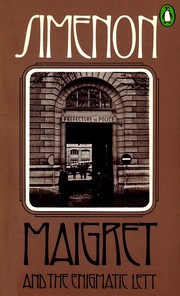
Start with The yellow dog. The obvious alternative is Pietr the Latvian, the first Maigret novel, published in 1930 — and it is worth reading, but not first. It is rougher than what follows, and it shows Simenon still assembling a character who arrives fully formed a few books later. The yellow dog is the cleanest demonstration of what the series actually does: a fog-bound Breton town, a handful of suspects, and a solution that turns on human weakness rather than on clues.
The more important thing to understand before you buy anything is that Simenon wrote seventy-five Maigret novels, and nobody sensible reads all seventy-five in order. This is a selection, not a series you complete. The books are almost entirely self-contained and Maigret barely ages across forty years, so order is a convenience rather than a requirement — which is liberating, and is the opposite of the situation with most long-running detective series.
The three to start with
The yellow dog, then Pietr the Latvian as an origin story, then Night at the Crossroads. Each runs 160 to 185 pages, Simenon wrote them in about ten days apiece, and they are meant to be read in one or two sittings. Night at the Crossroads shows how little he cares about fair-play plotting: atmosphere first, with the puzzle assembled loosely around it. If that bothers you, this is the right moment to find out.
The early classics
A Man's Head is the tightest of the early novels and inverts the whole detective form — Maigret deliberately arranges for a condemned man to escape and stakes his career on being right. The Late Monsieur Gallet is the book Simenon himself singled out, and it is the clearest early case of Maigret solving a life rather than a crime. Our catalogue stores that one with its article at the end, as Late Monsieur Gallet, The; it is the same novel.
The postwar peak
Most readers think Simenon peaked after the war: the same length, far more control, much less interest in crime as spectacle. My Friend Maigret puts a Scotland Yard observer at Maigret's shoulder, which forces Simenon to articulate a method he usually leaves implicit — it is the most explanatory book in the series. Maigret and the Old Lady is a seaside inheritance case and one of the warmest. Maigret Sets a Trap is a Montmartre manhunt and the most conventionally gripping of the later books.
A buying warning belongs here. One record in this path, Maigret's memoirs, is not a single novel but a ten-novel omnibus, collecting Maigret's Memoirs along with Maigret Takes a Room, The Brothers Rico, Maigret and the Burglar's Wife and six more. Check its contents against what you have already read. Maigret's Memoirs itself — in which Maigret writes back at the novelist who invented him — only works once you know a good number of the novels, which is exactly why it sits late.
The late, dark ones
Maigret and the headless corpse is a grim canal-side case that is really a portrait of a marriage; the mystery is close to incidental. This is late Simenon: less puzzle, more autopsy of a life, endings that offer understanding rather than justice. Our record for the last book on the path, La patience de Maigret, is the French-language edition; the English translation is published as Maigret's Patience. Reading Maigret in French is a genuine option, incidentally — the vocabulary is small by design, and these are standard texts for intermediate French readers.
Where to stop, and where to go next
There is no stopping point, which is the point. Once you have read eight or ten of these you can pick almost any of the remaining novels at random and it will work. The Penguin retranslation project has put nearly all seventy-five into consistent modern English, so continuing is a matter of choosing a title rather than hunting editions — though be aware that the modern translations are noticeably plainer and colder than the mid-century English versions, and the edition you pick changes the experience more than it does with most translated fiction.
If you like this register, Inspector Morse is the closest English equivalent.
Follow the full ordered path here: Maigret Reading Order: Where to Start.